


People of Note (XS) - Review
by Lee Mehr , posted on 21 May 2026 / 3,386 Views
Reviewer's Note: Though limited in detail, certain critiques & praises demand I mention SOME SPOILERS. Read on at your own risk.
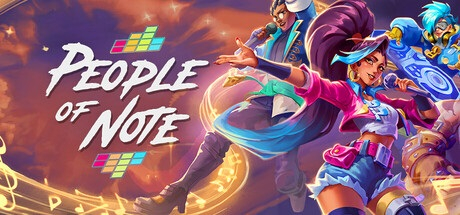
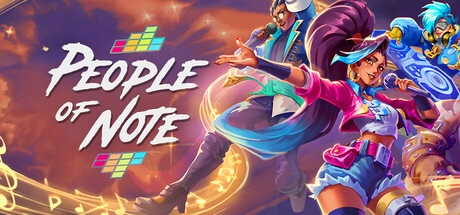
Iridium Studios shares a specific commonality with our protagonist Cadence: building and tweaking upon something – whether a track or gameplay template – with hopes of reaching the main stage. Iridium's Before the Echo (formerly known as Sequence) had a similar rhythm-based core that was limited by budget and scope; essentially a $5 EP. Fast-forward 15 years later to a new $25 double-sided album on that concept called People of Note. Is it more Thriller or filler?
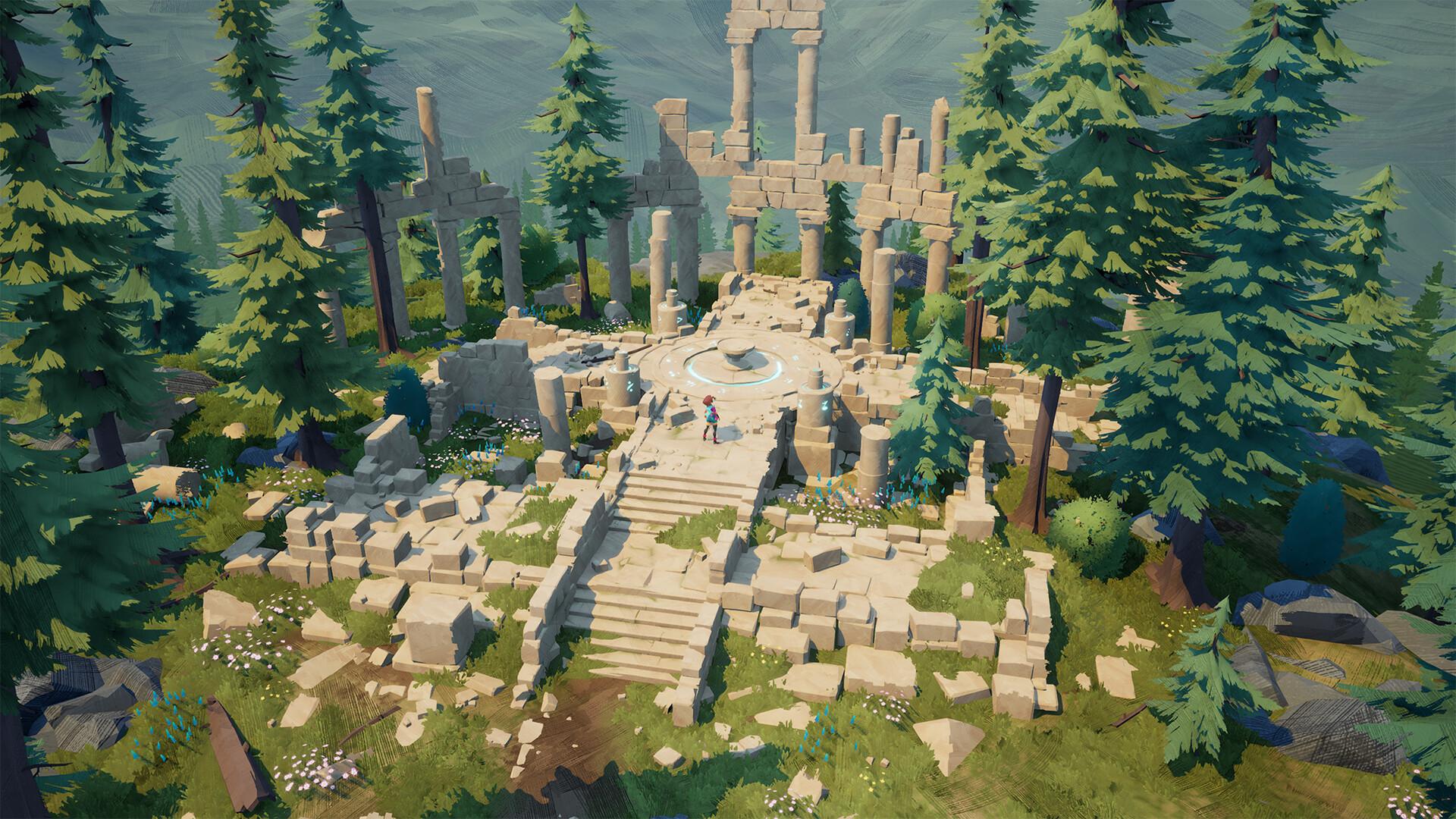
Comparisons between Iridium and Cadence – hopefully – stop there, at least when it comes to her initial attitude. She's not one to care for Chorida, nor fellow Choridans, outside of wanting to receive their adulation. The news report of a looming astronomical event called "Harmonic Convergence" may as well be White Noise in her solipsistic focus to become the next pop icon. It's not all that surprising given music's all-encompassing role across the continent of Note; vast spits of land are divided across genre lines: architecture, fashion, and even potential wildlife reflect an area's adherence to EDM, rock, and so on. Despite her ambition – plus singer Lexxe's impressive pipes – the journey to winning this year's Noteworthy singing contest is dashed by a premier judge's off-stage critiques. Inspired to incorporate fresher sounds into her routine, she ventures to lands unknown and form a new band.
Of course, gathering party members for a frivolous competition is merely a primer for the narrative's grander aims. Though its music-centric puns, references, and sight gags fill in air time, Note adheres to certain classical JRPG customs: a quest where the world's fate eventually falls on your shoulders, turn-based combat system emphasizing cooperation between members' disparate talents, and so on. Swap out those anime "…" grunt sounds for Cadence's wide-eyed shock during in-game dialogue moments and Bob's your uncle. Quest design is focused on ferrying you along the golden path with only a helping of side quests and activities drizzled around. The distractions can be mechanically rewarding (especially puzzles) but narratively slim to keep attention on the main goal.
Credit where it's due to Writer/Director Jason Wishnov: beginning with such a self-absorbed protagonist is a tough hurdle. The first of several fully-animated musical cinematics emphasizes her tunneled commitment to stardom. Of course, life-long personal dreams aren't immoral on their own, but the framing here is less aspirational than, say, The Little Mermaid's "Part of Your World". Cadence's best friend and music producer, Cerrin, is a tag-along obliged to be at her beck and call (practically a walking doormat). It plays the long game; as Cadence ventures across Note and assembles her Mötley Crüe, the cracks in her initial outlook start to open.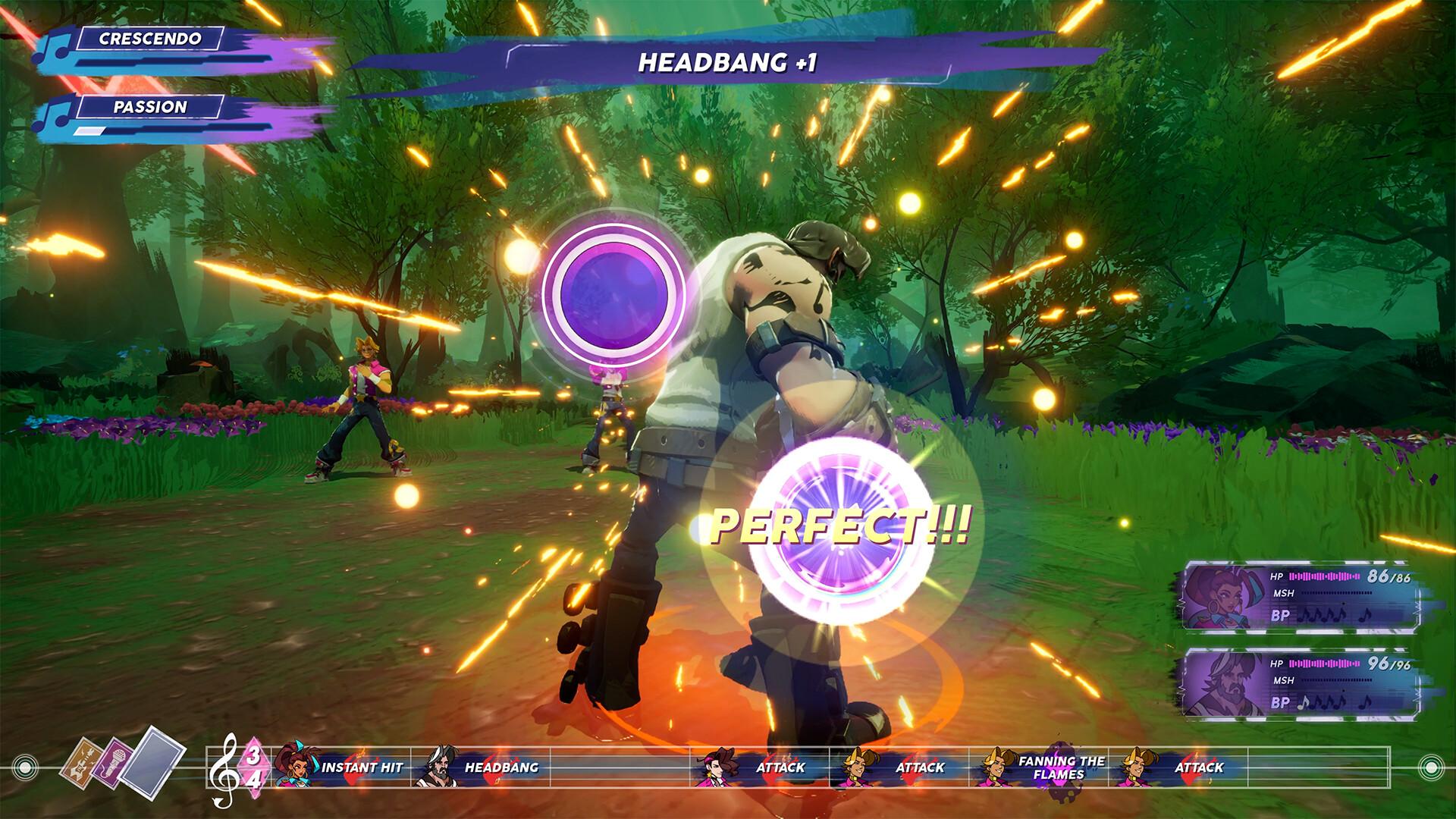
It's also not useful to dwell on her shortcomings when it can be balanced by suspicious antagonists and humorous world-building. The rock-centered Durandins of Durandis have recently been besieged by country music folks of Homestead under false allegations. This not only sets up grander factional fights but also begins Cadence's journey towards cooperating with strangers and disinterring the wider musical world outside of pop – a decent meta joke there. It's easier to enjoy the adventure when there's something fresh around each corner:
- Music-laden puns between locations, animals, and so on – though some are hit or miss.
- The contents of this varied bestiary you'll fight are musically-themed Pokémon if given input by Cronenberg.
- Despite whatever factional differences Durandins have over grunge, metal, or punk's superiority, they'll all reflexively say that pop is wretched dogshit.
- Some 4th-wall-breaking flavor text touching on game design or story structure.
The list could go on.
These measured praises all come with one crucial asterisk: everything's told with a modern, theater-kid affect. To its credit, most of the voice acting is suitable for it and the actors sincerely inhabiting that spirit leads to a few gems; though most musical numbers only reach Disney Animation's straight-to-video sequels, the rival boy band's track is perfect in concept and execution. The wider problem is similar to that of Dragon Age: The Veilguard: mawkish sentimentality where important tensions can be eased at will. A character's tragic pitfall is but a brisk conversation away from being papered over; similarly, certain antagonists' motivations lack connective tissue to make either their villainy or redemption feel earned.
Combat is more in-tune, even if most bars are familiar. Each round is modeled like a line on a music sheet: the UI aesthetic, section breaks between every decision, and the allotted moves between both sides are framed like a prescribed tempo (3/4, 4/4, & so on). The primary goal is efficiency. Which tactics finish enemies in the quickest way possible? A big part of that is its real-time rhythm-action when attacking or healing; whichever of those is selected transitions to a brief quick-time event (QTE) that results in the maximum value if perfectly executed. Said QTE complexity varies from one-touch to quick successive button presses. Fumbling completely isn't ruinous either, since there's a reasonable number ceiling and floor.
Strategic acumen trumps twitch reflexes though. Between Cadence's more offensively-inclined custom moveset, guitarist Fret's mix of damage and healing, DJ Synthia's focus on buffs/de-buffs, and rapper Vox's flexibility, there's a lot to consider regarding which power to use and in which order. The typical 4/4 bout (four moves for both sides) lets you 'cheat' by seeing your enemies' move order. And since most options beyond a standard attack cost Battle Points (BP), the answer isn't always simple. Perhaps hunkering down for a round by healing certain characters and enfeebling enemies can serve as a useful respite; even resting everyone to restore more BP may be the best option.
Alongside this are each bandmate's Mash-Up Meter and shifting passive multipliers per round. For the latter, it's a simple color-coded round signifying that their attacks or heals are stronger. The former is a combo between two or more members that varies between a powerful strike against one opponent, multiple opponents, a mass healing of allies, and so on and so forth. It's quite intricate, with interesting permutations locked away behind side quests. The major conflict, however, is how it's only filled by them taking damage. So, effectively, getting an important lifeline comes down to how well your team can drag out a fight versus a more nuanced value system. Beyond that, a specific Mash-Up that "severely" weakens an enemy's attack power feels like false advertising – especially with no listed percentages to judge its worth.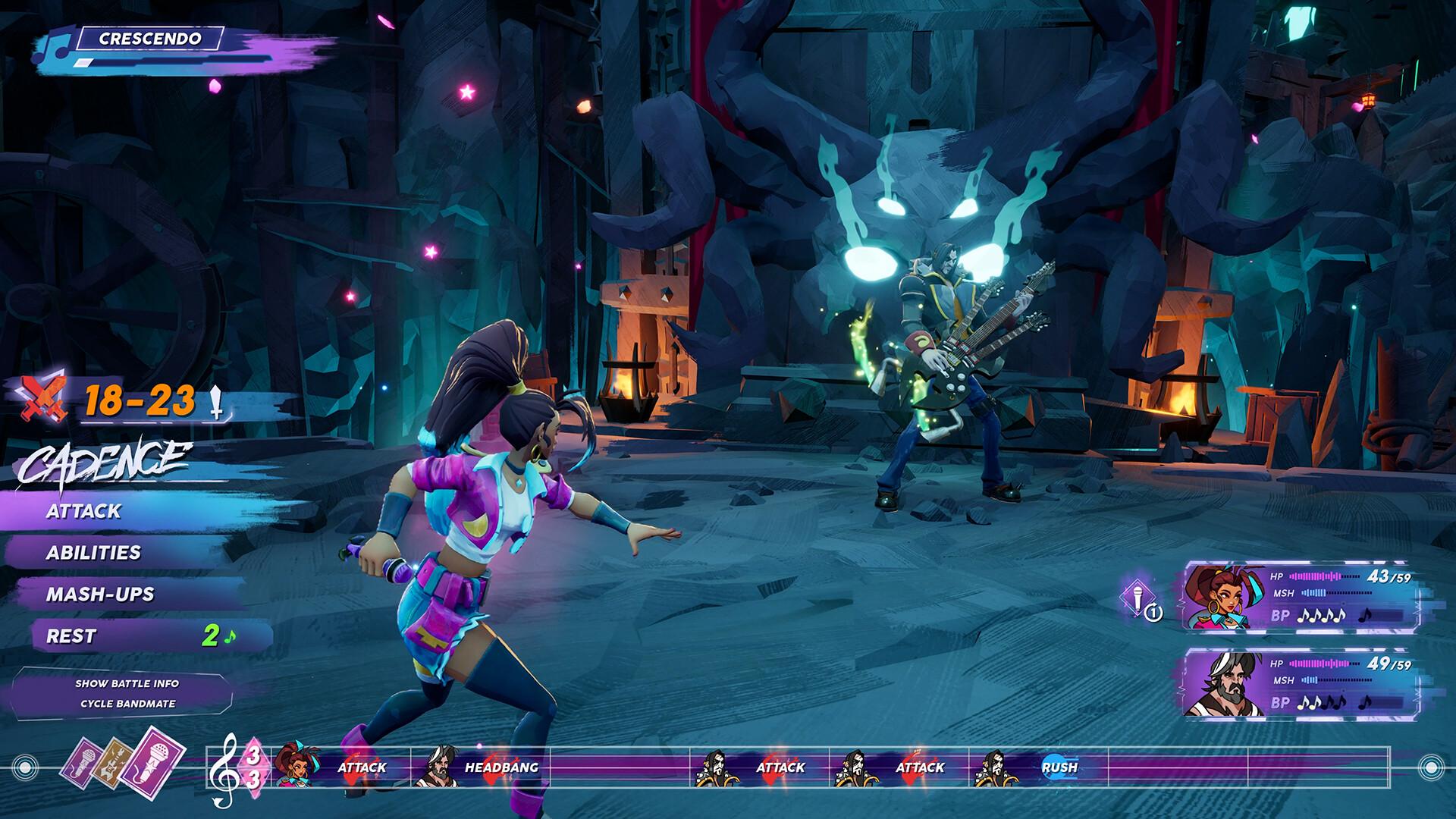
The nuts 'n bolts tend to read like baby's first JRPG, but its marriage with music succinctly highlights the importance of preparation within both domains. Discovering or buying better weapons for each bandmate doesn't merely up their attack damage but also potentially grants more slots to use their powers – or "Songstones," as they're called. Each member can select between generic and character-exclusive moves within their respective Songstone pool to tweak whenever outside of combat. Alongside this is a universal shared collection of "Remix Stones" that enable certain buffs, such as reducing BP cost or healing after each use. What starts as a rather simplistic means of selecting a couple of Songstones with a buff expands into this spider-web of potential options wherein several of them can share the same Remix or a favored one can have multiple Remixes. There's a nice layer of strategy in weighing how to share between both Stone types and how to exploit them.
Past all of the pre-planning and fighting, puzzle-solving plays critically alongside a few other ancillary mechanics. The breadth of its brainteasers is quite surprising, from small math games to intricate physics-based challenges. What begins as more familiar setups like redirecting lasers expands into Cadence acquiring a few powers to manipulate platform levels and more. Their depth is more debatable, but at least there's a consistency to them. The same can't be said of various one-off concepts like playing detective or quasi-treasure hunter. The latter involves repetitively pinging a special detector to see how close you are to an invisible item. A good rule of thumb for developers: if YOU comment on how arbitrary and time-wasting a mechanic is, perhaps the better idea is to scrap it altogether.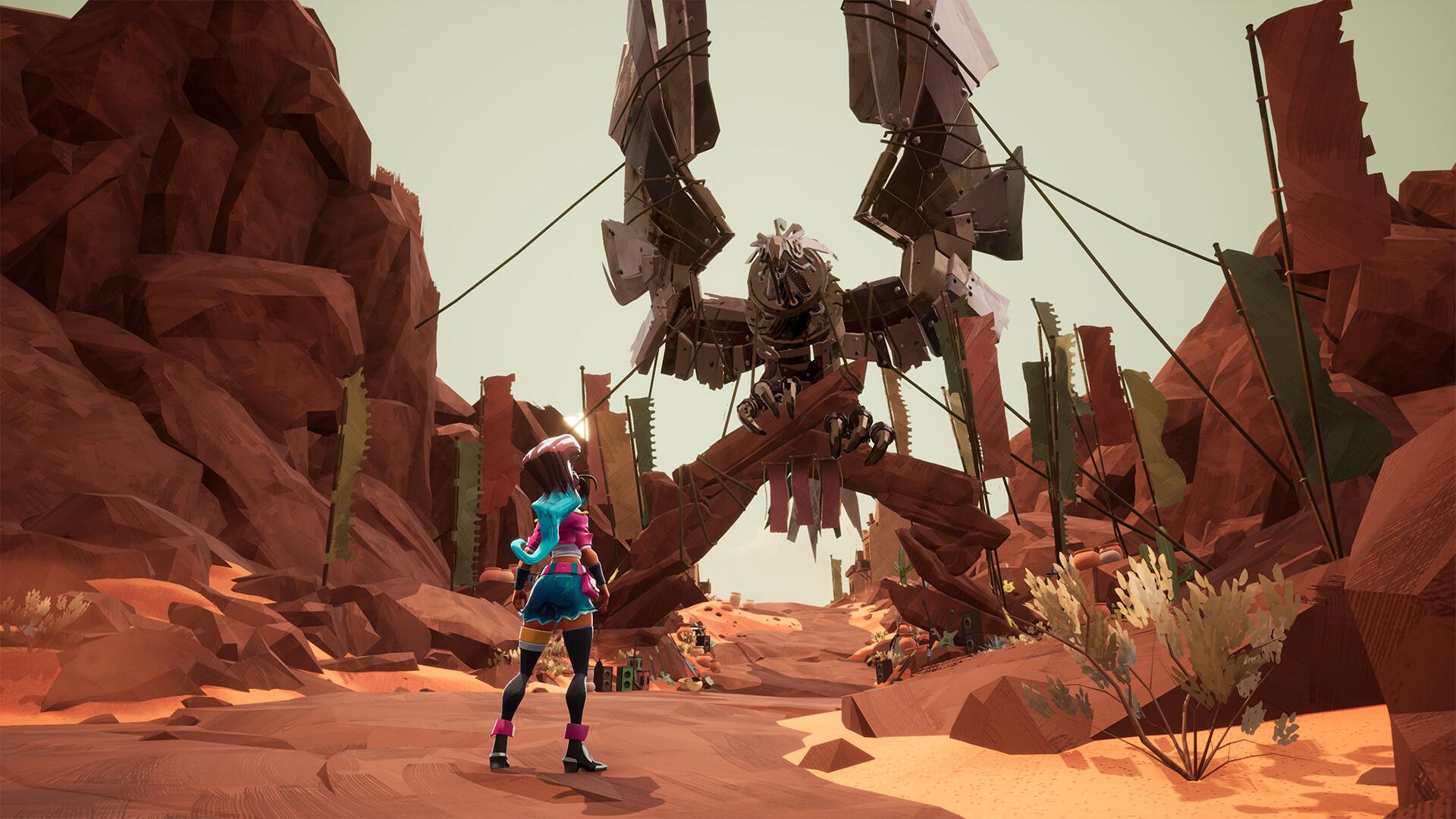
As with Iridium Studios, Cadence also shares an important commonality with the game proper. She doesn't accomplish her dream through continual iteration by herself but rather through a collective effort after absorbing several distinct personalities discovered along the way; likewise, People of Note is an ensemble of various storytelling and gameplay components fashioned into a nuanced whole. The danger is in how often this blend sounds off-key instead of like a harmonious symphony. Ambitious as the composition may be, sometimes the band is rushing and other times it's dragging.
Contractor by trade and writer by hobby, Lee's obnoxious criticisms have found a way to be featured across several gaming sites: N4G, VGChartz, Gaming Nexus, DarkStation, TechRaptor, and Cubed3! He started gaming in the mid-90s and has had the privilege in playing many games across a plethora of platforms. Reader warning: each click given to his articles only helps to inflate his Texas-sized ego. Proceed with caution.
VGChartz Verdict


6
Decent
This review is based on a digital copy of People of Note for the XS