




Full Metal Schoolgirl (PS5) - Review
by Evan Norris , posted on 22 November 2025 / 3,849 Views
Full Metal Schoolgirl wears its mechanical heart on its sleeve. It's upfront about its intent and its audience, and it gleefully embraces the absurdity of its premise, characters, and gameplay. Designed by Yuke's, the team behind Earth Defense Force: World Brothers, and produced by Nobuyuki Okajima, who's contributed to both Earth Defense Force and Onechanbara, it's a tongue-in-cheek Rogue-lite action game that lampoons the corporate culture of overwork.
Set in a dystopian Japan in 2089, Full Metal Schoolgirl follows cyborg schoolgirls Akemi and Ryoko as they infiltrate Meternal Jobz, an abusive corporation that forces its robotic employees to work 24 hours a day. The heroines must climb 100 floors in the corporate HQ, while confronting security systems, booby traps, and legions of zombified cybernetic workers known as the "Working Dead". At the top of the building sits the ruthless CEO, Kyohei, responsible for the death of the girls' father and a sinister plot that involves a new smart device.
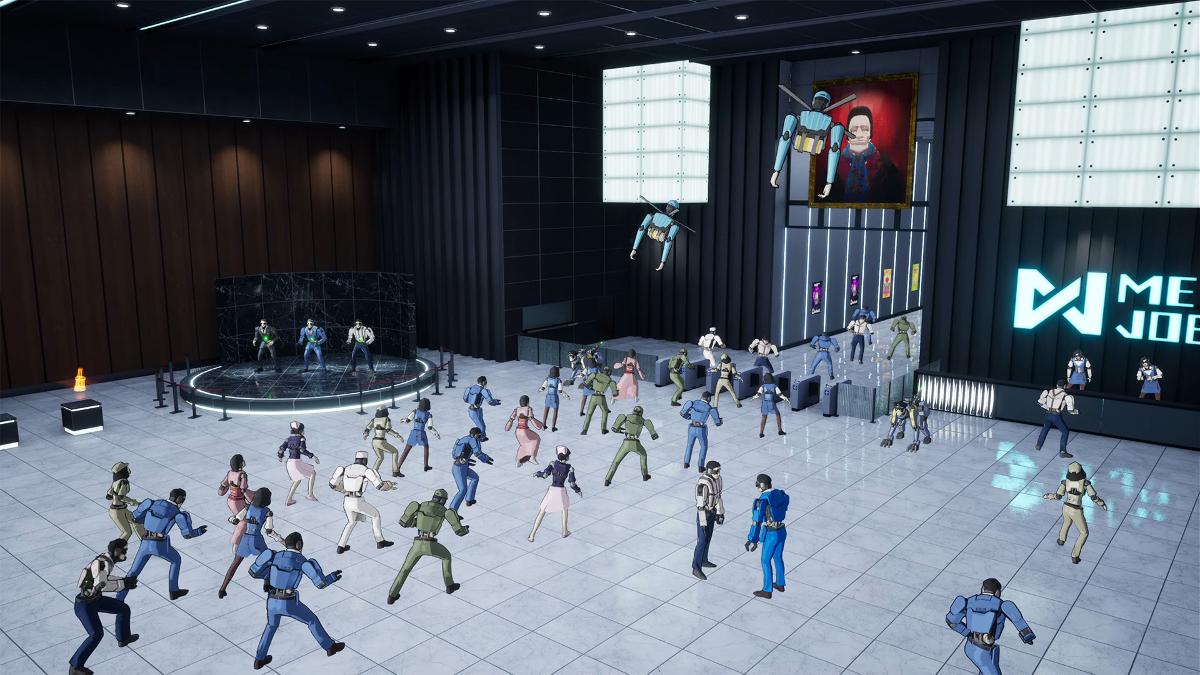
As you'd expect from its knowing title and preposterous premise, Full Metal Schoolgirl is intentionally over-the-top. It's silly, ironic, and apologetically subversive, particularly about the dangers of overwork. It pulls no punches when it comes to commentary on corporate greed and the zombie-like nature of employees who work slavishly for the company. It also pokes fun at social media, the world of content streaming, and the voyeuristic audience that often flocks to games like this one. For example, it includes the trophy "You Trying to Get Banned!?", which will activate if you keep a low-angle shot for a certain duration. At the same time, however, it caters to that audience. This is a game that offers bikini and bunny costume DLC, after all.
As for the gameplay, it's similarly exaggerated and explosive. As either Akemi or Ryoko, you'll climb the Meternal tower one floor at a time, clearing rooms and dismantling corporate drones with a deadly arsenal, all from a third-person perspective. You can use your melee weapon to slice bots nearby, your projectile weapon to mow them down from far away, your shield to block incoming bullets and lasers, and your drone companion to provide cover fire or boost your offensive capabilities. Which weapons and utility devices you use depends on how lucky you get with random drops.
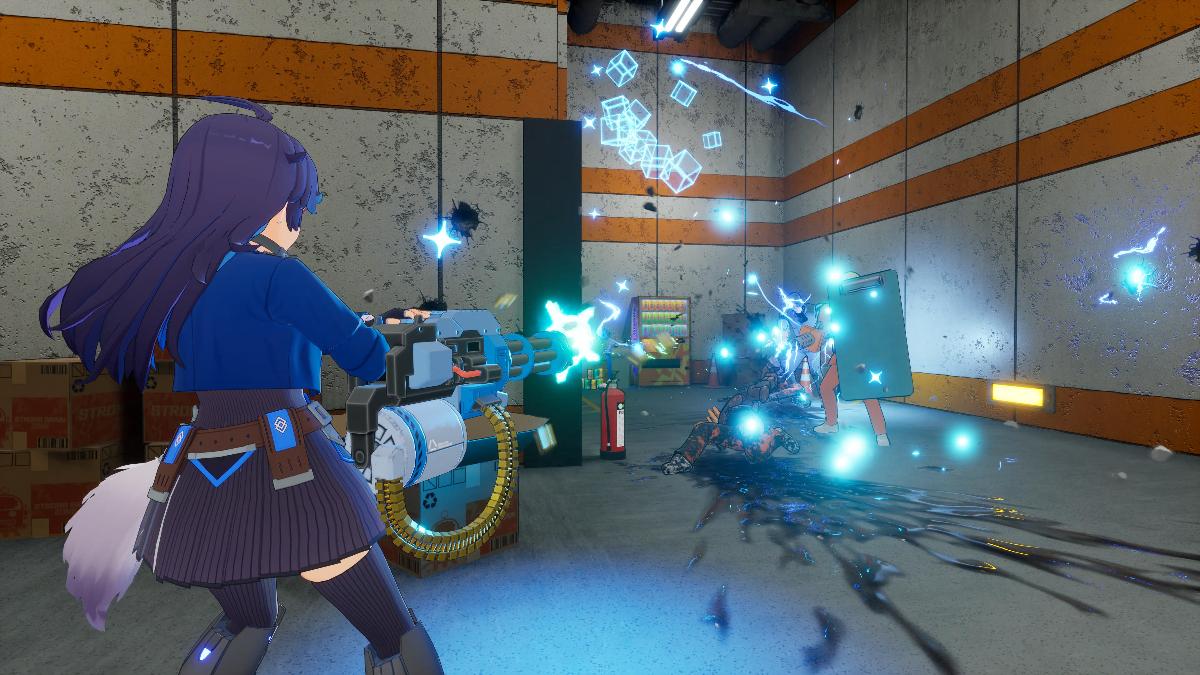
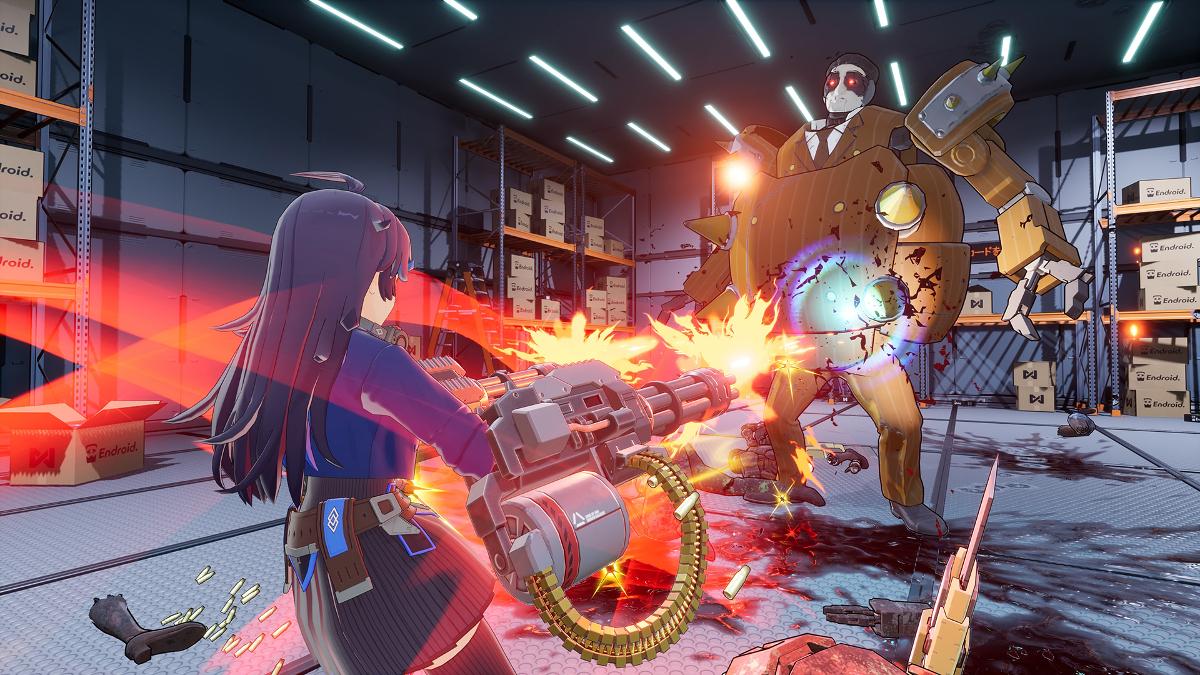
The moment-to-moment action in Full Metal Schoolgirl is quite fun, if a little shallow. Each of the Machine Girls controls smoothly and responsively. Combat is flashy and entertaining, whether you're punching holes in the opposition with a mini-gun or carving up robots with a chainsaw. Moreover, both Akemi and Ryoko can skate around each hallway and conference room on rocket-powered legs, which adds a great sense of fluidity to the fighting framework.
The variety of available weapons is also impressive. On the melee front, you'll choose from blades, chainsaws, and heavy-duty axes. As for projectile instruments, you'll gain access to usual options like sniper rifles and shotguns, but also oddities like a cannon that shoots business cards. My personal favorite is a shoulder-mounted rocket launcher that fires four heat-seeking rockets. It's great for bosses.
That rocket launcher points to a flaw with the game, however. Not all guns are created equally. It's far better to have a weapon with accuracy and range, in part because getting too close to the enemy is a recipe for disaster and in part because sometimes you need to get close but can't. There are certain room types with moving platforms and bottomless pits where picking off enemies at a distance is the most realistic solution. If you have a shotgun in this situation, well, good luck.
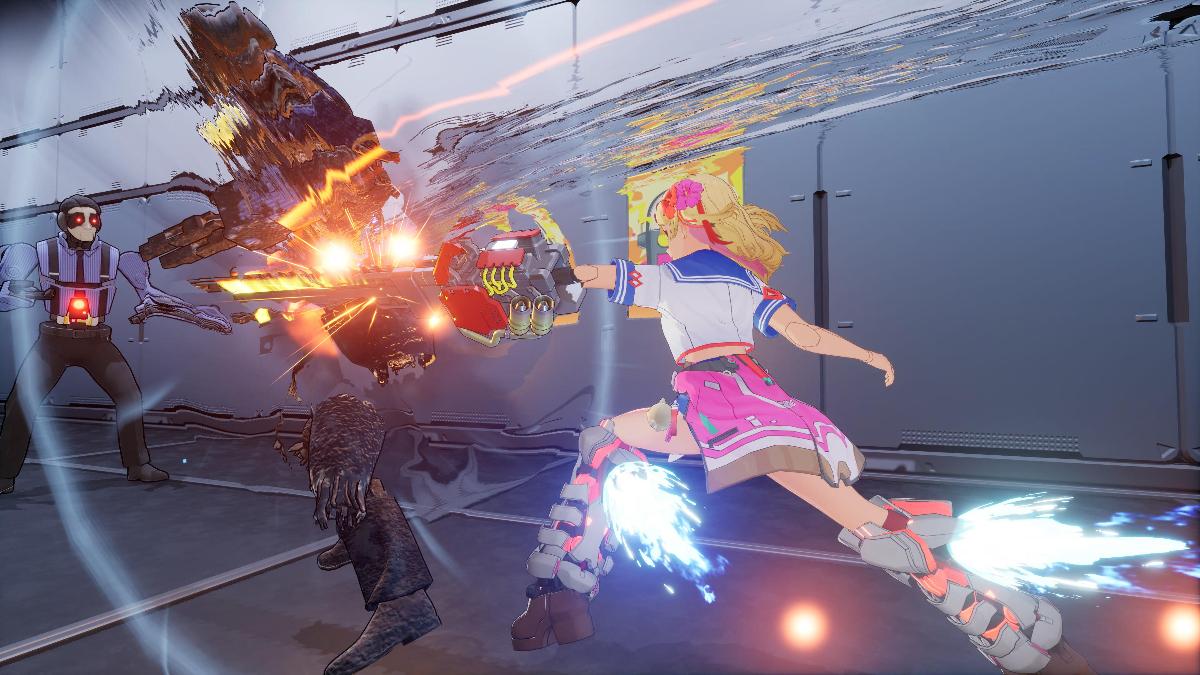
A few unbalanced weapons notwithstanding, the momentary gameplay in Full Metal Schoolgirl is a highlight. The lowlight, conversely, is the structure that surrounds it. It's just too repetitive and monotonous. Now, there's always going to be a certain dose of tedium in a Rogue-lite game; that's inescapable. But Okajima's latest project doesn't do much to confront that reality.
There are a few problems here. The first is level design. It's fairly forgettable. While certain floors have unique aesthetics (one is based on a restaurant, another on a hospital, another on C-suite offices) they're all made up of the same building blocks: long, rectangular hallways and box-like rooms. Floors above 55 start experimenting with platforming challenges, but this is actually worse. The game's controls are built for third-person combat, not precision jumping.
The second problem is the elevator system, which is linked with the third problem, the scarcity of boss battles. On the first floor of the Meternal building are several elevators, which go directly to higher floors. In order to take advantage of these shortcuts, you must have defeated the boss from that floor. For example, after beating Tomoyo on floor 10, you can then return to the 10th floor on your subsequent raid. Here's the catch: you can only use the key card once. So, if you perish before toppling the next boss, which is on floor 30, it's back to the ground floor. At one point, on the journey between floors 55 and 85, I spent two hours between bosses. It was just too long and repetitive.
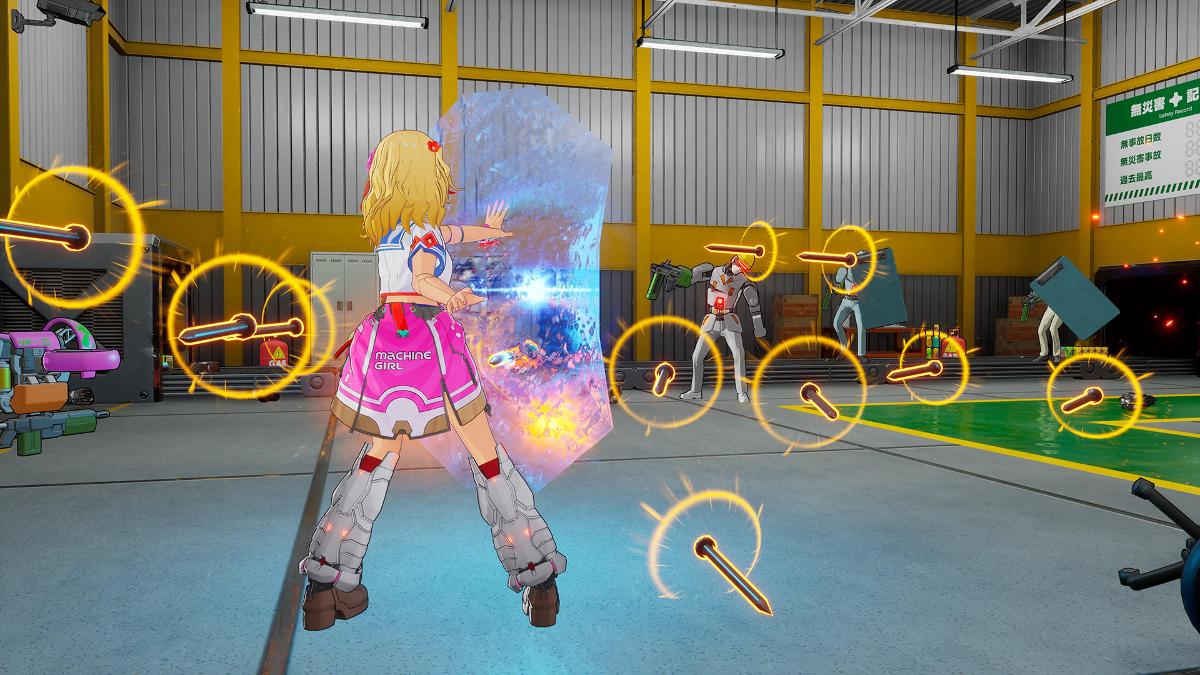
Now, to be fair, the game rewards additional keys on higher floors for defeating certain powerful mini-bosses. So things aren't as punitive as they seem at first glance. This is good, because there's a significant difficulty spike between floors 85 and 100.
While there aren't many bosses, those that are present are fairly good. They're big, they hit hard, and they mix up their tactics in unexpected ways. My favorite is Himena, the spider boss who clings to the ceiling and fires off heat-seeking missiles.
After clearing a boss room for the first time, or suffering an untimely death, you'll return to the lab of Professor Hakase, a busty, pervy doctor who makes modifications to the Machine Girls — for a price. Using the currency and materials gained from previous raids, you can power up one of several special attacks; boost your HP and stamina; gain extra slots for healing batteries and perk-giving mods; and increase the starting level of your weapons, drones, and shields. Overall, Full Metal Schoolgirl offers its players many opportunities to create a build that suits their tastes.

Much of the revenue needed for these augments comes from Cash Chats, one of the game's most inspired ideas. Each raid on Meternal HQ is livestreamed for a curious audience, which will sometimes make requests of Akemi and Ryoko. These requests are essentially bite-sized challenges for specific enemy rooms. You might need to defeat all foes in 50 seconds or less, or clear the room without using a battery. If you succeed, you'll gain extra money that won't be lost when you die. And if you're feeling brave, you can even "stretch" the goal and make it harder. Careful, though: if you fail, you'll receive fewer Chats moving forward.
Risk-taking is the name of the game in Full Metal Schoolgirl, though. If you plan carefully and avoid unnecessary risks, you should be able to reach, and clear, the 100th floor after about 15 hours. But, of course, you can continue playing the game long after that. Once you finish the campaign, you'll gain access to a NG+ and an endless mode with a secret unlockable character. The game has a lot of replay value, in the end; it's just a matter of how much repetition is too much.

One thing the game could have done to make each raid more exciting is offer more interesting weapon mutations and modifiers. Weapons, shields, and drones increase in power on each new floor, but they generally just get higher DPS and a few perks like 8% more HP. It would be great if there were weapons with acid, flame, freeze, and other elemental powers to keep things fresh. Mods suffer from the same sort of issue. They'll increase your movement speed, critical hit chance, or stamina gain, but won't do much to change the rules of the game in exciting, unanticipated ways.
One thing I wouldn't change at all? The game's art direction, which is one of its very best features. The visuals are sharp and clean on PS5, and the enemy robot designs are outstanding. Just wait for the final boss; he's a wacky work of art. There are also lots of dramatic visual flourishes, like geysers of motor oil erupting out of dismembered bots.
The audio side of the equation doesn't hold up its end of the bargain, sadly. The Machine Girls utter the same tired phrases over and over, which is most obvious during those long, uninterrupted raids between boss battles. Also — and this deserves special mention — the screaming voice sample from the suicide bombing enemy type is unacceptably aggravating.
Full Metal Schoolgirl is proud and unapologetic about its personality, which is admirable. It's over-the-top and subversive, in a good way. It's not quite a good game, though. While it succeeds in moment-to-moment action, character customization, and production design, it's too repetitive and monotonous to recommend. Still, it's a decent Rogue-lite that will scratch the itch between bigger, better releases.
VGChartz Verdict


6
Decent
This review is based on a digital copy of Full Metal Schoolgirl for the PS5, provided by the publisher.