
Switch 2 vs PS5 Sales Comparison - September 2025 - Sales
by William D'Angelo , posted on 09 November 2025 / 16,038 Views
The VGChartz sales comparison series of articles are updated monthly and each one focuses on a different sales comparison using our estimated video game hardware figures. The charts include comparisons between the PlayStation 5, Xbox Series X|S, and Nintendo Switch, as well as with older platforms. There are articles based on our worldwide estimates, as well as the US, Europe, and Japan.
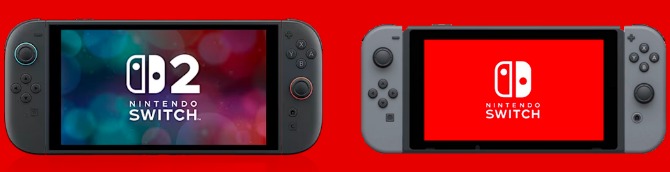
This monthly series compares the aligned worldwide sales of the Nintendo Switch 2 and PlayStation 5.
The Nintendo Switch 2 launched in June 2025 and the PlayStation 5 launched in November 2020. This does mean the holiday periods for the two consoles do not lineup.
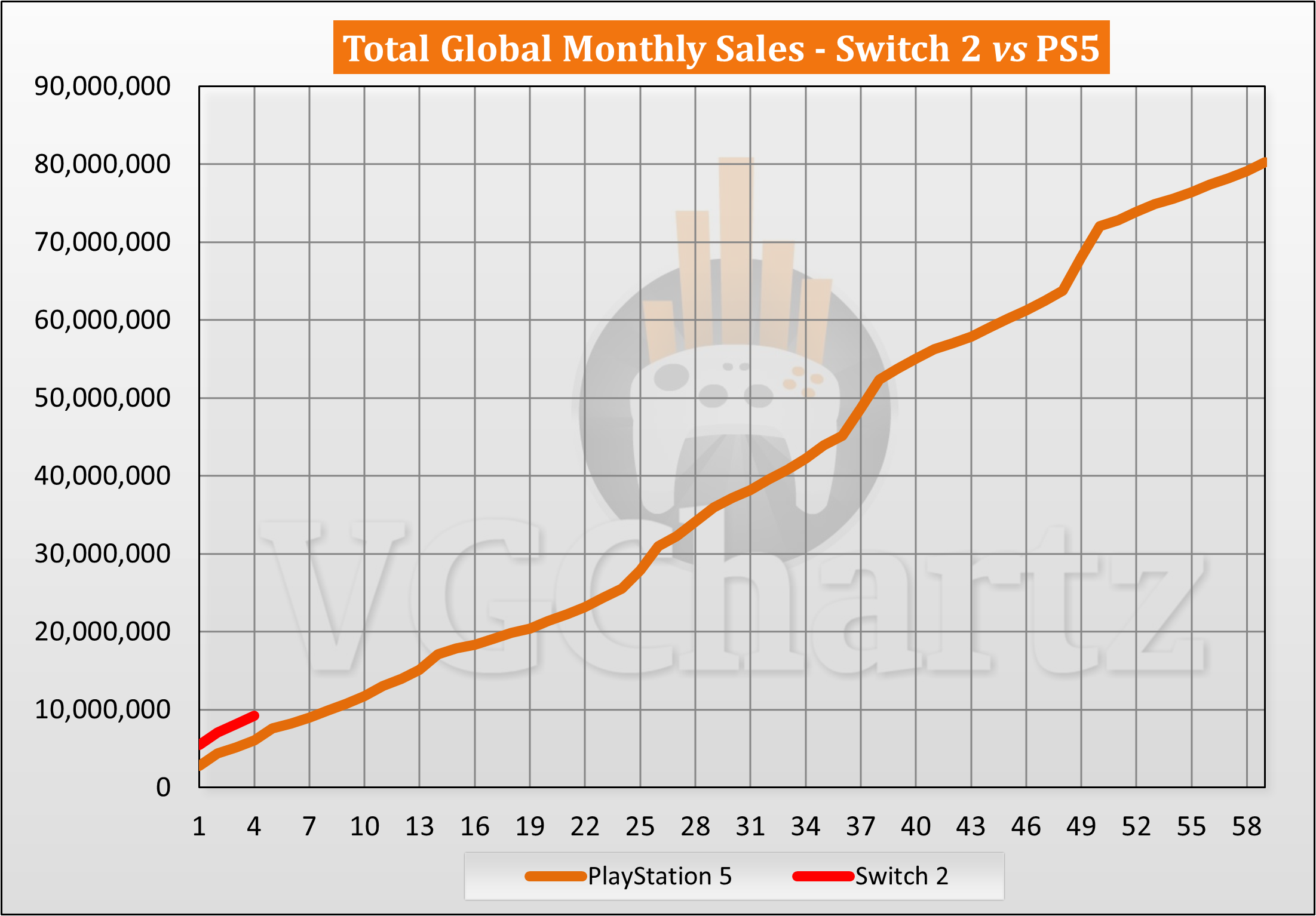
Switch 2 Vs. PS5 Worldwide:
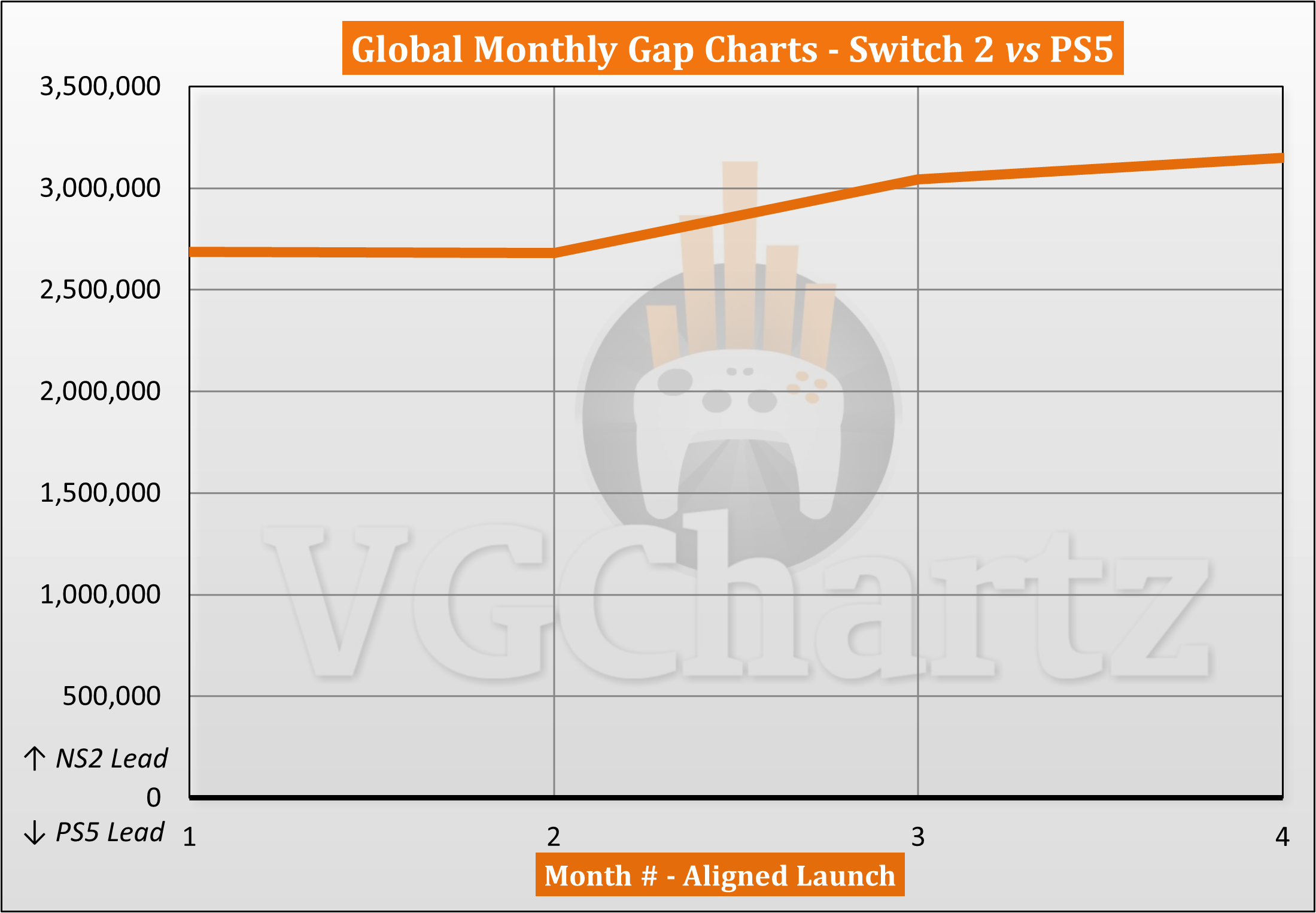
Gap change in latest month: 122,835 - Switch 2
Total Lead: 3,210,999 - Switch 2
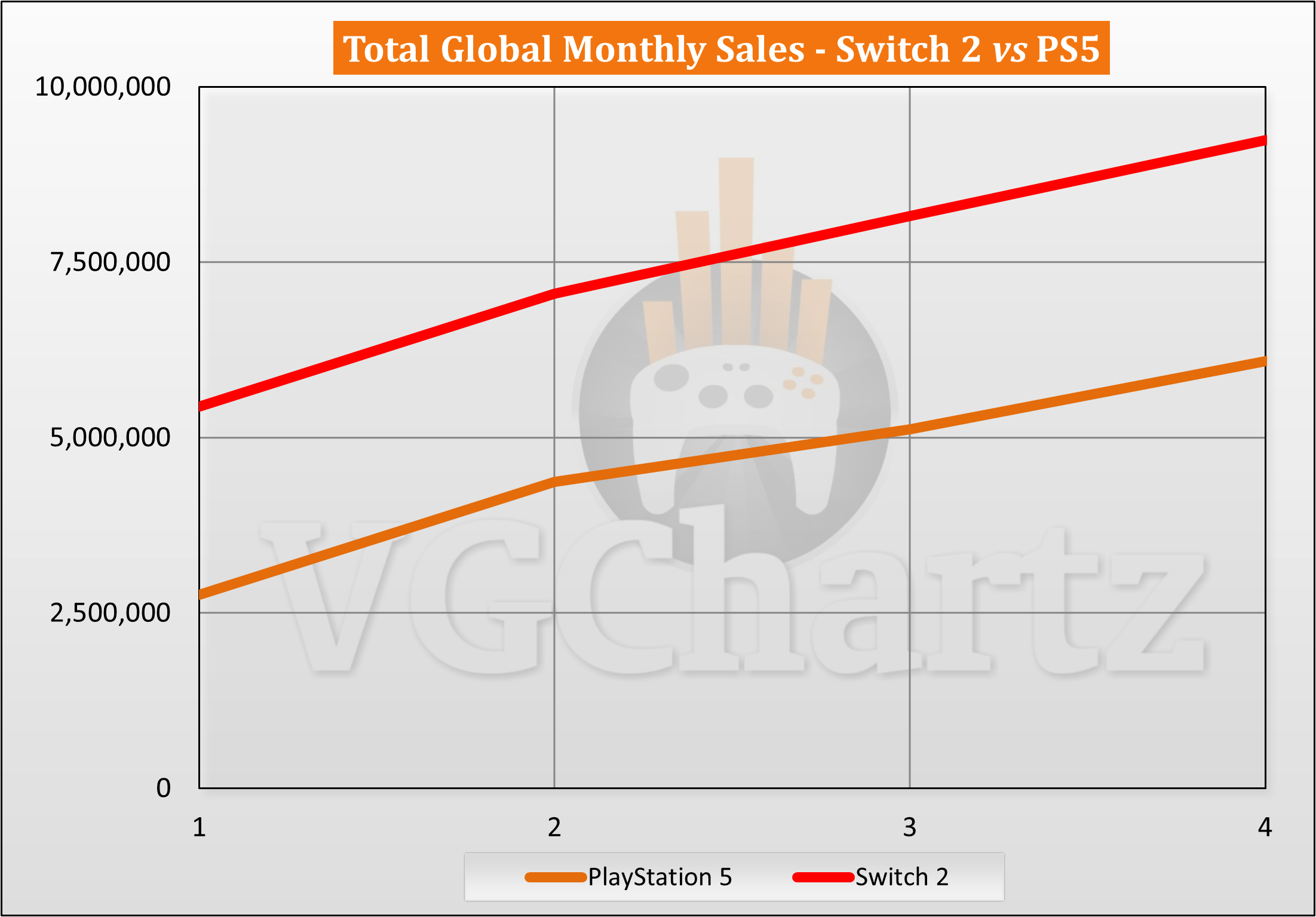
Switch 2 Total Sales: 9,300,199
PlayStation 5 Total Sales: 6,089,200
September 2025 is the 4th month that the Nintendo Switch 2 has been available for. During the latest month, the Switch 2 has outsold the PlayStation 5 by 0.12 million units when you align the launches. The Switch 2 is ahead of the PS5 by 3.21 million units.
The 4th month for the Switch 2 is September 2025, while for the PS5 it is February 2021. The Switch 2 has sold 9.30 million units, while the PS5 sold 6.09 million units during the same timeframe.
The PlayStation 5 sold 81.21 million units to date. The Switch 2 is currently 71.91 million units behind the lifetime sales of the PS5.
A life-long and avid gamer, William D'Angelo was first introduced to VGChartz in 2007. After years of supporting the site, he was brought on in 2010 as a junior analyst, working his way up to lead analyst in 2012 and taking over the hardware estimates in 2017. He has expanded his involvement in the gaming community by producing content on his own YouTube channel and Twitch channel. You can follow the author on Bluesky.
More Articles

The gap is likely going to get a lot wider over the next few months with the Switch 2 entering the holiday period.

The Switch 2 is off to an unprecedented explosive start. Much like the Wii, nearly 20 year ago now. Then we'll see if it has Switch-like legs. It's kind of crazy to consider the Wii is the halfway point between NES and Switch 2... at least in relation to the NES's wide Western release between late 1986 and early 88.

If SNY had a far larger supply lined up for PS5 earlier on, or could've ramped up production like they typically would have at any other time, this gap would certainly be tighter.
I wonder if SNY will follow Nin's strategy this time, making sure there's a ton of PS6 units available for launch and the months after, so there's no shortages for any reason, within their control anyway. Baring another global shutdown or something like that, in which case there's nothing SNY could really do, but count their bad luck.
It would be much, much harder for Sony to follow Nintendos strategy due to Sony using more advanced process nodes which would be in far greater demand from other companies who would also be using them to manufacture their products. By choosing a 2020 node to manufacture hardware in 2024/25 Nintendo ensured it would practically have the node to itself as few companies would still be using it and if they were it wouldnt be in any volumes that would meaningfully impact Nintendos production goals.
So Sony will be constrained by available production capacity and costs from using an advanced, high tech node.
More advanced nodes yes, but not something that's just started production.
SNY (and MS) have always waited for nodes to become mature enough so the yields are high. Which means TSMC has ramped up well into production and has typically expanded by then. Which also means the 7nm early birds are moving on to the next node, freeing up even more space.
As also was reported on, earlier this gen, once TSMC could ramp up production again due to the shutdown restrictions being eased on, companies like MS and SNY were getting into bidding wars to expand their chip production asap to feed the market since it was starving for more product and growth.
Now back then in 2020, if things were different, and it was possible, could or would SNY have increased TSMC production to levels that would've matched or exceeded SW2 sales in 2025? Likely not, which is why I said the gap would be tighter, and not closed or reversed.
SW2 sales so far have been impressive, nobody can deny that, but the comparison here to PS5 is a bit misleading. SNY didn't have the luxury of knowing a global shutdown was coming to build up supply, leading to mass scalping, and couldn't ramp up production even if they wanted to during that early sales period.
You seem to have lost track of the discussion. There was no comparison with PS5. You pondered on whether Sony would follow Nintendos strategy for the upcoming PS6 gen and I picked up on this and said it would be harder for them to adopt this strategy due to the difference in nodes and the considerably more constrained production capacity available to them as a result.
So could Sony seeing Nintendos success aim to increase their order with TSMC? Of course. But they'll still be limited in their ability to ape said success by the comparative age of the nodes in question.
What makes you think SNY will have PS6 using the absolute latest production node asap?
The cost would be astronomical and they already understand the PS5 is a bit too expensive, which it wasn't even using a brand new node either in 2020. They also wouldn't be able to get enough units made because of poor yields from early production.
So what's the point if the console is way too expensive and you have massive PS6 shortages that make PS5 in 2020 seem like it was growing on trees?
There is no point, which is why SNY would never do that, like they never have and won't in the future. They won't use a newer node until it's well into production with high yields at a reasonable enough price.
It's not like SNY can't plan well ahead and let TSMC know that when the time is right to start PS6 production, that SNY is going to want more chips than they typically would otherwise to try and build up a huge supply for the launch and thereafter. Leading to TSMC making sure that their node production is expanded to meet that PS6 demand when the time comes.
Youre missing the point. They dont have to be using the absolute latest node. They just have to be using a node thats recent and still in demand by a multitude of companies. The same node will be used by Microsoft and pc handheld manufacturers, as well as AMD themselves for their PC products.
Such demand automatically excludes them from being able to ape Nintendos strategy of manufacturing SOCs in 2025 with a 2020 vintage node. It would be the equivalent of PS6 releasing based on a 2022 node. That'd be Zen 4 and RDNA3 lmao.
This conversations over.
Someone's missing the point alright.
You really think that not only is SNY going to use a fairly early new node, but that they're not going to make a deal with TSMC in advance?
Like SNY is just gunna walk in 6 months before launch and be like crap, we can't get enough of this hot off the press node, man that sucks.
This isn't how things work at all. SNY will not use a node that's too new and early, and if SNY wants more units than they typically would in the past, they'll make that clear to TSMC well in advance, and TSMC will let SNY know what they can do. Whether that means expand production, or plan with SNY to launch the console at a date when recent node customers have moved on so the production space is available, one way or another, they'd make it happen.
You continue to miss the point. Sony are confirmed to use zen 6 and rdna 5/udna in their 2027 console release which ties them to the latest nodes. The design and performance of said technologies are hugely dictated by the node they're on. Sony will not have the latest graphics architecture on an older node as then it will not be the latest architecture lol. These nodes are gonna be in huge demand from other companies. Some far larger than Sony such as Apple and Microsoft. Sony can desire more capacity but TSMC has only so much to make available and other companies have more bargaining power . As such Sony conclusively will not be able to ape Nintendos strategy to anywhere near Nintendos scale. Just to reiterate in the hope that it finally sinks in, Nintendo manufactured Switch 2 in late 2024/early 2025 on a 2020 node. That meant there was next to no companies competing for capacity. Sony will not be able to ape that with a console on a much more modern node even with the best laid plans. There is no getting around that. Youve lost this exchange and have nothing of value to contend anything ive said. Just a repetitive "but but Sony will make it happen because theyre Sony." Really? We're done here.
Confirmed? Zen 6? RDNA 5? 2027 launch?
Why was PS5 Pro 4nm and not 3nm if SNY is so hellbent on using the latest and greatest? Why is Pro using Zen 2?
PS6 is going to be competing with massive XB Series PC sales, requiring lots of chips?
Glad the point is this is finally over.
You just dont get it do you? Sony isnt hellbent on using the latest and greatest node. They do however go for the latest AMD architecture that aligns with when they wish to launch their consoles. PS5s 2020 launch aligned with RDNA2s 2020 launch. PS6s 2027/28 launch will align with RDNA5/UDNA1. Those architectures are tied to specific nodes. If those nodes arent used, then those architectures wouldn't be the same.
Using PS5 Pro as an example shows a lack of understanding as its a mid gen refresh, a stop gap measure to retain engagement in the eco system . So an entirely different design approach to a launch of a new generation. What would be the point of a PS6 a few years later if you went all in with the refresh? When will common sense prevail on your end? Lol
This is over.
PS5 Pro uses Zen 2, and that's not 4nm. How's it on 4nm now? Why not just use the newest Zen arch?
What's the point in getting a PS5 if you know a better Pro is coming? PS4 Pro to PS5 Pro?
What's to say SNY doesn't change their future launch design approach? PS3 to PS4, next gen handheld (hybrid)?
These are common sense, but they clearly go over some heads.
Again youre highlighting lack of insight. Taking an old design and making it more efficient with a newer node, is entirely different from taking the latest graphics arhitecture thats designed with the latest nodes in mind (theyre a big part of what gives said newer architectures its performance and efficiency advantages over the old) and putting it on an older node. The architecture would have to be fundamentally re-designed. Youre conflating two entirely different things and confusing yourself. Console designers routinely utilise newer nodes to make their consoles more efficient or more powerful as a gen goes on. Nintendos done this with their handhelds since forever and Sony and Xbox have either utilised newer nodes to go the efficiency route with Slim consoles, or the power route with the mid gen refreshes.
Sonys next gen launch approach is rumoured to be a traditional console alongside a companion handheld. That approach doesnt change the fact that Sony will be using AMDs next graphics architecture which is due to launch in 2027, which is also the rumoured PS6 launch date. This ties into Hideaki Nishinos comments about how the launch of new Playstation hardware is directly tied to the evolution, implementation and availability of new technology and as such there would be no delaying hardware launches due to the popularity of existing hardware:
https://en.gamegpu.com/news/igry/sony-ne-budet-zatyagivat-s-vypuskom-playstation-6-nesmotrya-na-populyarnost-ps5#:~:text=GAMES-,Sony%20won't%20delay%20the%20release%20of%20PlayStation%206%20despite,to%20talk%20about%20PlayStation%206.
This is over. Know when to let go.
Lack of insight or lack of open mindedness? Who says SNY is going to do things the same as they always have? Always have...? Have they...? Has Nin even always done things the same?
Who says PS6 will launch at the beginning of the next newest node? Would there be any reasons for it to launch during mid to late node? What's the point in a new high performance APU node if you can't use the newest RAM tech because it's unavailable? Can you get enough of any RAM period when you need it 'asap' for next gen?
I wonder if someone earlier on, mentioned unexpected things happening that could cause headaches for SNY, positive or negative? Because hey, every console always launches exactly as you'd expect without seen or unforeseen issues, Right...?
It's been over like 10 posts ago supposedly...
It's not over until the fat lady sings.
Its over because ive eaten you up and debunked all of your baseless assertions. Youre now running on nothing but fragile pride. But lets continue....
Sony has stated clear as day that their hardware launches are tied to the availability of the latest technology. SIE CEO Hideaki Nishino has been crystal clear: he doesn't believe in delaying products just because the previous generation is still selling. He explicitly stated that the timing of new hardware is tied to the timeline of technological evolution. In plain English: if the tech is ready, Sony launches. They aren't going to sit on the PS6 for two years while Microsoft potentially jumps ahead, just because "RAM is expensive right now."
https://en.gamegpu.com/news/igry/sony-ne-budet-zatyagivat-s-vypuskom-playstation-6-nesmotrya-na-populyarnost-ps5#:~:text=GAMES-,Sony%20won't%20delay%20the%20release%20of%20PlayStation%206%20despite,to%20talk%20about%20PlayStation%206
The RAM Myth: Your "unavailable RAM" argument falls apart when you realize Sony and AMD are building Universal Compression tech specifically to solve memory bandwidth bottlenecks. While PC RAM prices might fluctuate, console manufacturers sign multi-year supply contracts years in advance to secure priority. In essence, Sony's approach is a smart engineering solution to bypass hardware bottlenecks and market volatility by achieving more with existing or less physical RAM through software and dedicated hardware optimization.
The next generation of AMD graphics hardware will launch in 2027 and with the 2 year cycle for each GPU generation that will be all thats available for customers until 2029. Sony will not be waiting until 2029 to release the PS6 lol. That means Sony will be using AMDs next generation architecture.
Mark Cerny confirms as much by stating that the next Playstation hardware is tied to AMDs hardware release roadmap:
https://www.digitalfoundry.net/news/2025/10/mark-cerny-talks-project-amethyst-future-sony-hardware-you-have-indeed-spotted-the-win
"In the past, we were largely creating custom technologies just for PlayStation platforms. But now with Project Amethyst, we’re placing substantially more of a focus on co-engineering and co-development with AMD on their roadmap hardware and libraries."
Throughout their history AMDs GPU gens consistently use modern and recent process nodes. If not the very, very latest node available, then the one behind it, meaning said nodes are still very much in high demand from other companies both bigger and smaller.
GPU architectures are designed with a specific semiconductor manufacturing process node (or a targeted range of nodes) in mind. The architecture and the process node are deeply intertwined, as the node determines the fundamental physical and electrical characteristics that the architecture will leverage.
Architectural design is a balancing act between performance, power efficiency, and physical die size. The process node provides the "budget" for these factors.
GPU tech isnt Lego lmao. These aren't generic parts you can just "swap" onto a cheaper, older node like you’re changing a lightbulb. Modern GPU architectures like RDNA 5/UDNA1 are physically designed for specific transistor densities—likely TSMC’s 2nm—to achieve the massive ray-tracing and AI performance leaps Sony is targeting. Attempting to backport a 2nm design to an older, larger node would result in a chip so massive and power-hungry it would melt through your floor.
Lastly You can’t compare the PS6 to the Switch 2's production "flexibility." Nintendo is using Samsung’s 2018-era 8nm node—a "sweet spot" of mature, cheap, and abundant capacity. Even if Sony delayed the PS6 by two years, they would still be fighting Apple and Nvidia for cutting-edge nodes. Delaying doesn't magically turn a current, high demand chip into a high-yield legacy chip; it just leaves Sony with outdated hardware in a market that moves at the speed of light.
In short, "waiting for a cheaper node" isn't a strategy; it's a recipe for launching a literal space heater that’s obsolete on day one. Sony is playing the long game with Project Amethyst, and that game doesn't involve sitting on the sidelines hoping for 2018 prices in 2028.
Youve been conclusively debunked.
We'll leave it there Erc :)
What's SNY have to worry about being a few years behind the next gen XB when it's going to be way too expensive with all that RAM, as well as ever increasing GPU prices, as recently reported. Nobody will be able to afford the next XB. SNY will have its compression tech a few years later and will end up with newer faster much cheaper tech all around.
Care to explain how SNY waiting a few years, after the newest node has reached a maturity where it's yields are high enough, will have to fight Nvidia and Apple? By that time those companies will have moved onto the next newest node, leaving room for PS6 expanded production. It's not like TSMC nodes reach those maturity levels in months after production starts, and it's not like TSMC takes a decade to introduce a new node.
What about those from SNY who've been saying PS needs to take a new approach going forward due to higher and higher costs yet less and less perceived visual upgrades? That doesn't sound like making PS6 high performance large silicon on an immature new node.
More reports recently of next gen consoles being delayed. That's odd, because if SNY is always going to launch next gen due to TSMC's next newest node being mature, then there couldn't be a delay, so how's that possible?...
Throwing out random facts that don't directly apply to my point is just grasping at straws. You haven't debunked anything. I don't hear no fat lady, do you?
Your entire argument rests on one unproven assumption and a stack of contradictions built on top of it:
If Sony just waits a year or two, the node will be mature, Apple/Nvidia will move on, capacity will magically free up, and Sony can stockpile PS6 units the way Nintendo did
That sounds neat. It also collapses the moment you apply even a basic understanding of how modern leading-edge semiconductor economics actually work
1- You keep pretending “mature node” means “low demand”
This is the core fallacy you never escape.
Nintendo’s situation worked because:
• Switch 2 is reportedly built on a 2018-era node
• That node is functionally obsolete for flagship mobile, PC, and AI products.
• Capacity for it is cheap, abundant, and no longer strategically valuable.
Sony’s situation is the exact opposite
Even if PS6 launches on a “mature” version of a modern node:
• That node will still be used by Apple, Nvidia, AMD, Microsoft, Qualcomm, AI accelerators, automotive, and data center products
• These companies do not abandon nodes the moment a new one appears. Apple alone keeps massive volume on N-1 and N-2 for years.
• TSMC has publicly stated multiple times that leading-edge nodes remain supply constrained for their entire useful life, not just at launch.
So no, waiting a year or two does not “free up space.”
It just means Sony arrives later to the same knife fight, except now the market expects more performance for the same price.
Nintendo avoided this entirely by choosing a node nobody else wanted anymore.
Sony literally cannot do that without launching hardware that would be laughed out of the market.
2- You keep treating architecture and process like Lego bricks
This is where the technical misunderstanding gets fatal.
You repeatedly imply:
“Sony can just take the latest AMD architecture and put it on an older, cheaper, mature node.”
That is not how GPU or CPU design works. At all.
AMD’s public commentary — echoed by Mark Cerny — has been crystal clear:
• Architectures are co-designed with the target process node.
• Power targets, clock behavior, die size, cache hierarchy, ray tracing blocks, and AI acceleration are all tuned around transistor density and electrical characteristics.
Backporting RDNA5 / UDNA to an older node would:
• Explode die size
• Destroy power efficiency
• Increase cost instead of reducing it
• Require a fundamental redesign (i.e. it wouldn’t even be the same architecture anymore)
Nintendo can do this because:
• Their performance targets are low
• Their SoC philosophy prioritizes efficiency and price over raw throughput
Sony cannot do this without abandoning the entire premise of a generational leap.
3- You contradict yourself on cost… repeatedly
You argue:
• PS6 can’t be expensive
• Sony must wait for cheaper nodes
• But also that Sony should delay for years and still deliver cutting-edge performance
Pick two. You don’t get all three.
Every credible analyst (including those Sony themselves brief) agrees on this:
• Waiting longer increases expectations
• Expectations increase die size, memory bandwidth, and silicon cost
• Which pushes BOM up, not down
Delaying PS6 doesn’t give Sony a cheaper console.
It gives Sony a more expensive console that has to justify the delay.
That’s exactly why Nishino explicitly said Sony does NOT delay launches just because the prior generation is selling well.
The tech cadence dictates the window — not vibes, not RAM spot prices, and not hope that Apple will politely step aside.
4- The “Apple and Nvidia will move on” argument is fantasy
This is probably the most detached-from-reality claim you keep repeating.
Apple doesn’t “move on” from nodes.
They:
• Consume multiple nodes simultaneously
• Lock capacity years in advance
• Outspend Sony by an order of magnitude
Nvidia?
They’re not leaving high-margin AI silicon on the table just because a newer node exists.
They actively backfill demand on every viable advanced node TSMC offers.
TSMC themselves have stated that:
• Advanced node capacity expansion lags demand
• Priority goes to the largest, longest-term contracts
Sony is important.
Sony is not Apple.
Sony is not Nvidia.
Sony does not get to clear the board just by “planning ahead.”
5- You keep misusing PS5 Pro as if it proves something
It proves the opposite of what you think it does.
PS5 Pro:
• Uses a node shrink to improve efficiency and clocks
• Reuses an older CPU architecture
• Exists explicitly as a stopgap, not a generational leap
Sony doing this mid-gen is normal.
Sony doing this for PS6 would be self-sabotage.
A node shrink does not equal an architectural leap.
You keep conflating them, and that’s why your argument never stabilizes.
6- Analyst “delay rumors” don’t support your case
You wave at rumors of delays as if they validate your position.
They don’t.
Those rumors are about:
• Market timing
• Software readiness
• Ecosystem alignment
They are not about Sony waiting around for some mythical moment when advanced nodes become Nintendo-cheap.
If anything, analysts consistently point out that the longer Sony waits, the harder the launch becomes, because Microsoft, PC handhelds, and cloud platforms keep moving.
7- Final reality check (the part you keep dodging)
Nintendo succeeded because:
• Low performance targets
• A dead, cheap node
• Minimal competition for capacity
Sony cannot replicate any of those conditions.
Even if Sony delayed PS6:
• The node would still be in demand
• Capacity would still be contested
• Costs would still be high
• Expectations would be higher than ever
Delaying does not turn a cutting-edge SoC into a legacy product.
It just turns it into an expensive one that launches late.
Bottom line
Your argument boils down to:
“Sony can do what Nintendo did if reality cooperates differently this time.”
Reality won’t. LMAO.
Nintendo’s strategy worked because it was Nintendo’s strategy, not because Sony somehow forgot how planning works.
And no amount of repeating “they’ll make it happen” changes the physics, economics, or public statements from Sony, AMD, or TSMC.
At this point, this isn’t a debate.
It’s just you insisting the semiconductor industry should behave differently so your conclusion can survive.
Spoiler: it won’t.
PS: Stop liking your own comments. Its cringe and needy. Want better for yourself.
1-Who says SNY needs an entire node to themselves to be able to build up enough supply for PS6? You're acting like PS6 is going to sell 100M units year 1.
2-I'm not implying that. You seem to keep wrongly thinking that for some reason, like everything else.
3-Again I didn't say that, you're assuming based on what you 'know' is going to happen. You're not arguing with my points, your arguing with what you assume or want them to mean.
4-I never said Apple or Nvidia wouldn't keep some production on older existing nodes. I just said they would move on to newer nodes for newer tech, which SNY won't. SNY would only put the existing tech on a newer node, eventually, for a Slim model, once that node is mature enough.
5-You're telling me PS5 Pro doesn't have any new advanced architecture vs base PS5? No RDNA 3 or 4 tech? Let me guess, PS4 Pro was no different? For 'knowing' so much you seem to know so little about the mid gen upgrades.
6-Yet you think what someone says, even from SNY or MS, is gospel? Everyone knows the XB 180 meme, and SNY does the same at times, or just doesn't do what they say they will. Your sources are no better then.
7-PS6 could aim for lower performance. PS4 was tame compared to PS5 and especially PS3. Do you not believe anything to do with the supposed handheld coming? Do you think the handheld would have 20TF or more?
SNY designs multiple versions of the console before deciding what final prototype they're going to launch, and when.
No amount of wrongly assuming what I mean and assuming you know exactly what's going to happen with PS6 will make it so.
At least someone agrees with me. Maybe that's a good hint you're not taking because of your misguided assumptions.
Alright, let’s do this one last time and actually close the loop, because your reply is basically a greatest-hits compilation of moving goalposts, strawmen, and “that’s not what I meant” defenses.
I’ll go point by point, using your own words against you, and leaning on what Sony, AMD, TSMC, and analysts have actually said — not vibes, not hypotheticals, and not “well maybe they change everything they’ve ever done.”
1 - “Who says Sony needs an entire node to themselves?”
Ah yes, the classic pretend-the-argument-was-extreme maneuver.
No one said Sony needs 100% of a node.
The actual claim — which you still haven’t addressed — is that Sony cannot secure Nintendo-like excess capacity on a modern node.
Nintendo didn’t just “not need the whole node.”
They were operating on:
• A 2018-era process
• With minimal competing volume customers
• At low wafer cost
• With huge elasticity
That is categorically different from Sony competing for:
• N-1 or N-2 - leading-edge nodes
• With Apple, Nvidia, AMD, Qualcomm, Microsoft, AI accelerators, automotive, etc.
• On nodes TSMC themselves say are fully booked for years
So no, PS6 doesn’t need to sell 100M year one.
It just needs more capacity than is realistically available to replicate Nintendo’s stockpiling strategy — which it won’t get.
This isn’t about sales numbers.
It’s about wafer allocation physics.
2 - “I’m not implying that”
You don’t have to say it explicitly. Your argument requires it.
Your entire position depends on:
• Sony waiting
• Demand easing
• Big customers “moving on”
• Capacity freeing up
• Sony then building massive inventory
That only works if architectures can be decoupled from nodes, or if demand meaningfully collapses.
Neither happens.
So when you say “I didn’t imply that,” what you actually mean is:
“I don’t want to defend the implications of my own argument.”
That’s not a rebuttal. That’s an escape hatch.
3 - “You’re assuming Sony can’t do X”
No — I’m referencing Sony’s own public strategy and AMD’s roadmap alignment.
Sony:
• Publicly ties generational launches to new architectural availability
• Explicitly rejects delaying launches due to prior-gen success
• Has co-engineered future hardware with AMD (Project Amethyst) around AMD’s roadmap
AMD:
• Designs new GPU architectures around specific process targets
• Does not design flagship architectures to be retrofitted onto legacy nodes
TSMC:
States repeatedly that advanced nodes remain supply constrained throughout their lifecycle
You’re the one assuming Sony will:
• Break architectural cadence
• Accept lower performance
• Compete with PC/Xbox from a weakened position
• And somehow reduce cost by doing so
That’s not evidence-based. That’s wishcasting.
4 - “I never said Apple and Nvidia wouldn’t keep production on older nodes”
Right — you just said they’d move on, freeing capacity.
Which is wrong.
Apple and Nvidia don’t “move on” in the way your argument requires.
They:
• Layer demand
• Run products across multiple nodes simultaneously
• Backfill demand aggressively because margins stay high
This is exactly why TSMC says:
Demand for advanced nodes does not meaningfully decline when newer nodes launch.
So again — waiting does not create a Nintendo-style vacuum.
It creates a more crowded, more expensive battlefield.
5 - “PS5 Pro has no new architecture?”
This is where you finally step on the rake.
PS5 Pro:
• Adds select features
• Improves efficiency and clocks
• Does not introduce a new GPU generation
• Does not redefine performance targets
• Does not change Sony’s generational positioning
Same with PS4 Pro.
Mid-gen refresh ≠ generational leap
Node shrink ≠ new architecture
If PS5 Pro were equivalent to a generational jump, PS6 wouldn’t exist.
You’re citing the exception to justify rewriting the rule.
6 - “Executives aren’t gospel”
Correct — but repeated, consistent strategy over three console generations is not random PR either.
Sony has:
• Launched on RDNA-aligned architectures
• Maintained cadence with AMD’s roadmap
• Never delayed a generation by “a few years” to chase cheaper silicon
Your counterargument is essentially:
“Sony might do something totally different this time because reasons.”
That’s not skepticism. That’s refusal to engage with evidence.
7 - “PS6 could aim for lower performance”
This is where your argument finally eats itself.
If PS6:
• Targets lower performance
• Uses older nodes
• Prioritizes cost over capability
Then congratulations — you’ve just argued for Sony abandoning the high-performance console space, conceding ground to Xbox and PC.
Which is ironic, because your entire argument started with:
“Sony could just copy Nintendo.”
Sony is not Nintendo.
Nintendo wins by not competing on performance.
Sony’s brand equity is built on exactly the opposite.
A companion handheld does not change this.
It complements the flagship — it does not replace it.
Final Reality Check (Again, since it didn’t land the first time)
Nintendo’s success comes from:
• Low performance targets
• Dead, cheap nodes
• Minimal capacity competition
Sony’s reality:
• High performance expectations
• Modern architectures
• Advanced nodes
• Heavy competition
• Fixed launch windows tied to tech cadence
Delaying does not turn a cutting-edge SoC into a legacy product.
It just makes it late, expensive, and underwhelming.
You keep saying:
“You’re assuming.”
No — I’m observing how this industry actually works, backed by:
• Sony’s own executives
• AMD’s design philosophy
• TSMC’s capacity disclosures
• Analyst consensus
You’re arguing that Sony could rewrite all of that.
They won’t.
And the fact you now need to say “that’s not what I meant” after every point is a pretty good indicator that the argument itself doesn’t survive contact with reality.
We’re done.
PS: I take back what I said before. After the battering you’ve just received feel free to make yourself feel better by liking your own comments.
Enjoy your day! :)
That's a whole lot of an explanation, again and again, for proving yourself correct based on your own assumptions, and not what was initially said by me, or what was further explained after your incorrect assumptions and 'knowledge of the future'.
Maybe you should go back and refresh yourself, or maybe you'll just keep making up 'claims' or spinning what was said to fit your narrative.
The fact you can't accept what I meant, which means that you're mistaken, and you have to spin it like wafers to make yourself feel correct, makes me thankful I actually operate in reality.
I will absolutely enjoy my day in the real world. Try to enjoy the virtual world or whatever you're living in.
Oh wow, the “you live in the virtual world” mic-drop. Truly devastating.
Let’s unpack this last bit of performance art before you head off to touch grass.
What you’ve done here is the classic retreat to “that’s not what I meant” once your argument collapses under its own weight. Notice something? At no point do you actually defend your position with anything concrete — no numbers, no TSMC statements, no AMD roadmap logic, no Sony policy, no analyst commentary. Just vibes and wounded pride.
You keep insisting:
“You’re arguing against assumptions, not what I said.”
No — I’m arguing against the only version of your argument that actually makes sense.
Because if we take your words literally, stripped of the hand-waving, your claim is:
Sony can delay PS6 a bit, wait for node maturity, and then stockpile like Nintendo.
That implies:
• Modern nodes become cheap and available
• Big customers stop crowding them
• AMD architectures can just sit around waiting
• Sony can ignore competitive timing
Those are not my assumptions.
Those are the unstated requirements of your own position.
You just don’t like them being spelled out because they’re obviously false.
So instead of addressing that, you do this:
“That’s not what I meant. You’re spinning it.”
No, what you meant changes every time the previous version gets debunked. That’s called moving the goalposts, not “being misunderstood.”
You also love pretending I’m claiming to “know the future.”
No — I’m citing:
• Sony saying launches track technology readiness
• AMD saying architectures are node-targeted
• TSMC saying advanced nodes stay constrained
• Analysts saying delays increase cost and risk
That’s not prophecy. That’s how the industry operates.
Meanwhile your “reality” consists of:
“Well Sony might do something totally different one day.”
Yes. They might.
They might also make a PS6 powered by hamsters.
Neither is a serious argument.
So enjoy the real world — just remember that silicon fabs, wafer allocations, and multi-billion-dollar supply contracts exist there too. And they don’t care what you “meant.”
We’re done.
So you're making up whatever you have to so you don't have to argue against what I said because you can't. I got that. I know.
Hamsters potentially powering PS6 vs SNY potentially building up stock for PS6. Nice comparison...... Not.
I also know we're done, because you never started.
Ah yes — when all else fails, declare victory and accuse the other guy of “making things up.” Very on brand.
Here’s the awkward part for you: I did argue what you said. I just followed it to its logical conclusion, which exposed the parts you keep pretending don’t exist — node demand, architecture–process coupling, and TSMC capacity constraints. You don’t get to float a claim that only works if those things go away, then cry “misrepresentation” when someone points out they don’t.
And the hamster joke? That was me illustrating how your fallback — “Sony might just do something totally different” — isn’t an argument. It’s a shrug dressed up as insight.
So no, I’m not dodging what you said.
I’m explaining why what you said can’t work in the real semiconductor market — the same “real world” you keep invoking while ignoring how it actually operates.
But hey, enjoy declaring yourself the winner. That seems to be the only supply you’re not constrained on.
You have a nice day, Scoopz. In fact, have 2 scoops!