Hollow Knight: Silksong (PC) - Review
by Mark Nielsen , posted on 03 October 2025 / 6,336 Views
Few games have had as infamous a wait time as the once DLC, now full-fledged game Silksong, which was announced in 2019 and then years later finally confirmed for release in 2023 2024 2025. It’s been a long, arduous journey, but after six years (and more if you count the full development that allegedly started before the original game), Team Cherry has managed to spin us exactly the sequel you’d expect.
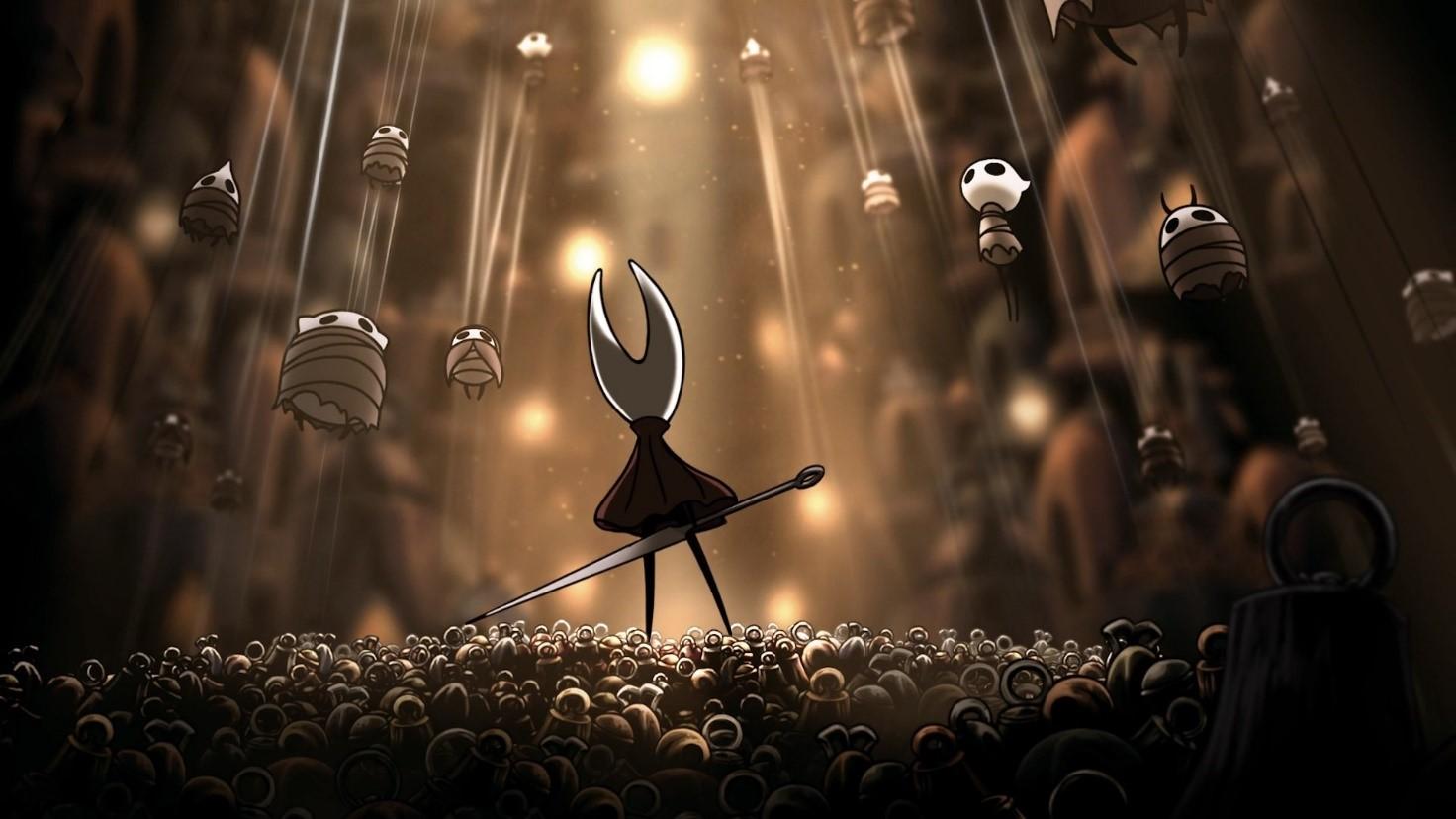
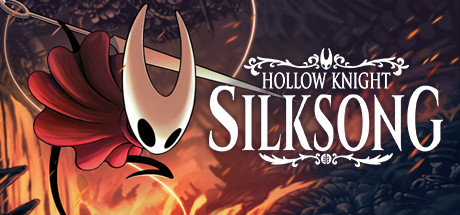
Like its predecessor, Silksong is a combat-focused Metroidvania with thinly veiled inspirations from the Dark Souls series, both mechanically and in its storytelling. This time around we play as Hornet, our slightly cooler-looking rival from the first game, and even though this change doesn’t alter the core game immensely, it makes for a few interesting and generally positive changes.
For one, Hornet isn't a silent protagonist like The Knight, instead having a personality of her own, with a warrior’s pride and a kind heart, which makes her a quite likeable character to play as and gives her more meaningful interactions. For another, the death mechanic has been somewhat altered. We still get to enjoy the convenience of dropping all our money when we die, but this time it's no longer protected by an angry ghost that we have to fight off in the presumably already-lethal location where we died, but is instead contained in a cocoon that will restore all our Silk - a sort of “mana” used to heal (and theoretically cast spells, but you’re going to need it for healing) - upon getting struck once. It’s one of the kinder ones, as far as Souls death mechanics go, but unfortunately Team Cherry still felt the need to limit your maximum Silk later in the game until your cocoon is picked up; an almost hidden punishment that starts out pointless and gets more annoying as you progress.
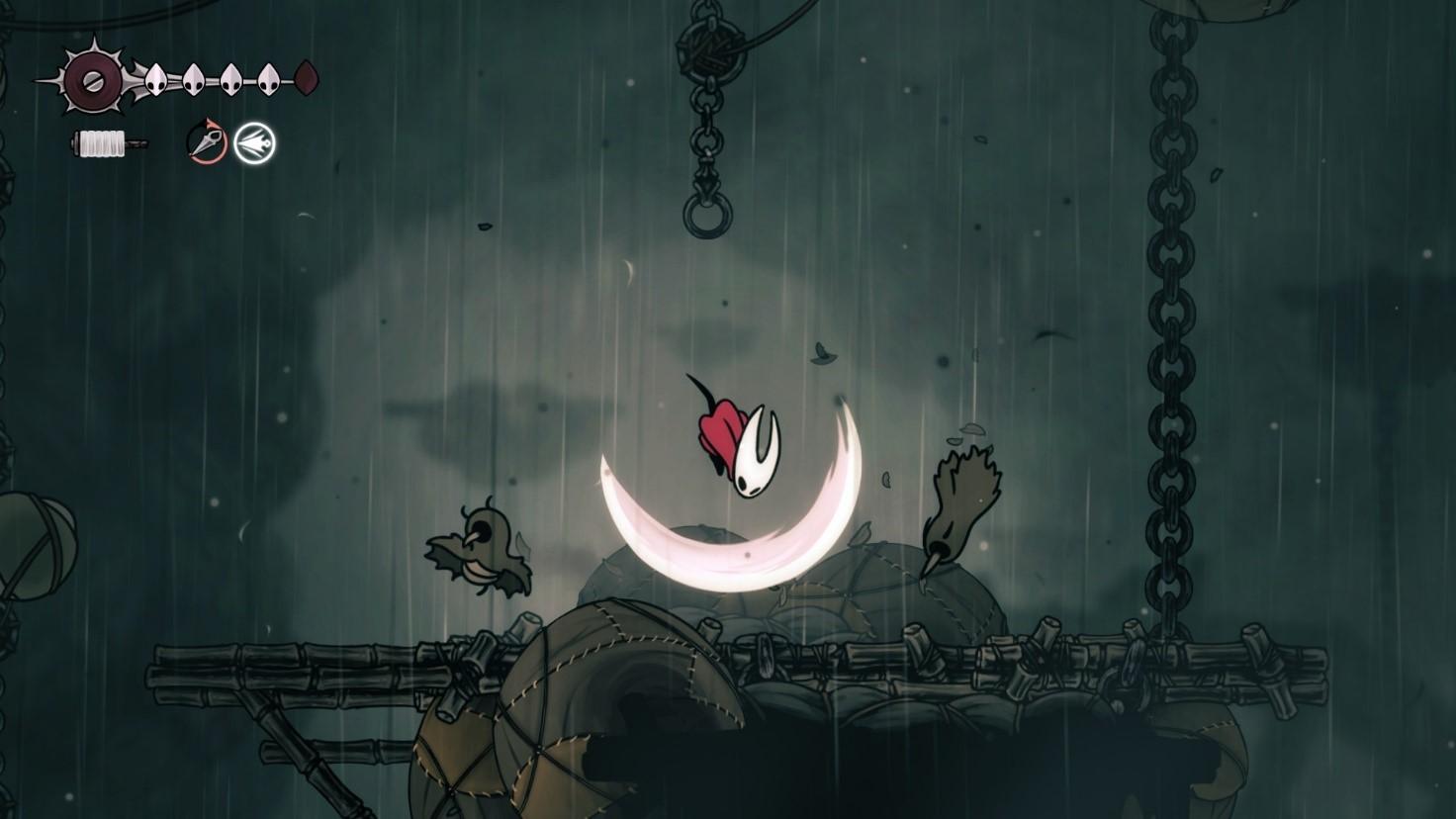
Finally, and perhaps most importantly, are the combat changes that come with the switch to Hornet. The core mechanics of gameplay are still how you remember them: simple, fun, and fast-paced, but it’s often underrated how much a satisfying moveset adds to the combat of a game, and Hornet delivers there with satisfying slashes and diving attacks that can also be altered with certain crests you find throughout Silksong.
These crests can also be imbued with trinkets – which replace the charms from the first game – that give various, usually minor buffs to Hornet. Trinkets come in three colors: the blue ones give advantages in combat, the yellow ones are more utility based, and finally the red ones – the most novel of the three – are tools to use in battle, like throwing knives or traps or a draught that increases your speed, with limited uses but which can be refreshed when resting at benches. All in all, while there’s nothing ground-breaking in Silksong's combat, it's well-crafted and satisfying, and along with a few additions as you progress it makes for an excellent Metroidvania moveset.
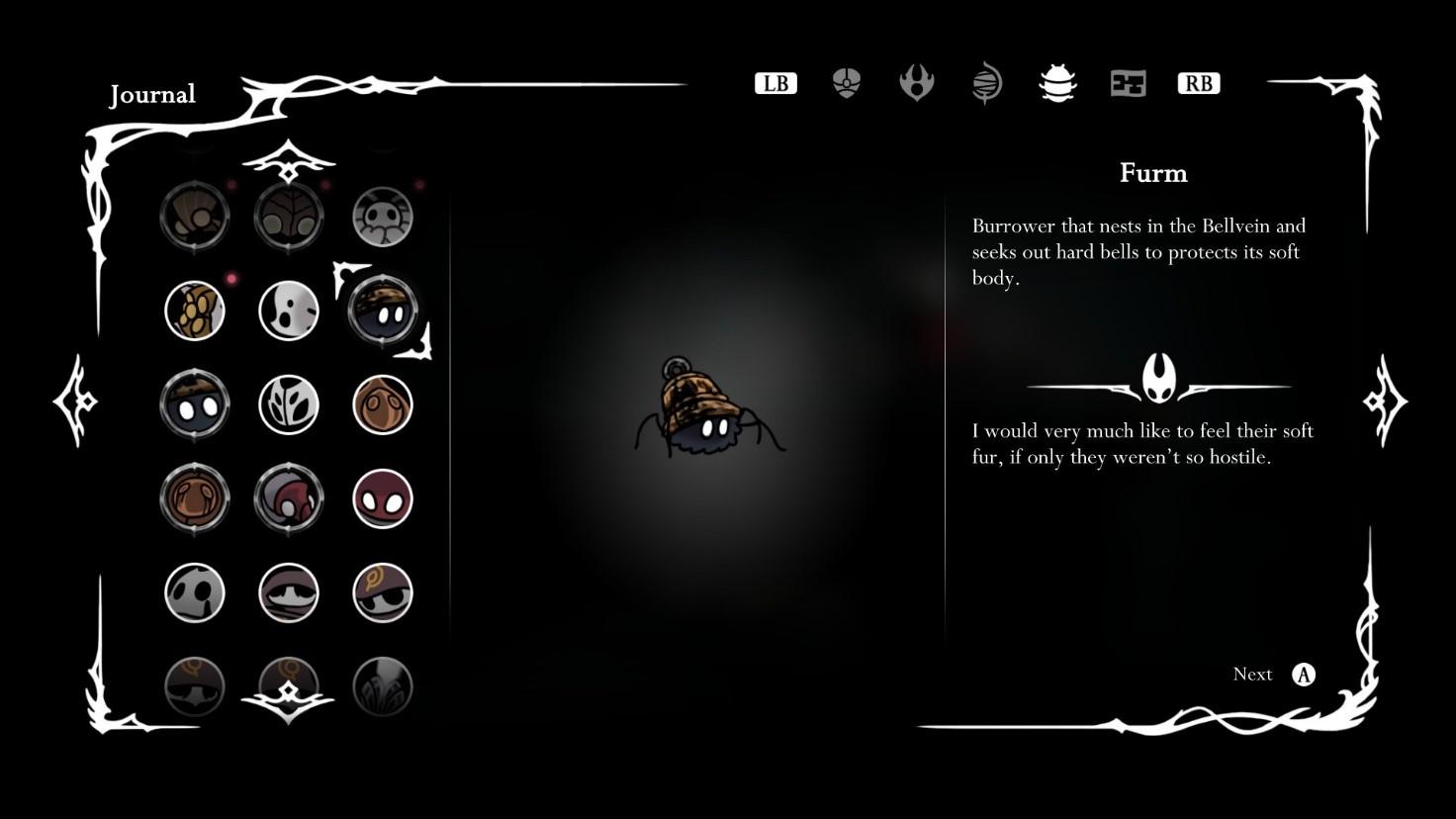
When it comes to the enemies and bosses that you’ll be using this moveset on, Silksong has a pretty massive bestiary by any standards, indie or otherwise, and there’s a good level of variety and challenge to be found. The game also has an actual hunter’s journal that you can fill out, which adds to the level of interest when finding new foes for the first time and learning their moves and how to counter them.
Certainly not every enemy is a joy to fight, and Silksong does have a few that you feel more tempted to run past rather than face the hassle of fighting them, but the average enemy is still on the good side of the scale.

As for the bosses, these are obviously a major part of the series, with their grand telegraphed moves and patterns to learn. Though it’s hard to generalize too much - as we shall get to later on - they’re generally a positive force of the game, with a sense of epicness and achievement in taking them down.
If I was to place a point of criticism on the enemies and bosses, however, it would be that a few later encounters do fall into the unfortunate trope of being more a test of stamina than skill, with long drawn out fights with a trivial phase one. It might not be the worst sinner in this regard, but there are a few cases where you’re likely to run out of patience before you run out of masks.

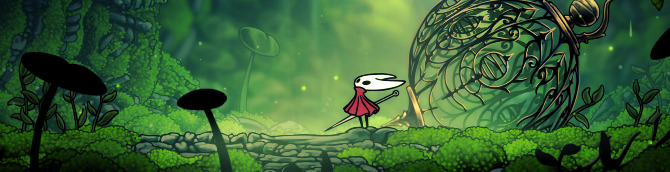
Aesthetically, it’s once again like its predecessor: a beautifully-crafted game both in terms of its visuals and art style. The blend of simply drawn characters, highly detailed multi-layered environments, and masterful lightning & VFX combine splendidly to bring the world of bugs to life like few other 2D games. And the visuals aren’t all, as the music and audio deliver just as strongly, and deliver an atmosphere that can range from relaxed and serene to brutally intense.
All the aforementioned elements so far add together to form an incredibly strong core Metroidvania experience, probably even more so than the first game, since Silksong does deliver a bit more variety in its environments early on, which adds to the enjoyment of exploration. Traversing and exploring the first many areas, interlaced with the occasional encounter of new characters, side quests, or a boss fight to master is simply a joy and proves Team Cherry has the talent for putting together a damn fine Metroidvania.

Frankly, I wish that the review was finished at this point, and that there were only praises to be sung for Silksong, and many hours in it almost felt like that would be the case, since the exploration and combat were so enjoyable that any tiny flaws I encountered were easy to forgive. Unfortunately there came a point when the scales tipped, and they tipped hard. The problem with many Souls-inspired titles has always been not in their difficulty, but their insistence on kicking the player when they’re down, and though that wasn’t my experience at first with Silksong, it actually has a built-in mechanic beyond the usual resource dropping that serves exactly this role.
As mentioned earlier, Hornet has various tools at her disposal beyond her regular moveset that are limited in use, and the problem is how those tools are limited. The game has two main resources: rosaries and shards, and you'll only drop the former on death, which seems like a blessing. However, shards are instead consumed upon death (or resting on a bench) to refill any tools you've used. So, what’s the problem? The problem is that even with a full pouch of shards, one death can take away a tenth or even a fifth of your total shards if you’ve used up all your tools, and they aren't regained nearly as quickly. In other words, Silksong has taken a page out of Bloodborne’s book and introduced a mechanic that means if you die ten times to a challenging boss, you're not only back where you started - you’re worse off.
The combination of this mechanic with a game that has successive tries at challenging fights as such a core part of its game loop is an unfortunate one; I strongly believe that Silksong would have been better off without it. If, perhaps, bosses had dropped some shards when stunned (at least the ones where that seems plausible), and occasional enemy gauntlets weren’t completely exempt from dropping resources, that would have done much to alleviate this issue. As it stands, all of the difficult encounters are pure resource spenders, with no rewards during or after, so if you find the difficult encounters difficult you might very well be forced to stop fighting them to go grind those shiny rocks or buy tiny bundles of them with your hard-earned rosaries that will last you two or three attempts at best. Admittedly the tools are an optional advantage that are rarely strictly necessary to beat a fight (I rarely used them at all for the first half of the game), but it’s still a limitation that not only puts a struggling player at a disadvantage, but also adds to the frustration of dying and forces players to get stingy with their tools both inside and outside of boss fights.

Unfortunately, while the tools issue is the most universal problem for later parts of the game, it can’t be said to be the only one. After all, the tools mechanic remains the same throughout the entire game. What provokes it to become an issue towards the end is that the difficulty curve, which had been more even than its predecessor, suddenly gets hit by an earthquake. I know that in this post-Souls world it’s damn near blasphemy for a reviewer to criticise a game for its difficulty, but at the risk of being told to “git gud” I have to do exactly that, not for the number of deaths itself but for the things that cause them and the impact this has on the overall experience.
In the world of games, challenge can be its own reward, but only when that challenge feels fair. That tricky line, which Team Cherry walked beautifully during the first half or more, unfortunately starts getting shaky in the later parts. Not only is the enemy density of difficult sections increased, giving you little breathing room to enjoy the journey, but a few areas end up feeling infuriating just for the sake of it. Like traversing a bullet hell of awkwardly-placed enemies and traps, or boss fights where you have to dodge around for 10 seconds between each hit you can safely land, which really only tests your patience. And as much as I can understand the satisfaction that comes from overcoming an annoying boss or section, when the game insists on punishing deaths and placing such sections back to back, it presents a two-fold issue: not only the frustration it can cause, but even more so the pacing that it hurts, thereby taking away focus from exploration, Metroidvania elements, and even the game’s story.
If I should summarize my issue in brief, it’s that the first part of the game is an excellent Metroidvania and a good Soulslike, while the second half (or maybe last third, as it’s a bit of a gradual transition) is only the latter. While this isn’t strictly unique to the second game, it’s made all the more frustrating by how brightly the Metroidvania part shines early on. This is certainly not to say that there aren’t redeeming qualities in the second half, but the fact that I even have to make that disclaimer shows how much these elements tax on what should simply have been an epic conclusion.

If the first half of Silksong was sold separately, I would call it the best Metroidvania since Metroid Dread. If the second half was sold separately, I would call it shock therapy. Put together, Silksong is essentially the exact sequel you’d expect, for better or worse - epic, brutal, fun, and infuriating. A massively impressive game to be sure but, held back by a few design choices, it falls a tad short of the potential you see so clearly in its early stages.
VGChartz Verdict


7.5
Good
This review is based on a digital copy of Hollow Knight: Silksong for the PC
More Articles
This one was a weird one for me. First off I liked the game just not as much as the first one. Exploring felt more rewarding in the original and this game felt like a mix of more of the same but with a first half that felt like it padded out the playtime with tanky monsters and low player hp.
But as for a review of this game it comes down to this
If you loved the OG you picked this up day 1 so why are you bothering reading any reviews.
If you liked the OG and haven't picked this one up yet then just wait for a 50-60% steam sale in 6-12 months and you will be much more satisfied with this game and its minor flaws and it won't matter if you think the OG is better or this one is better.
If you like games like this but didn't pick up the OG just get that one it is a better game

sighs GIT GUUUD!!
I am, of course, kidding. All of the more pessimistic reviews I see of Silksong read a bit like this. And I get it. I'm something of a veteran of this genre and Silksong is the toughest entry therein I've ever played! Let's not pretend otherwise. And I mean if that fact makes it too frustrating for you to enjoy large chunks of, that's totally fair! The game seriously could do with a story mode or some kind of accommodation for those who don't just eat up extraordinary levels of difficulty. I'm kinda hoping one gets added at some point as DLC just because it would make the whole experience enjoyable to so many more people.
All that said though, you state at one point in your review that "a few areas end up feeling infuriating just for the sake of it". It's absolutely intentional! It's clearly a deliberate design choice, not an accident. You are meant to be frustrated. They were trying to bug you. The rule that I've found though is that it's generally meant to pressure you to do more exploring of the world the devs have created for you to experience, not just progress more or less along a straightforward trajectory toward the end of the game like most people do with these types of games. There's meant to be lots of zig-zagging. That's the effect it had on me and I came to actually appreciate the push sometimes. I can see your point about that taking something away from the pacing that one might be hoping for though. Nothing is perfect.
Anyway, this was a well-written review. Just wanted to acknowledge that. Y'know, I actually predicted that this would be the exact score the game would get here on VGC. I almost wrote a post a couple days ago to the effect of "Where's the official VGC 7.5 review for Silksong? I'm anxious to dispute it!" :P Do I know this place or do I know this place?

While I definitely agree that it applies here "It's intentional" has always been a weird argument in my book because it implies "surely there can be no fault with a design choice as long as it was done on purpose" :P I enjoy difficult games too, but it comes down to what the challenge is as much as the level of challenge. I don't mind spending hundreds of tries on B-sides in Celeste because the time per try is short, you lose nothing in the process, and most importantly it feels fair (to be clear it's not that there are many sections that feel "unfair" in Silksong but there are a few that feel more painful than they are satisfying). Of course in the end it is subjective and there's no doubt big fans of the first game have gotten what they wanted with this one, I enjoyed it too despite my complaints, just wish I could have enjoyed the second half as much as the first.
Oh of course it's perfectly valid to just not enjoy an intentional design choice, you'd just made it sound like an accident in my reading. But yeah, after experiencing Bilewater, I totally get the kind of pain you're talking about, omg! And honestly I'm with you in liking Celeste a bit better myself, but of course that game belongs to a somewhat different genre that's not meant to heavily emphasize exploration the way Metroidvanias are meant to. See what I'm getting at here? That's why sometimes I wound up actually appreciating the push to do more of that than I might have otherwise. Anyway, I'm just sharing how I felt about it, not trying to invalidate your experience.
To close this out though, I think I'd like to echo Vodacixi's question about whether you got the chance to experience the game's...
SPOILER ALERT!
...hidden third act, given that you mentally divide it into halves rather than thirds? I was just curious because getting the chance to experience what most will consider the canonical ending may well affect their overall evaluation of the game.
To your spoiler: Yes, as mentioned below.
To close off I'm not sure I agree with your logic that that frustrating areas pushes you to do more exploration, it's true that Dark Souls style games encourage zigzagging, but that's a natural part of Metroidvanias to begin with. I can still appreciate that feeling of "I'll come back when I'm stronger", but I don't think it encouraged me to do anything I wouldn't have otherwise and honestly some of the most frustrating areas are the ones you find through exploration, which is why I think it took away from that fun instead of adding to it. But again to each their own, I think the game had great exploration for most of its runtime.



As with any review, some will find a game glorious and some will not since a review is always subjective. After playing this game a lot, one thing for sure is that the devs poured a lot of love into it. Some will appreciate that love and some will not but at least the devs were able to execute their design and dream of this game like they wanted which I will always respect.
My favorite critique of Silksong is that it's too good; that it offers the player so much value that it's unfair to the competition. That it was the devs' civic duty to charge more than they needed to for it. That argument always makes me laugh. To me it just says it all. Everything that is wrong with this industry is concentrated in that argument. Three people used funds provided by fans they earned from the success of their first game to build exactly the sequel they wanted to make for fun on their own terms, without crunch scheduling, other exploitation, or censorship, and sold it at a sacrificial price because they could afford to. That's exactly how it should be! Just my opinion.

I agree with this review, one of the few objective ones available online. Be wary of day-one reviews that give it a 10/10; they're actually very suspect.
The title's major problem is the extremely high level of frustration, boredom, and repetition, which undermines its playability, limits the joy of exploration (essential in this genre), and, unless you're a gamer who enjoys these things, makes it unplayable. So it's a game for very, very few people.
Furthermore, as you can easily discover online, the game has only had two playtesters and zero external feedback... does that seem normal for a title of this size and complexity? Not to me.
In the past, when paper magazines reigned supreme—in times that were less suspicious, let's say, when there was less money around and reviewers were often "free" to write—these things were punished in reviews, perhaps with a low average score, but with the caveat that a fan of the genre could add 1 or 2 more points to their rating.
It's a shame because I consider myself a fan of the genre, and obviously I loved Hollow Knight. What can I say? Let's try to remain critical and put the hype aside, for the good of video games in general.

Did you unlock Act 3 at all? I'm asking because you talk about the "first half" and "the second half" when the game follows a three act course.
I did, the halfway point I'm talking about is a good chunk into Act 2. (But I didn't mention it because I got it spoiled myself)

My playstyle is tool-light, so thankfully my shard pouch is typically chock full and I only ever had to grind for them once. Mainly, I just use the spike traps for bosses and annoying flying enemies.
The difficulty definitely spikes in the second half, but the thing that bothered me most in the difficult areas was the lack of benches. I felt zero shame looking up how to fix the broken bench in Sinner's Road or the hidden bench in Bilewater. A tough section of the game is fine, but forcing me to endure it over and over to reach a boss or other obstacles without a decent checkpoint is just sadistic.

Interesting. I felt like most of my issues with the game were in the first half.
Very well written and structured review.
I am very perplexed by the way the difficulty of Silksong has been received. I see a lot of people that are veterans of the first or generally good at this kind of game struggle with the second entry in the Hollow Knight series. My own experience was very different as I felt that the sequel was easier than its predecessor.
I found the game challenging, but not overly difficult or too punishing. I never once lost my beads after dying (always managed to recover them), I found the platforming sections fun and not too taxing and beat most bosses after 2-5 tries (expect the true ending boss which took be about half an hour of tries and was the only one that "cheated" by reading my inputs)
I almost didn't use any tools, so I was always full of shards and thought that the game should be a bit harder, as I never felt the need to use some of its mechanics. I never looked up anything and went in completely blind.
In general, I found the difficulty just perfect for me and I am puzzled to see people struggle so much and end up enjoying the game less because of its difficulty.
Does this game now have the option to turn off the stupid and annoying flashy light and screen shake gimmick? The 1st one didn't have those option

IIRC you can turn off screen shake. Not sure about flashy lights
Thank you. Back then I requested team cherry to patch in that option for the 1st game but nothing, good thing they finally give that option. Couldn't play the 1st one as it was so unbearable and headache inducing.