

Atari 50: The Anniversary Celebration (NS) - Review
by Evan Norris , posted on 17 November 2022 / 6,910 Views
Back in 2015, Digital Eclipse's first Head of Restoration, Frank Cifaldi, participated in an interview with Vice. While talking about the recent release of Mega Man Legacy Collection, he noted that his dream was for the company to be for video games what The Criterion Collection was for movies: "I wanted to reinvent [the treatment of classic games], by focusing on what I consider the proper restoration and premium packaging, as if we were treating these old games as the art form that I believe they are." Seven years later, Digital Eclipse has officially lived up to Cifaldi's ambitious goal with the release of its magnum opus, Atari 50: The Anniversary Celebration.
Let's start with the numbers, which are staggering. Atari 50 includes a curated list of over 80 video games from the following platforms: arcade, Atari 2600, Atari 5200, Atari 7800, Atari 800, Atari Jaguar, and Atari Lynx. That number balloons above 100 when you factor in unlockable titles and variants. Included in that list are stone-cold classics like Asteroids and Yar's Revenge; interesting curiosities like Fire Truck and Quantum; expensive, hard-to-find titles like Atari Karts and Quadrun; rare prototypes for unreleased games like Saboteur; and even brand-new experiences designed by Digital Eclipse itself as love letters to the halcyon days of Atari.
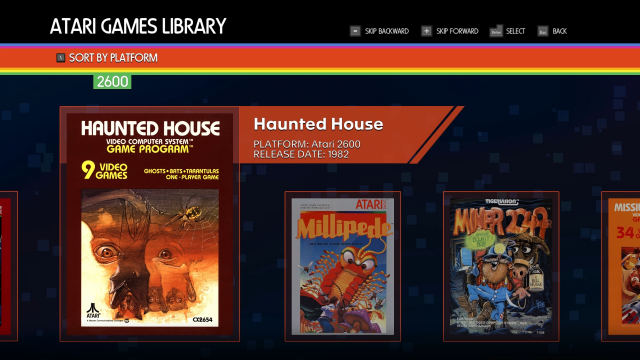
As expected from the port masters at Digital Eclipse, all of these titles are expertly emulated — a monumental feat in itself, considering the diversity of software and hardware involved. Heck, the studio even digitally reproduced Atari's handheld title Touch Me from 1979. Apart from reliable emulation, each game has several quality-of-life adjustments and special features. From the game options screen you can view the manual (or flyer, for arcade titles), remap the controls, and change the screen size, filter, and border. Some games get specific options, for example adjustable glow in Asteroids. The filter and border options are rather meager, but overall the customization options hit the mark.
Perhaps the best QoL feature comes with the early Atari 2600 releases, like Combat and Air-Sea Battle, which launched in 1977 with 27 game modes each. While you still have the option to cycle through the game modes manually like they did during the Carter administration, you can now save time and select the game variation directly from the thumbnail. Finally, you can create and load a single save state for each game, arcade titles excluded.
If there's a downside to this collection of games, it's the reality that many of them are simply not good enough to play more than once. A good chunk of the titles within Atari 50 are worth checking out a single time for their cultural significance or novelty, and then never again. The Jaguar and Lynx titles fare especially poorly.
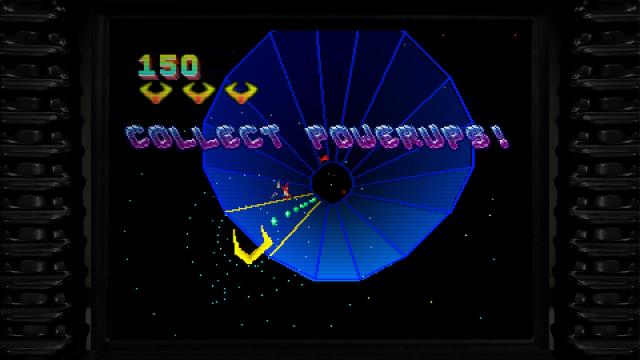
That said, there are more than a few that you'll likely boot up again and again. Arcade hits like Asteroids, Centipede, and Missile Command remain addictive to this day. Local multiplayer titles like Warlords, Combat, and even Pong would make fine additions to game night. The Gauntlet-esque Dark Chambers and twin-stick shooter Black Widow are a couple of hidden gems. Star Raiders, the Atari 800 "killer app", is represented here in its 5200 version, and it's a blast. Last but certainly not least, there's Tempest 2000, the best Jaguar game ever made and arguably the best individual entry in the collection.
The lineup of games would look even better were it not for some notable omissions. The absence of the Jaguar game Alien vs Predator hurts, as does the exclusion of all the Activision titles that elevated the Atari 2600 catalog in the early 80s. Games like River Raid, Ice Hockey, Dragster, and Pitfall! would round out the collection and help tell the story of Atari's success in the home console space.
Although, to be fair, Digital Eclipse doesn't need any help when it comes to telling the story of Atari's success (and eventual downfall). In fact, the storytelling in this collection is probably the best of any video game compilation ever made. Cifaldi wanted the video game equivalent of The Criterion Collection, and he got it. As a digital museum exhibit and preservation effort, Atari 50 is peerless. Indeed, it's as much a journey through 50 years of Atari game development and corporate decision-making as it is an anthology of classic video games.
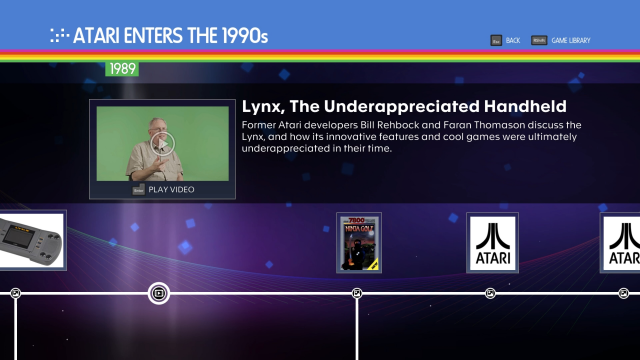
To help explain that journey, Digital Eclipse assembled archival images, product design documents, documentary footage, commercials, and over 60 minutes of exclusive interviews with early Atari engineers and other giants in the industry — including Cliff Bleszinski and Tim Schafer — and laid them out along an interactive timeline from 1972 to 2022. From this timeline you can read internal memos from the Atari offices in the 1980s, listen to Howard Scott Warshaw explain how he came up with the name for Yar's Revenge, or jump immediately into Breakout or Tempest, or any of the dozens of games listed alongside their respective release years. This is the true heart of Atari 50, and the feature that elevates the collection above its contemporaries.
Atari 50 is elevated further by its obscene value proposition. With over 100 games, plus plenty of interviews, documents, images, and artwork to pour over, there is more than enough to see and do. Furthermore, many of the games on offer are ridiculously expensive on the second-hand market. For $40 via Atari 50, you can get rarities like Atari Karts, Quadrun, and Swordquest: WaterWorld at your fingertips, where it would cost you roughly $600 on eBay for the lot.
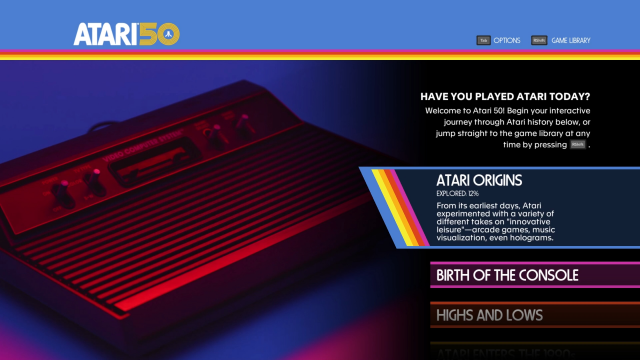
Finally, Atari 50 benefits from striking and clean presentation. From the handsome landing screen, you can easily navigate to each of the color-coded "eras" of Atari: Arcade Origins, Birth of the Console, Highs and Lows, etc. Each timeline is laid out neatly with thick white lines and icons that light up when you first view their respective entry. The game library is equally sharp and comprehensible — neither cluttered nor empty. It just feels like a premium product.
It will be difficult for Digital Eclipse to top Atari 50: The Anniversary Celebration. The studio has gone above and beyond not only in bringing together dozens of landmark Atari titles across seven platforms and three decades, but in assembling the materials required to contextualize and celebrate them. This is an extraordinary effort to preserve and cherish Atari's legacy and the history of early electronic game development in general. Despite some clunkers and a few omissions, this collection is required playing for any serious student of video games, or anyone ever moved by the magic of Atari.
This review is based on a digital copy of Atari 50: The Anniversary Celebration for the NS, provided by the publisher.
More Articles

I'm so looking forward to playing this. Grew up with the 2600 and all other iterations of Atari thereafter. Jaguar could have been something really special but they made it tough to develop for. I'm glad they included some of the more rarer titles in this collection.
I grew up playing Intellivision, then C64, then Amiga, so my Atari nostalgia starts and stops with the Lynx and Jaguar. If they'd had more games for those systems (and especially if it had included the Jag CD rarities, "HoverStrike: Unconquered Lands" or "Iron Solider 2") it would have been a Day 1 buy for me! As it stands, I'll wait for it to go on sale and/or be added to GamePass.
I do have a titch of curiosity about the Atari 7800, as (along with the Sega Master System) I rooted for it from afar since it was an underdog against the mighty NES. But not enough to actually buy one since my Commodore 64 played games of similar fidelity (but with the option of more complexity thanks to its keyboard).
I went right from the C64, to the CDTV as my first Amiga! I added a keyboard, mouse, floppy drive, and HDD, so I was one of the few people to have a CD-equipped Amiga when I got it. :) That Amiga lasted me many years, until I finally broke down and got a PC.
I did get a CD32, but never did get it properly equipped to also be a computer. While the CD32 was never released in the U.S., it was released in Canada where I live, so I was able to get one of the ultra-rare NTSC CD32 units! Canada was the only NTSC territory to get the CD32.
I miss those times. :)
As an aside, I'm also a big Babylon 5 fan!

this is a perfect opportunity for the younger generations to try out video game history!

This was a great collection. In addition to playing the 2600 at friends' houses, I had an Atari 130XE 8-bit computer, and the Atari 8-bit line was the second best gaming platform of the 80s after the NES. I'm glad they included Miner 2049er on it. It's also great seeing Solaris on here, since it usually doesn't get released in Atari collections due to Doug Neubauer personally holding the rights to his creation.
One third-party omission that I felt helped define the 2600 was Berzerk, which was licensed for the 2600 from Stern Electronics. Other than the lack of digitized voice effects, it was probably as "arcade close" as the 2600 could possibly manage. I wonder who owns the IP now, or if it is simply abandonware.

How Neubauer got Solaris looking that great on Atari 2600 I will never know. It's sorcery :-D
I didn't have a 2600. My friend down the road did. He got this game, along with late ports like Vanguard, in the last few months before he got a NES for Christmas and we moved onto the exquisite joys of Zelda, Metroid, and Kid Icarus. Solaris was probably the best console game I'd seen up to that point. I've never been able to beat it because it's brutally difficult. Seriously, fuck those "cobra" ships. Hopefully save states will help me finally conquer it after 35 years. I've actually streamed one of my failed attempts at it on Twitch. It's got a level of content that rivals a few NES games.
Curious, what made the Atari 8-bits a better gaming platform in the '80s over the Commodore 64? The C64 was generally as (or less) expensive but with a bit better fidelity, no? And had a vaster library of games, too.
No shade against the Atari 8-bits, they were a good platform too, don't get me wrong.

Great article! Very well written and deeply researched. I'm not a big fan of atsri games even though I owned a 2600 and a jaguar, but reading this was really interesting.. Thanks :)
This sounds like a real passion project. The timeline feature in particular is a really cool idea that should become standard for meaty collections like this.
i ordered yesterday from best buy :)
I hope you enjoy it!
Ooh might pick this up if it goes on sale. Would be cool to have some of these classic games.

There's still no game out there which includes the 2600 version of Space Invaders. Why?
Because the Space Invaders IP is owned by Taito and its parent company, Square Enix. Most of the games attributed to Atari in the 80s were licensed from Japanese companies like Taito, Namco, and Sunsoft. Asteroids, Centipede, and Millipede were home-grown Atari franchises. The Atari version was very different from the arcade version, and Taito carefully curates the Space Invaders IP. They're likely not interested in revisiting an Americanized re-interpretation of one of Japan's most iconic series.