

Securing JRPG Exclusives for the Xbox 360, Was it a Good Strategy or Not? - Article
by Jonas De Jaeger , posted on 12 April 2015 / 9,280 Views
It is a well-known fact that Microsoft secured some exclusive and timed exclusive games for its Xbox 360 platform. One genre Microsoft was particularly interested in at the time was the Japanese Role Playing Game (JRPG). Microsoft secured exclusivity for a number of these games in an effort to boost Xbox 360 sales, especially in Japan. The question we're going to explore in this article is this: Was Microsoft's strategy a smart move?
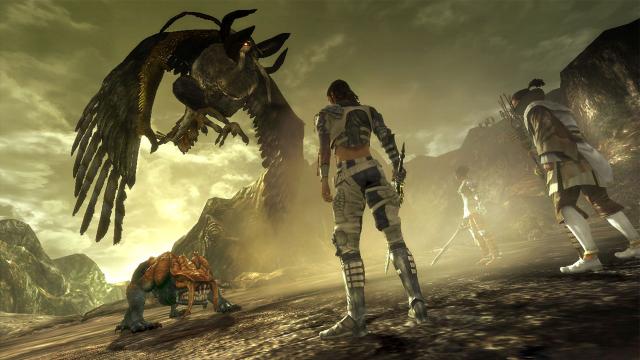
What better way to begin to answer this question than to compare the amount of exclusive JRPGs (permanent or timed) that were released with the amount of Xbox 360 consoles sold each year? Below we've used data from all exclusive RPGs released in Japan by Japanese developers that sold a minimum of 10,000 units (using rounded figures) on the Xbox 360, according to the VGChartz database.
Using this criteria, we find that 18 exclusive JRPGs were released in Japan on the Xbox 360. To begin to see if they had an impact on sales it's necessary to calculate the linear correlation between the amount of exclusive JRPGs released in Japan and the number of Xbox 360 consoles sold. For those of you not familiar with the concept of correlation, it demonstrates how strongly two types of data are linked together (in this case - the number of exclusive JRPGs released and the amount of Xbox 360 consoles sold). The closer the correlation is to 1, the stronger the effect.
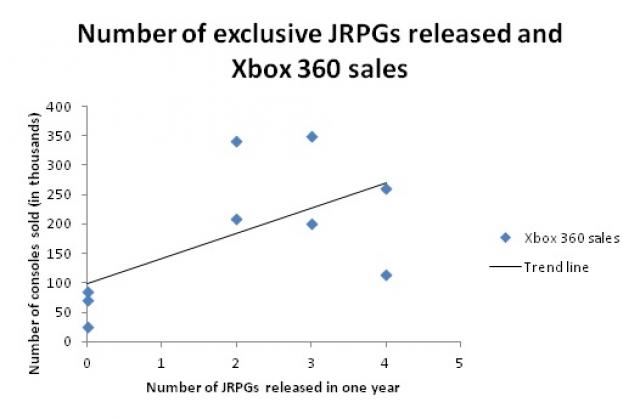
When we calculate the correlation, the result is 0.60. Not a very strong correlation, as you can see in the scatter plot above. Every point you see on this scatter plot is the amount of Xbox 360 consoles that were sold in Japan in a single year. The line you see is the trend line. A trend line does exactly what you think it does - it presents a trend. In a unique situation where the correlation matches 1 exactly, all the points of data would lie on the trend line. Here, they don't - the trend is weak.
Of course, not all games released on a system are equally popular. Some simply sell more than others. Naturally, more popular games will have a larger effect on hardware sales. But what is a popular game? For the purposes of this article we'll use the (rounded) threshold of 50,000 units sold. Coincidence or not, when we filter out all of the JRPGs that are under the 50,000 threshold, only 9 exclusive games remain. No multiplatform JRPGs have sold more than this amount.
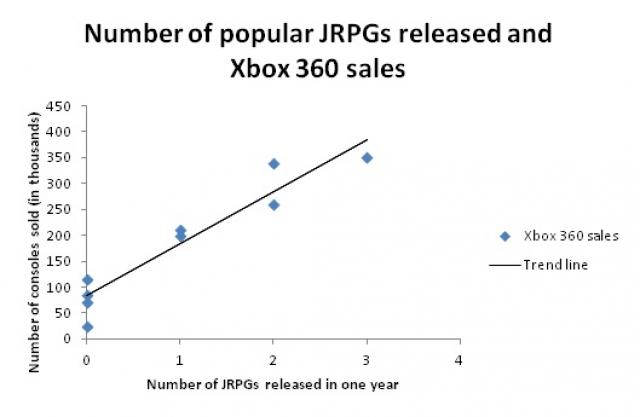
If we calculate the correlation now, the result is astonishing: 0.95. This means that there is a very strong positive linear correlation. It clearly shows that high sales of the Xbox 360 were linked to the amount of popular exclusive JRPGs released on the system. As you can see in the graph above, all points of data now lie very close to the trend line.
However, you might be asking yourself, isn't it obvious that hardware sales are linked to popular games? People need a console to be able to play its popular exclusive titles. So now we'll calculate the correlation between Xbox 360 sales in Japan and all popular exclusive games released on the platform, and compare this to the correlation of JRPGs. 35 exclusive games meet this new criteria.
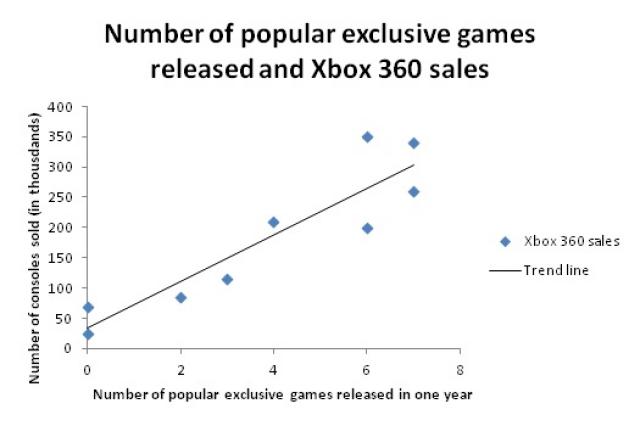
The result? A correlation of 0.91. As expected, there is a strong correlation between the amount of popular exclusives released on the system and the number of consoles sold. And yet the connection between Xbox 360 sales and the amount of popular JRPGs released is slightly higher.
We can't tell if the amount of popular exclusive games released is the cause of high Xbox 360 sales, we can only prove that there is a very strong connection between the two. Obviously, the amount of popular games released in a given year wasn't the only reason for platform sales - there were plenty of other factors, such as price drops and advertising campaigns.
But we can now try to answer the question I asked at the start of this article: Was Microsoft's strategy a smart one? 1.6 million Xbox 360 consoles have been sold in Japan up to this date, compared to 530,000 Xbox consoles, which in itself is a significant difference, and our calculations do show that these sales are linked strongly to the amount of JRPGs released.
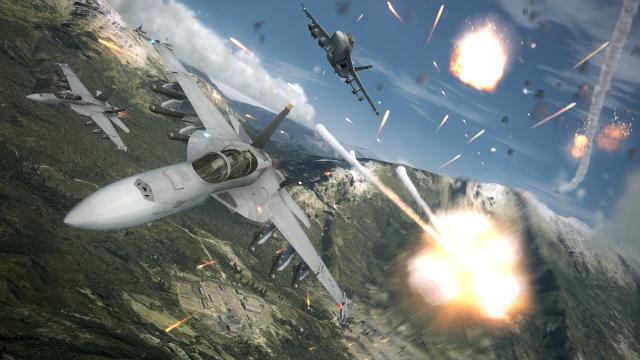
Microsoft did not only secure JRPGs - the most sold game on the Xbox 360 in Japan was Ace Combat 6: Fires of Liberation, which is obviously not a JRPG. The correlation between popular JPRG releases and the Xbox 360 sales is, however, higher than average, meaning that securing exclusive JRPG titles is definitely worth doing in future if your primary goal is to boost console sales.
Was paying for exclusivity worth it financially? That's something only Microsoft can answer. We cannot know if the profits from extra hardware and software sales outweighed the cost of securing exclusivity, but what our calculations do show is that Microsoft's last generation platform clearly benefited from exclusive JRPGs. If Microsoft is no longer willing to pay third parties to secure exclusivity, they should consider developing a strong JRPG franchise of their own.
More Articles

Microsoft's securing of JRPGs was less about winning Japan and more about cock-blocking Sony.

Definitely this, and it didn't do MS any favors anyways. It only hurt Japanese developers and of course gamers. I hope they stop this strategy completely. Hopefully Japanese developers have learned from this.
Most of the games for 360 had to be re-released on PS3 when their exclusivity contracts expired to have a chance at being profitable. Tales of Vesperia was one of those games, and I think Namco has vowed never to repeat that mistake again.

I'm not so sure about that. Why would Microsoft pay all that money just to hurt Sony? There's a third competitor as well. I'm convinced their primary goal was to boost the sales of the Xbox 360.
Making sure those JRPGs did not release on the PS3 (immediately) was a nice externality for Microsoft AND Nintendo. You could even argue that the Wii benefited the most from a lack of competition.
Simple: through denial of content to the competition, which is part of the point of moneyhatting exclusives anyway. Given how bad the Xbox did in Japan and how slow the 360 was selling, Microsoft can't have been kidding themselves that the 360 would succeed there in any form or that millions of Westerners would buy games like Tales of Vesperia on 360.

Good article

Maybe it was beneficial at first, but it created a huge amount of badwill and costumer defiance towards the Xbox brand (not to mention the anger to discover it was just lies and temporary deals)... which backfired at Xbone as we can see every Wednesday. You can't buy people's heart.

I bought the console because of it.

The real question is if its worth it to Japanese publishers to make exclusive Xbox games. Many of these exclusives last gen ended up timed and released on PS3 later on to make up the profit. Even if Microsoft were to try the same strategy this gen I'd doubt it would work as efficiently as it did with 360


I think it was a good strategy that they abandoned after the first 3 or 4 years of it's life cycle. It helped MS sell 2 million console there, Xbox One will be lucky to sell 150k lifetime in Japan.
It's what put 360 on top early last generation. Then once they had us in, they stopped caring and it became a Halo and Gears of War box. They've continued this on Xbone, just a completely worthless system.
Killer Instinct, Dead Rising, Forza 5/Horizon, Halo MCC, Titanfall, Sunset Overdirve, Project Spark.....seems like a healthy variety of genres covered.

What MS has to do is having a japanese AAA studio only dedicated to Japanese gamers, sales would be a lot higher if they would have 1 studio doing games for them and the rest of the world over a long period of time.

I remember someone from Japan mention that even though the 360 started strong, what killex its momentum and doomed the Xbox One was incredibly high hardware failure rate associated with the original Xbox 360 models.
What I am insinuating is that looking for a correlation between JRPG releases and hardware sales spikes is to be really oblivious to why sales were stagnant in the first place.

I only bought the system because of the JRPGs so there is your answer

Basically the same here + Original Gears of War.

@Jonas
In case you want to improve your writing a bit.
Criterion = singular
Criteria = plural
Best of luck!

It was a good move. I didn't know that they had that many (18). The only ones I'm aware of that where exclusive and timed exclusive are Lost Odyssey, Blue Dragon, The Last Remnant, Infinite Undiscovery, Magna Carta 2, Tales of Vesperia, Star Ocean 4 and Eternal Sonata.
not sure if MS should put more $$ in EXCLUSIVE in JAPAN..... JAPAN user are more SONY!! so no matter what SONY will always dominate JAPAN with the sale....
not really, it didnt really do much in the long run. Its not like they think better of the brand in Japan considering the current ONE numbers. As for the increase in sales from xbox to 360, it increased in sales WW

Wait... there were JRPGs for the 360? This is a joke, right?
This may be fanboyish, but I really wish there were less Americans enamored with derivative FPS, multi-player games where they can tea bag their friends all day long. The market could stand to lose some extra baggage :P
35 data points for all exclusives vs 9 data points for JRPG exclusives means there may be quite a low confidence level in the 0.95 being accurate for JRPG correlation. Or there may be no evidence that 0.95 is statistically significantly different to 0.91, i.e. it may be that any exclusive content is as good at driving sales as JRPG exclusive content. IMO the strategically significant move is securing exclusive content that is appealing to Japanese gamers, which is more than just JRPGs, but it does include JRPGs. I'd be interested to find out the correlation for exclusives of all genres that were developed by Japanese studios.
Interesting article, I hope we see more of these analytical articles given that's VGChartz's unique value proposition.

If Microsoft was still interested on this kind of business, they should try and secure exclusive JRPGs for Windows Phone or something like that, home consoles on average are going down in sales over at Japan, not worth paying for XB1 exclusives.

It was a solid strategy. MS needed to finish it though. They didn't finish the exclusivity deal with Mistwalker after Lost Odyssey failed to sell a million units. Its a shame too because Sakaguchi saw something along the lines of another Final Fantasy with it.
Because MS backed out we never got Cry On and Lost Odyssey 2 is probably not going to happen.

I fell stalked - for some reason.
Dunno what you're talking about. I was here before you.
As an avid Xbox fan - the JRPG is my least favorite type of game. I'd never own or play one.

short term: debatable, long term: no

I think trying to appeal to Japan made sense early in the life of the 360. It obviously helped MS gain support from Japanese developers as well. I imagine it was a worthwhile endeavor in the long run, but not worth continuing.
It gave its userbase variety....and only a PS3 owner can say that is bad. Loved Lost Odessey.

Of course it wasn't a good strategy. It did absolutely nothing for Xbox in Japan. Wasted money even trying.
1.5 million is still pretty bad, but the article points out that this number is a vast improvement over the Xbox numbers, JRPGs had a strong role in that increase.