



Look at Those Legs Game of the Day - Viva Piñata - News
by VGChartz Staff , posted on 09 November 2009 / 3,709 Views
Look at Those Legs Game of the Day
Viva Piñata
| Column1 | # of Copies Sold | % of Total Sales |
| First Week Sales | 0.04 | 2.53 |
| First Month Sales | 0.15 | 9.80 |
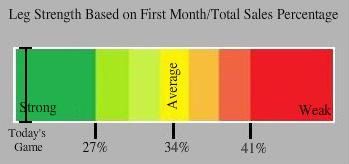
Description: Viva Piñata released in 2006, and despite a modest debut, the game went on to sale a very impressive 1.50 million copies worldwide. Viva Piñata is a bit of a departure from Microsoft's typical mature themed exclusives, featuring vibrant colors and seeking to appeal to people of all ages including younger gamers. Releasing a game for an audience outside of the Xbox 360's main demographic may have been risky, but because of the game's continued strong sales it was a risk that paid off. So why was Viva Piñata able to maintain strong weekly sales for an extended period of time? Read on to find out what we decided.
Very few games have a first month/total sales percentage less than 10%, so here is a graph of Viva Piñata’s worldwide total sales by week so you can see how the game’s strong legs developed.
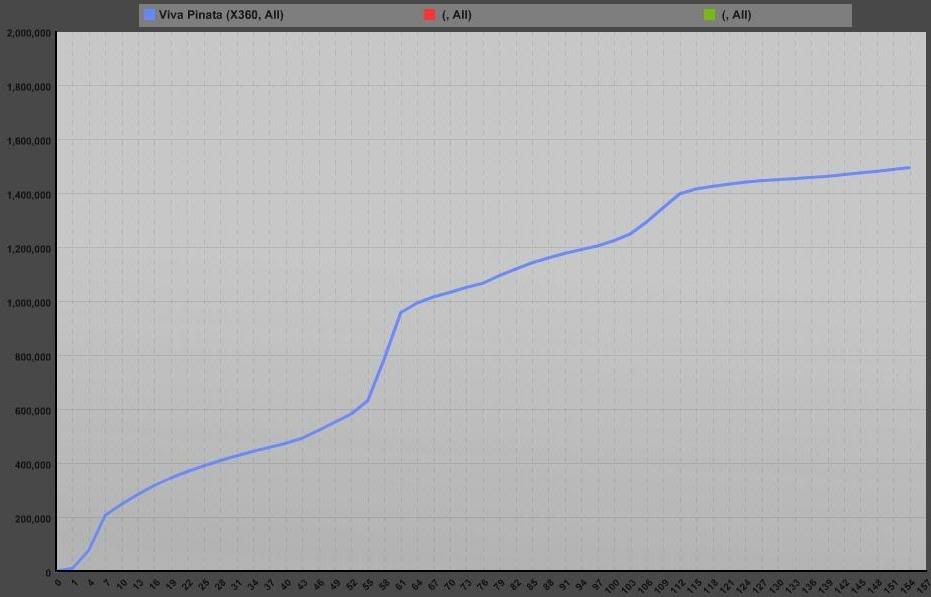
As you can see from that graph, while the game did consistently add to its total, there are also a couple of places where the game experienced unusually large boosts. To try to explain the sales better, let’s look at the sales of the game by region. I won’t be talking about how the game performed in Japan, because the total sales stand at around 20,000, which is not significant to the 1.5 million worldwide total.
In the Americas Viva Piñata had a disappointing opening week of ~10,000, but has since gone on to sell a very respectable ~380,000 copies in the region.
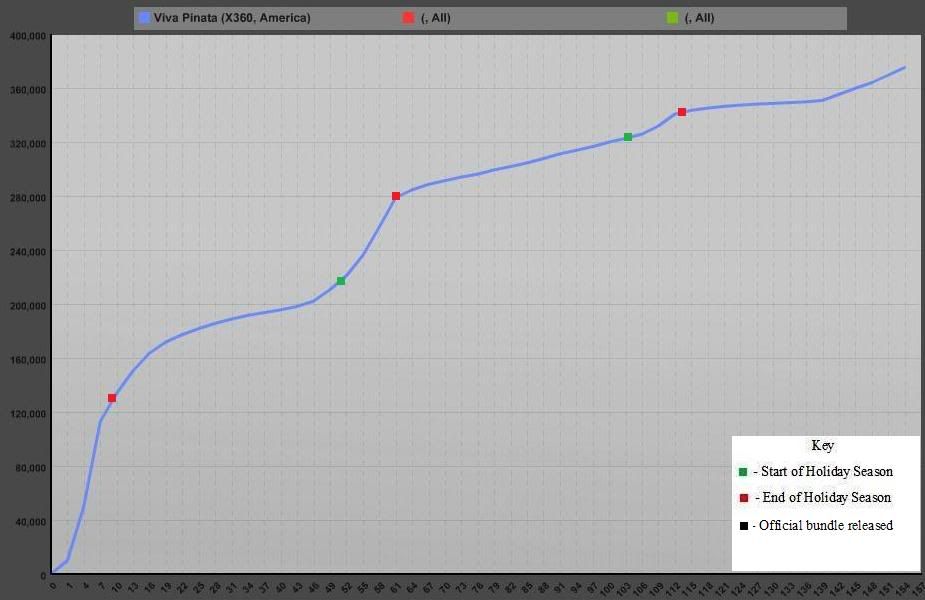
The game’s first week was low, but it was released during the holiday period, and continued to see strong sales until the holiday period ended. After the holiday period was over, the weekly sales of the game obviously dipped down, but it was still selling a few thousand each week. The game had a very strong second holiday period, but afterwards weekly sales died down drastically until relatively recently, around week 140 when they began to pick up again. Unlike in Europe, Viva Piñata was not a part of the Xbox 360 holiday 2007 bundle, but the game still enjoyed strong holiday sales typical with well received games that appeal to people of all ages.
Europe is Viva Piñata’s most successful region by far, selling 1.1 million of the games 1.5 million total.
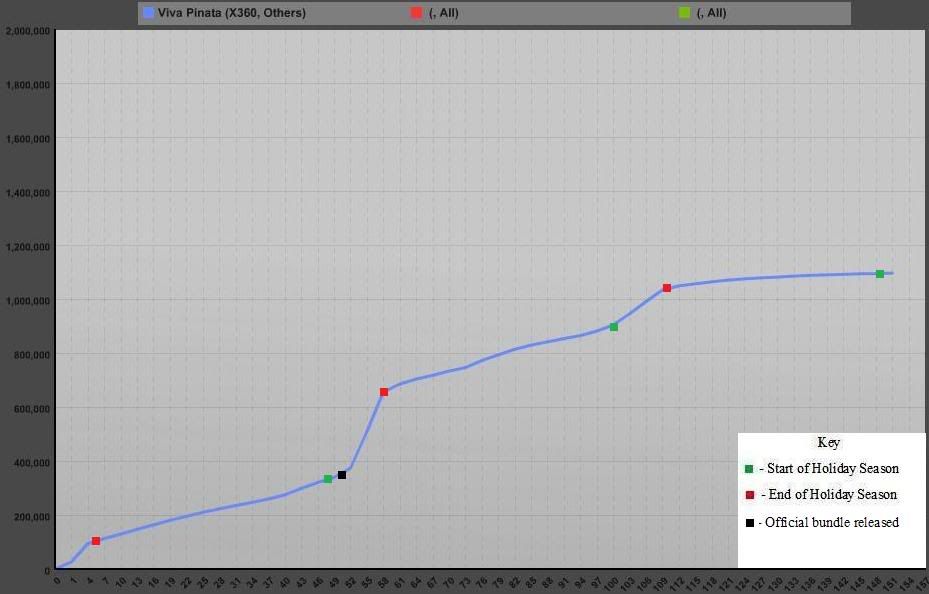
In Europe, the game was selling slightly better than in the Americas, until the game was made part of the Xbox 360’s 2007 holiday bundle along with Forza 2. Sales for the game increased dramatically during its second holiday period due to the bundle, and continued to sell relatively well until the start of the 3rd holiday (holiday 2008). In the last year the weekly sales of the game have severely died off, as new games replaced it in Xbox 360 bundles.
The fact that the vast majority of the game’s sales came from the Europe/Other’s region, and that most of those sales were due to being included in a system bundle, means that the legs of the game are based less on the merits of the game and more about being pushed by Microsoft.
Still the game had shown signs of sustained sales after its weak launch and before it was bundled. Those sales I believe can be mainly attributed to positive word of mouth. Viva Piñata is a very original game and as previously mentioned differs from the games typically released on the system. Once some people were willing to give the game a shot they spread the word about the quality of the title. However; the fact that the game’s direct sequel Viva Piñata: Trouble in Paradise sold less than 400,000 copies, would suggest that positive word of mouth was only a small part of the original Viva Piñata’s success, as typically games that generate sales from positive fan reactions build up a loyal fan base.
A few other factors may have played a slight role in allowing Viva Piñata to develop its successful legs, including the lack of similar titles on the Xbox 360. If someone was looking for a quality game on the Xbox 360 suitable for younger gamers there are not many other high profile choices to select from, with most of the other options being made up of movie tie in games and the more recent Banjo-Kazooie: Nuts & Bolts. Marketing might have also played a role, Microsoft teamed up with Burger King to put Viva Piñata toys in with their kid’s meals, which may have helped the game, but the promotion was suppose to officially end a little over a month after the game’s release, so the impact is probably minimal (toymania). Finally, price reductions to the game has also likely significantly helped the its legs, but because the game was being discounted by retailers before an official price cut from the manufacturer it is hard to determine the impact of cheaper price points.
That is my take on Viva Piñata’s legs, here is what the VGChartz community thought.
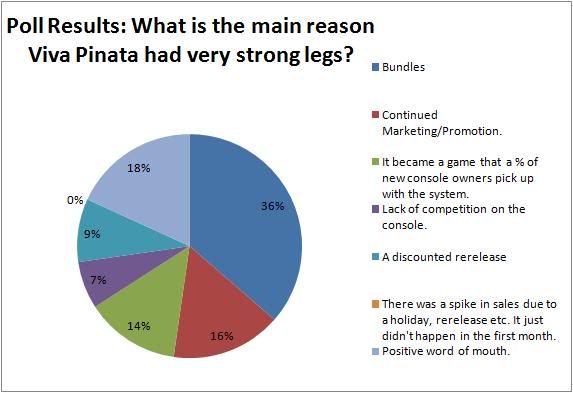
Reasonable – “I think low price and lack of similar games has enabled it to be bought fairly steadily, whether for younger family members or whatever, leading to the very long legs it has shown. Really, there seems so little choice on 360 if you want a game like this, I think it had the market to itself until Banjo hit.”
famousringo – “As I understand, this game was very heavily promoted and cross-promoted with Burger King and some animated shows. I'm betting that this is the main reason for the long tail.”
Thanks for reading today’s Look at Those Leg’s Game of the Day. If you missed the thread leave a comment letting us know what you think is the reason behind Viva Piñata’s strong legs. Also be sure to head over to the debut of a new “Sales of the Day” series, System Mover Game of the Day featuring Super Smash Bros. Brawl. There you can vote and comment on what you think and then be on the lookout for the follow up article to find out what other voted for and if your comment made it to the article.
Most recent "Sales of the Day" articles, Change in Sales, Sales Battle, Retro Sales, Look at Those Legs.
More Articles
Parents in low-income [url=http://www.rolexreplica123.com]Rolex shop[/url] countries fail to their [url=http://www.rolexreplica123.com]Rolex[/url]daughters because expect them to make an economic contribution to the family:
girls grow up [url=http://www.gucci-handbags.org]Gucci bag[/url] only to somebody[url=http://www.gucci-handbags.org]Gucci handbags[/url] else’s family and bear [url=http://www.gucci-handbags.org]Gucci[/url] children.

Thanks madman, I think I've fixed all of them.

I enjoy these acticles but you're using the word 'sells' instead of sales. As an example: 'but because of the game's continued strong sells it was a risk that paid off.' Maybe i'm being a bit anal but it bugs me because it's a series of articles about sales themselves.
Apart from that grumble I do enjoy reading them...carry on! :-)
Kai, the problem with that is what you are defining as legs. I think a game that is still selling four months later, is strong legs, but if I do a one year ratio a game that sells well for 8 months then dies off wont be considered to have strong legs, which I think is less effective then my current method. Obviously there will be flaws with whichever method is used.

Your "leg strength index" is biased because if a game is released in the holiday period the first month sales will be stronger, a 1 year index would be better.