

Metal Gear Solid V: The Phantom Pain (PS4) - Review
by Joseph Trotter , posted on 22 September 2015 / 11,190 Views
What’s in a name? More precisely, what’s in a subtitle? It may appear to matter little, but for a series as measured as Metal Gear Solid it can mean an awful lot. Famously, Metal Gear Solid would always feature the words ‘Tactical Espionage Action’. Reasonable. Explanative. For the latest incarnation, the subtitle has been changed to ‘Tactical Espionage Operations’. It may seem trivial, but it gives an insight into what makes MGSV such a unique, involving experience.
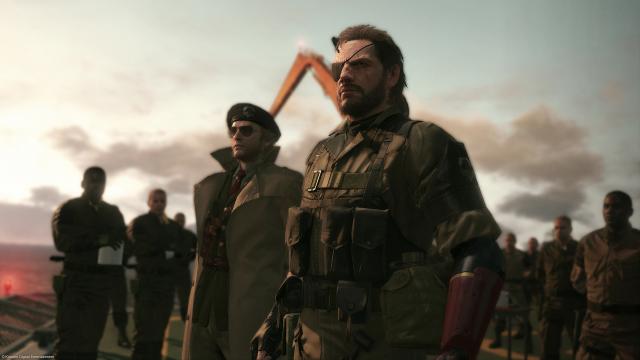
MGSV is an open-world adventure, but isn’t; a series of distinct, area-specific missions, but not quite; a tactical stealth game in which stealth is by far and away the most difficult way to accomplish a mission. So what is it? It is both an evolution of the previous Metal Gear Solid games and a revolution of what is to be expected from stealth-action games.
In some ways it borrows from spin-offs, such as Peace Walker, more heavily than the ‘headline’ console titles. Big Boss (or ‘Punished 'Venom' Snake’ as he insists on being called, the petulant arse) has narrowly survived the events of MGSV: Ground Zeroes, but was severely injured. After a nine-year coma, he escapes the military hospital he is held hostage in (with a little help from some friends) and establishes the ‘Diamond Dogs’, a mercenary group with a Mother Base in the Seychelles. This Mother Base can be expanded, equipped, and serves as a peaceful enclave in comparison to the war-zones Boss visits. Much of the ‘secondary’ gameplay takes place here, and there are constant reminders and incentives to return home.
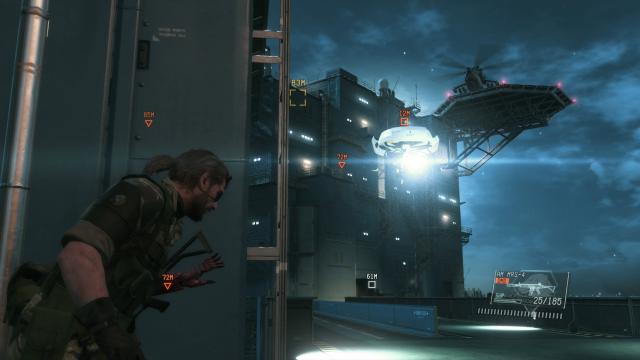
Why one would wish to, however, when the main environment and gameplay are so spectacular is a mystery. Set in Soviet invasion-era Afghanistan and later Angola-Zaire, the game world is neither too big to be daunting nor too small to feel totally explorable. Rather than being open-world in the traditional sense (SPACE! FREEDOM! Erm... now what?), players are encouraged to choose from a set of main or side missions from their helicopter, before choosing a landing zone and setting off. Weapons, armour and such like can then be chosen before commencing the mission, meaning you can mix or match armouries depending on the scenario. If all goes wrong, or a new approach is needed, drops can be made of new weapons or ammunition.
These are the ‘Operations’ of the subtitle, and it is this ‘plan for every eventuality’ mind-set that makes MGSV so very different. The operations have objectives, but they can be completed in whatever manner the player sees fit. Try and sneak through undetected without any fatalities and a perfect score will be the reward. Or you could C4 some communication devices before storming the compound as the guards are distracted. Or kill every guard within a mile using a sniper rifle. It is a matter of choice, and in some ways a matter of style.
These operations are generally enjoyable, even if as The Phantom Pain progresses some of the scenarios start to become over-familiar. This is fortunate, as the story offers little incentive for progression. An organisation named Cipher, led by Skull Face and his skulls (I know), are conducting undercover warfare in various warzones so as to cause as much confusion and doubt as possible, while they attempt to create the ultimate weapon. Long-time followers will be pleased to know that, as with MGS tradition, the narrative is completely and utterly baffling.
Many of the individual cut scenes, conflicts and conversations are fine when self-contained, and are often well presented and exciting. Several of the characters are memorable, particularly the soldier-child Eli, who makes a striking resemblance to Big Boss. Unfortunately, the central plot offers a flimsy skeleton onto which to hang this meat, and from an early stage it is clear that MGSV will be subject to Hideo Kojima’s particularly obsessive view of the New World Order. While the story of MGSV is difficult to stomach for series regulars, it is one of many features that makes MGSV pretty inaccessible for new players. This is probably MGSV’s defining weakness; it is inaccessible to MGS newbies (it really does drop you in the deep-end from the beginning) to the point that is very difficult to recommend it to series virgins. Instead, I would recommend you play one of the many HD packages of previous instalments and work your way up from there.
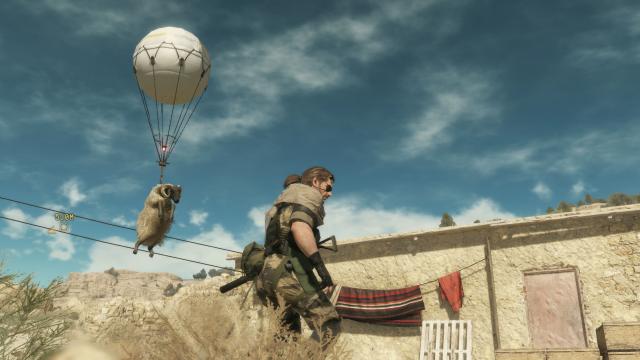
While the bad with Kojima may be witheringly familiar, the good is dazzling, riotous invention. The Fulton Device, first showcased in Peace Walker, is a piece of genius. Strap it to the back of a prone guard, animal, or piece of equipment and the poor soul is thrust into the air, where they are picked up by the Diamond Dog’s reconnaissance team and removed to Mother Base. Humans captured or rescued are converted into members of your militia, where they can be enrolled into a different service depending on their strengths. This is the primary way to increase your militia size, although many will join as a result of successful missions and acts of heroism. Early in the game an upgrade means that the abilities of enemies can be seen, and as a consequence you can choose which humans to Fulton depending on your needs and aims. This is one example of the great depth that pervades MGSV; as much time will be spent upgrading weapons and fine-tuning Mother Base as on actual missions.
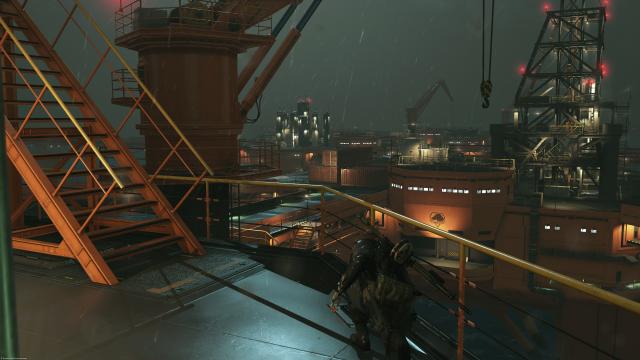
It is the core gameplay, however, which is MGSV’s true delight. Depending on how you play, the action is thoughtful and meticulous, and requires a great degree of planning and preparation. Movement is seamless and intuitive, with context sensitive actions clearly labelled. Although it can sometimes descend into Batman-style ‘cage’ set-pieces (‘you know the dynamics, use them’), the mixture of open-world and concentrated arenas means that options are available, but it is up to you to use them. Add to that the fabulous, console-generation leading graphics and involving (and involved) score and you have an excellent value package. One downside: Keifer Sutherland is no David Hayter when it comes to voicing Snake, although the ensemble is nonetheless generally high quality.

MGSV can be recommended depending on your previous experience of Metal Gear. Series veterans will love this, but newcomers may find the experience inaccessible and daunting. Everyone else can appreciate MGSV for what it is; an evolution for Metal Gear Solid but a revolution in what ought to be expected of a stealth action/adventure game. Ambitious and haughty, it is hamstrung by a nonsensical plot and accessibility issues, but these do not impact this simple truth: MGSV is a high-point for this generation of consoles, and probably the best stealth game ever. Inventive and beautiful, even its clear flaws cannot take away from what is simply a brilliant game.
This review is based on a retail copy of Metal Gear Solid V: The Phantom Pain for the PS4, provided by the publisher.
More Articles

"Operations" subtitle was also used in Peace Walker. Good review.

One popular series that i just can't seem to get into.
Sutherland's performance in this game is awesome, we all love Hayter but he did an amazing job. The story is also good as well, crazy at times but no different than any other Metal Gear. It takes a while to get going but the big moments are there, you have to play it through from beginning to end to truly experience everything the game offers.

Peace Walker is not a spin-off. It is the events that happens before Ground Zeros.

Oh, and I thought Sutherland did a great job. I was skeptical, even though I've always liked him, but I also have been so attached to Hayter for a long time. But Sutherland's performance in 'Ground Zeroes' and 'The Phantom Pain' actually made me wish he had voiced Big Boss from the beginning.
I was absolutely blown away by this game. My expectations were high, as a longtime fan of the series, but 'The Phantom Pain' is legitimately one of the greatest games ever made, in my opinion.
It has content to rival a Bethesda title, but it's still as super-polished as the series has always been. And I don't know understand the criticism about the plot. It's far from nonsensical, just as weird as 'Metal Gear Solid' has always been. And it's (likely) the final game in the series proper, so I don't see why it should pander to newcomers when loyal fans have been supporting the series for a decade and-a-half. It's like watching the final season of 'Breaking Bad' and then complaining that it was inaccessible to those who never watched an episode before.
Have to agree: "Keifer Sutherland is no David Hayter when it comes to voicing Snake". I still can't help but wonder if Kojima was, despite his (as usual) denials, considering a FOX Engine retelling of Solid Snake's mission into Outer Heaven and Zanzibarland, setting the stage for Hayter as Snake vs Sutherland as Big Boss. Thanks to Konami, the world may never know.