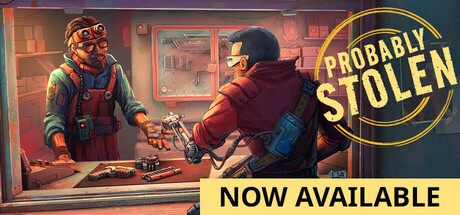









Probably Stolen (PC) - Review
by Miles Gregory , posted 26 minutes ago / 132 Views
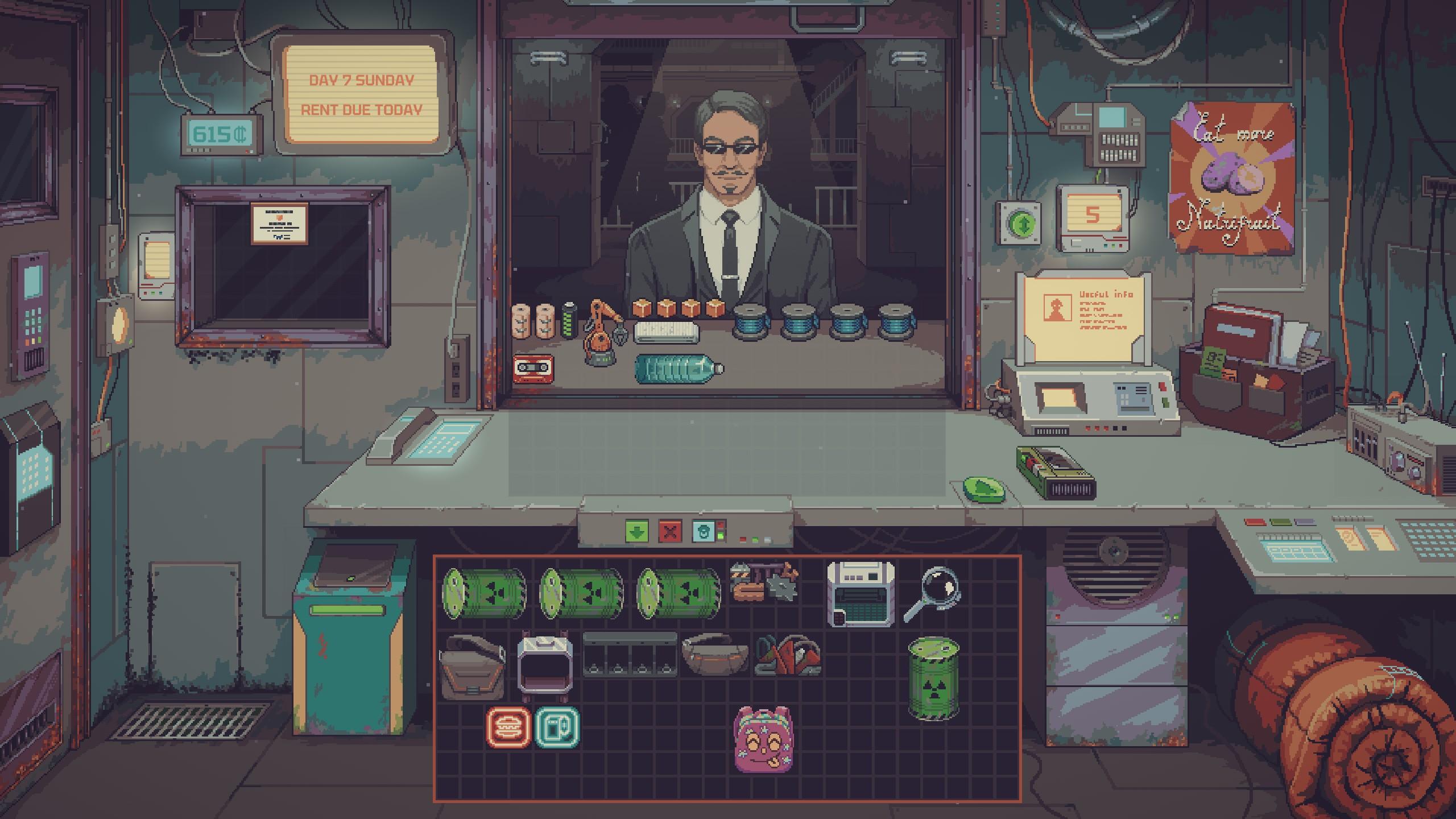
I rise from my sleeping bag, rubbing my eyes, exhausted from my excursion during the night. There is a strange stillness to my industrial surroundings, broken by distant voices and passing footsteps. A sign reminds me of the day and when rent is due. I have two more days to come up with another 245 credits. I check my dossier for a small slip of paper given to me by my informant. The paper reads, “Bad Nutrifruit Harvest today, lasts for 3 days.” I check my display case, remove the neon sign for food, and put a single Nutrifruit in its place. For the next few days, I won’t be buying food. I’ll be selling it — and at a considerable markup. Some might say I’m a bad person for capitalizing on a food shortage, but it’s not like it’s personal. It’s just business.
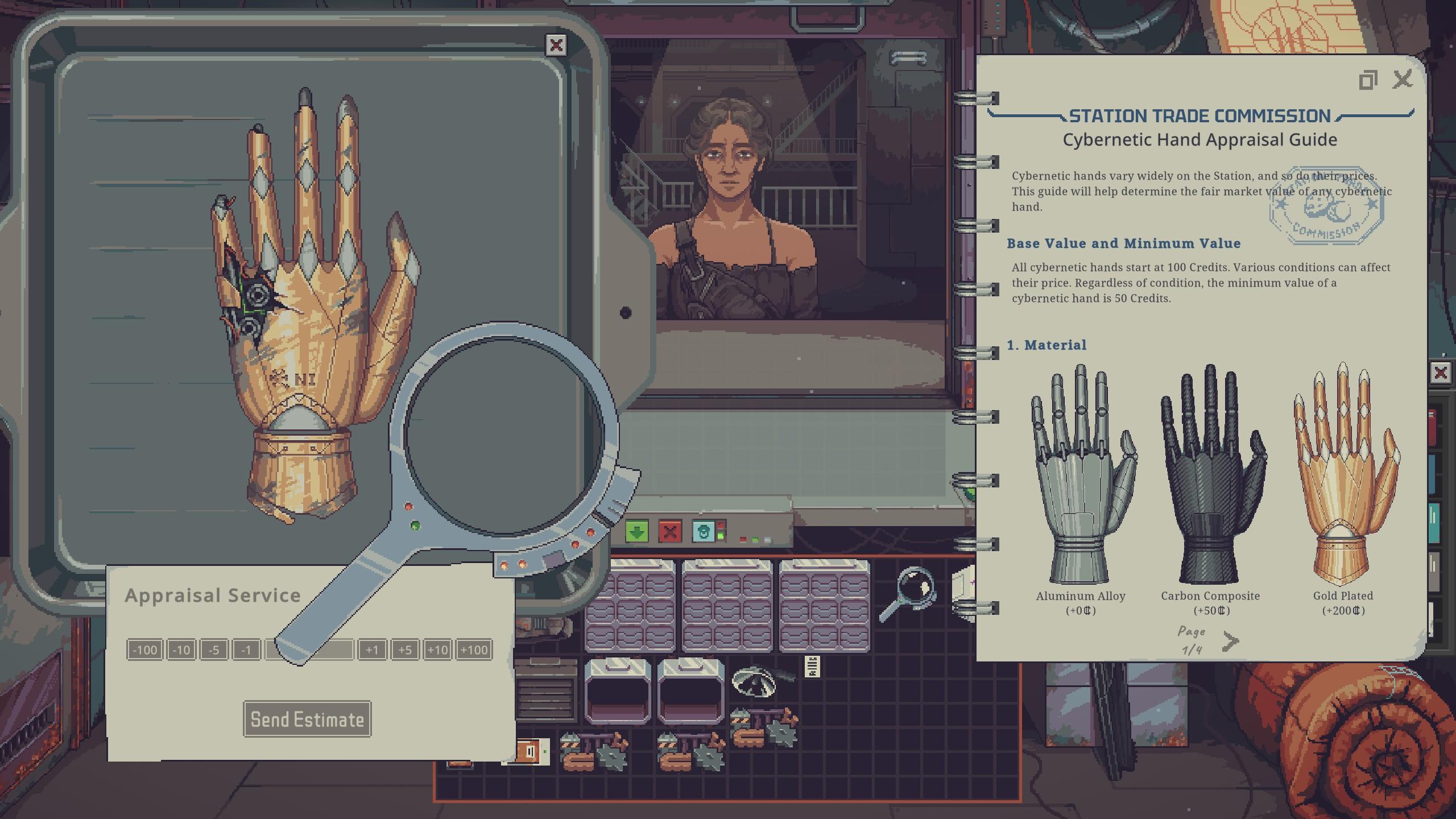
I open my shutter door to start my day and call for my first newspaper. Yep, just as my informant predicted, there is a food shortage. I ring the bell for my first customer, a fellow citizen of the Lower Level. They’ve noticed the Nutrifruit in my display case and would like to buy some food. I sell them as much food as I possibly can for a modest profit before ringing the bell for the next customer. This individual isn’t looking to buy but is instead seeking appraisal services. I examine each of the cybernetic hands they need assessed. Three of these hands look rough, with damage nearly exceeding their resale value. The fourth hand, however, is pristine: gold-plated, equipped with a neural interface, armored, and completely undamaged. That’s 670 credits right there. They leave happy with my services.
A few more customers pass through, some trying to buy and others trying to sell. Materials, household goods, medical supplies, food, weapons, and even drugs… I can’t keep all of these products in stock, so some customers leave empty-handed. My final customer wants to buy some medical supplies. Lucky for them, I purchased some bandages and oxymore injectors from a previous customer. I load up my counter with every suitable item I have and am about to confirm the sale when I notice something. It’s something so subtle that I nearly miss it, yet once I notice it, I can’t see anything else.
This buyer is completely still.
I shift my focus to their eyes. Their unusual pupils seem to stare right through me, as if they aren’t even looking at me. I smile at them and glance toward the shotgun at the bottom right of the counter. Hastily, I grab it, shoot the buyer in the chest, and call Security.
Security confirms my suspicion. This was no ordinary buyer. This was an Aug.
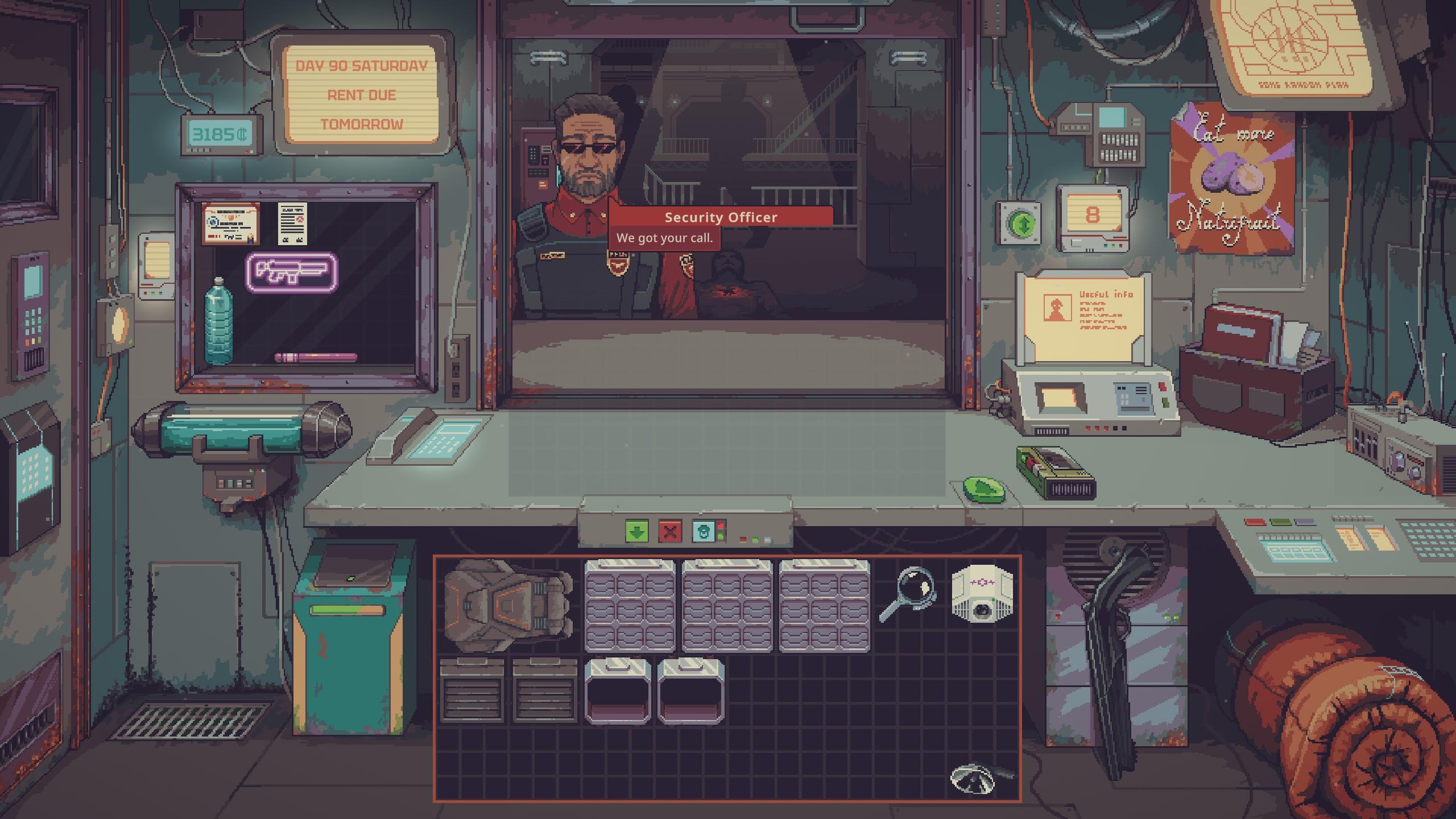
This is a day in the life of a shopkeeper in Probably Stolen, a game in which the seemingly mundane task of running a pawn shop is complicated by the dystopian society in which it exists. What begins as a simple exercise in buying low and selling high gradually reveals itself to be an intricate network of faction politics, market manipulation, investigative puzzles, skill trees, and industrial automation. It’s a game where min-maxing becomes both rewarding and, to some extent, necessary.
Probably Stolen is a game I had to play twice, and for good reason. There's a surprising amount of complexity beneath its relatively simple premise. When starting a new game, you’ll be asked to choose a specialization. If this is your first time playing, I highly recommend choosing “Apprentice.” Otherwise, you might set yourself up for failure by having to learn too much too quickly. After choosing your specialization, you’re presented with a selection of perks, none of which are available on your first playthrough. Even if they were, I wouldn’t recommend using them. Much of the satisfaction in Probably Stolen comes from understanding its mechanics before discovering how to manipulate them to your advantage.
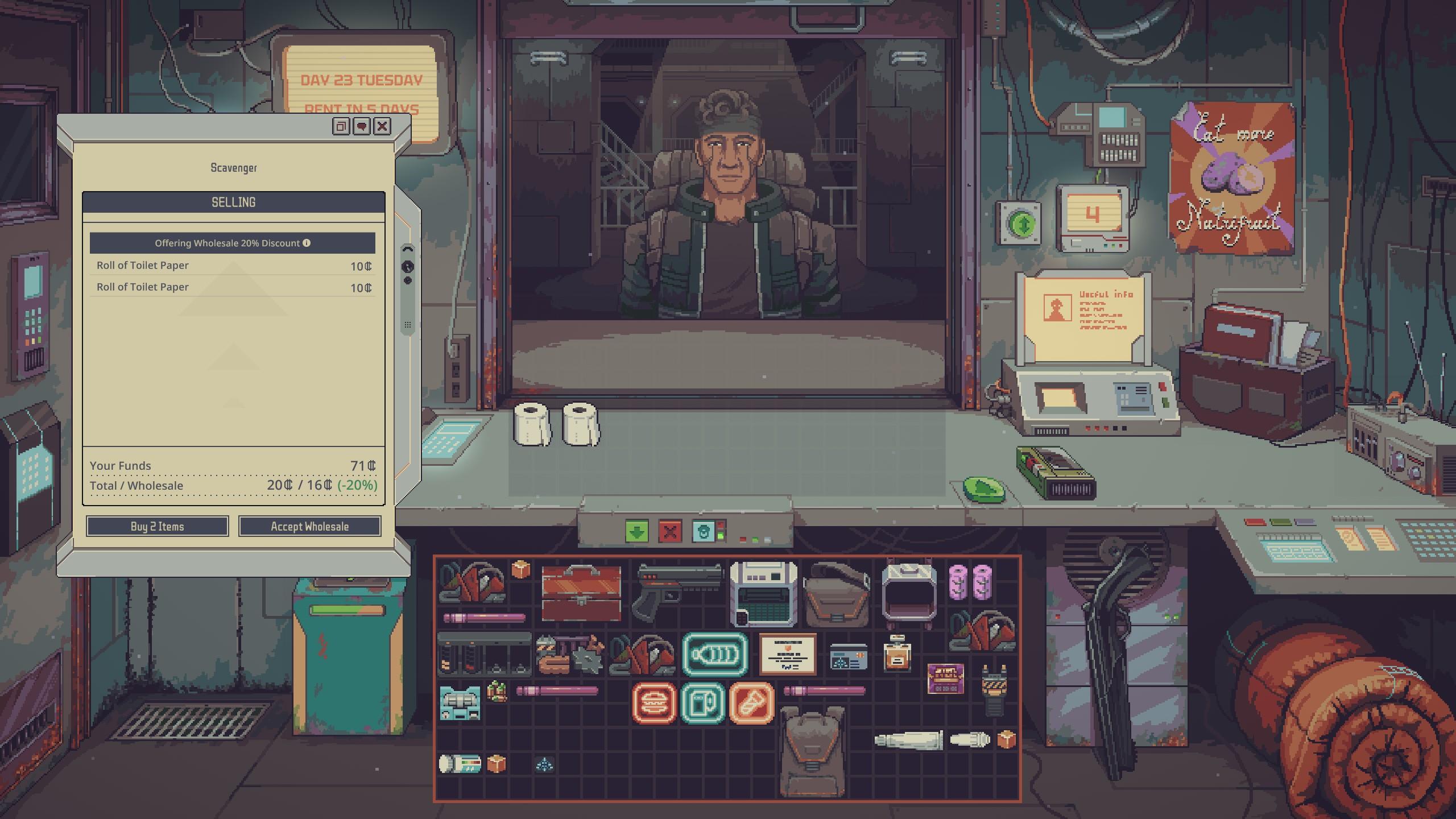
Unlike a traditional action game, you don’t move your character around in real time. Instead, Probably Stolen feels like a mixture of a job simulator and a point-and-click puzzle game. Your objective is simple enough: make rent each week. To signal what you want to buy or sell, you’ll use your display case. Neon signs indicate what you’re looking to buy, while the objects themselves indicate what you have to sell. The catch is that your display case must be prepared before you open your store each day.
Every morning, upon opening your shop, you’ll receive a newspaper detailing current events. These can range from an increased supply of medical goods to greater demand for weapons or even an influx of visitors from the Upper Level. These events have tangible effects on the economy. A bad Nutrifruit harvest means food becomes more valuable, whereas a surplus means the opposite. It’s simple supply and demand, but the fact that you must commit to your display case before receiving the newspaper makes anticipating these fluctuations particularly valuable.
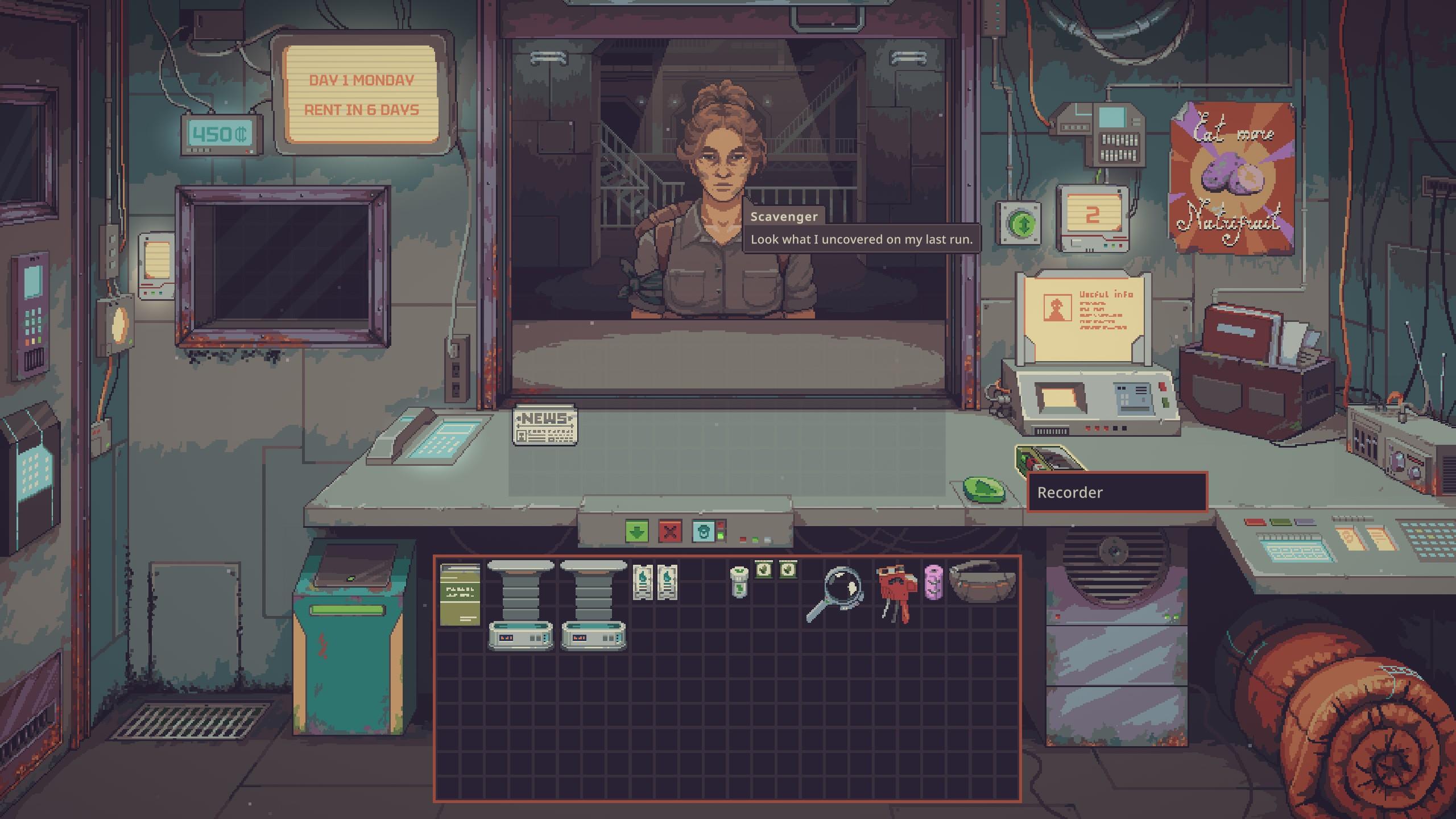
This is where informants come in handy. Every so often, someone will visit your store offering to sell you information about upcoming events. Knowing that there will be a shortage of medical supplies in three days gives you an opportunity to stockpile them while they’re still cheap. Suddenly, information itself becomes a commodity, and spending a few credits on a slip of paper can make a huge difference in profit margins.
Of course, maximizing your profit on every transaction isn’t necessarily the best way to run your business. Each customer has a set budget that can fluctuate through a bartering system. Give a buyer a discount, and their budget increases; mark up your prices, and their budget decreases. Your decisions also affect your reputation with their respective faction. A poor reputation with the Lower Level, for example, can reduce the spending power of its citizens. Let that reputation dip too far into the negative, and they’ll form a mob, and then… well… game over.
Conversely, offering discounts can improve your reputation and eventually increase the budgets of customers belonging to that faction. Other factions offer their own benefits. Maintaining a good relationship with Security, for instance, can make thieves less likely to target your store. What I appreciate about this system is that generosity and greed aren’t necessarily opposites. Taking a smaller profit today might be the more financially advantageous decision tomorrow.
Oh, did I mention there are thieves? Yes, people may break into your store at night and steal your merchandise. Lucky for you, there’s insurance to help recover stolen items. This is yet another daily expense alongside electricity and trash collection. Electricity powers your machinery, while trash collection keeps your store presentable and attracts more customers. Eventually, you’ll also need to purchase a business permit, with various other certifications available depending on the nature of your business. The dystopian future really wants to nickel-and-dime you for every credit you’re worth.
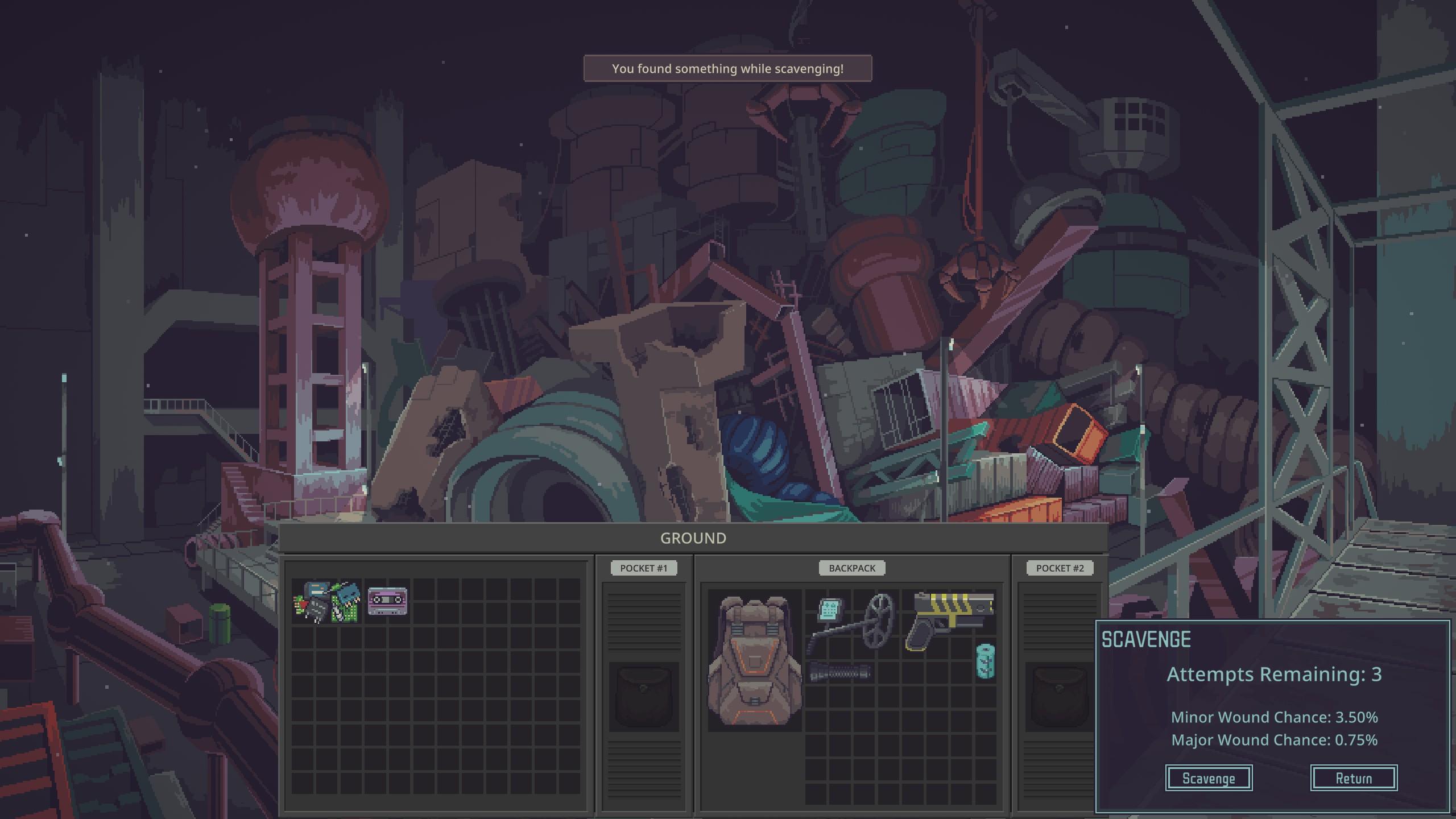
Closing your shutter for the night doesn’t necessarily mean your work is done, either. You can rummage through the dump for salvage, visit the commissary to spend your food stamps, or pay a visit to Dr. Jackson’s store. Spending the night exploring means missing your first customer the following morning, and you’re limited by whatever you can fit in your backpack and pockets.
The first time I visited the commissary, I forgot to bring any food stamps. The second time, I bought so much food that I couldn’t fit it all in my backpack and had to leave some behind. These are relatively simple mistakes, but they illustrate how easily poor planning can cost you both time and money in Probably Stolen. Even something as mundane as going grocery shopping requires a little forethought.
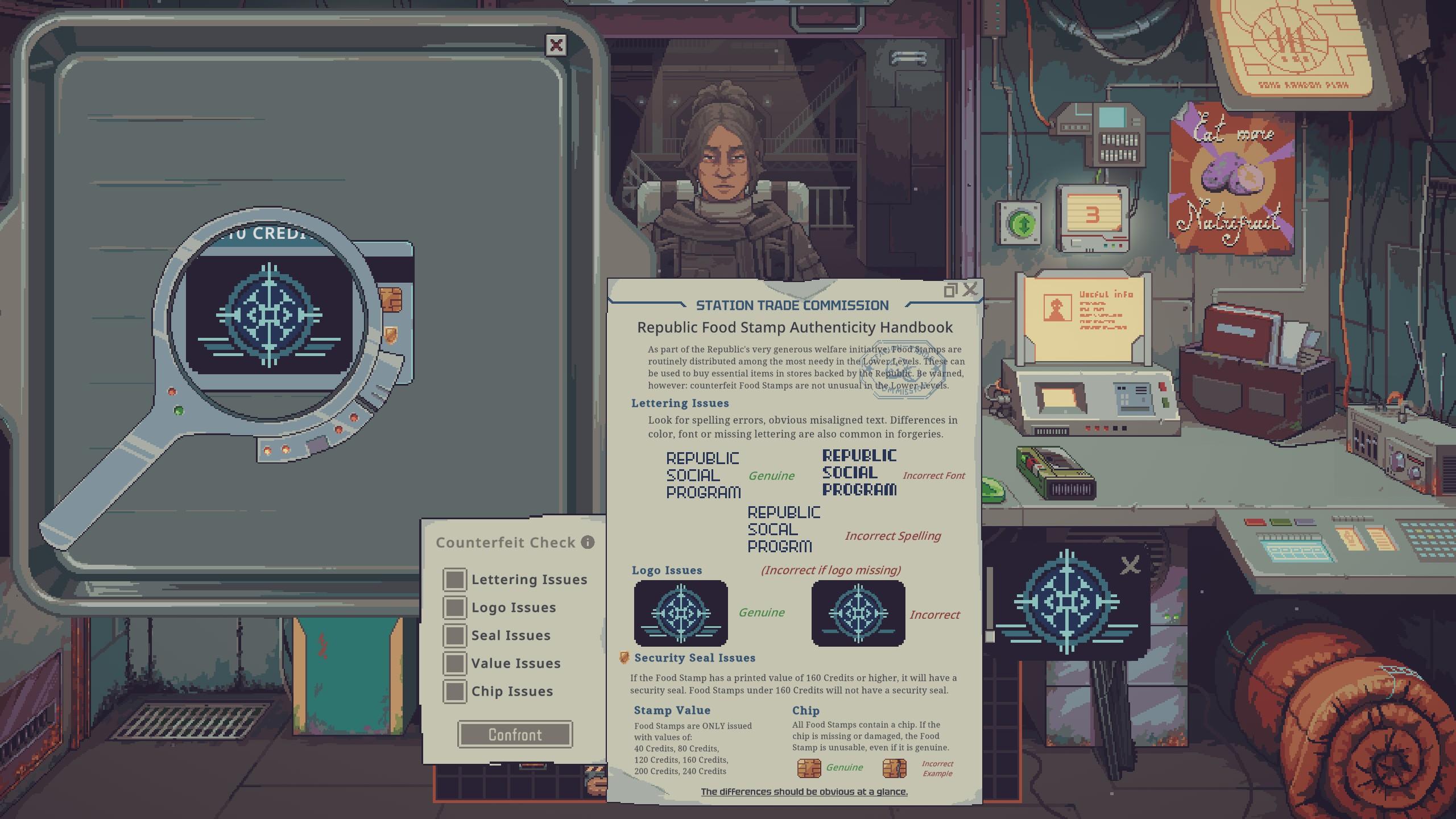
Speaking of food stamps, not everything that passes through your shop is what it appears to be. Item inspection was one of my favorite aspects of the game and is particularly reminiscent of Papers, Please, which appears to be a significant influence. Food stamps, cigarettes, immunivax injectors, and various other items can be counterfeit. Determining their authenticity requires you to examine small details with your magnifying glass and cross-reference them with the handbooks and identification guides you acquire throughout the game.
What makes this mechanic particularly interesting is that discovering a counterfeit doesn’t necessarily mean rejecting it. You can call a customer out for attempting to sell you counterfeit cigarettes, purchase them at a reduced price, and then label them as genuine for the next unsuspecting customer. Be careful, though: some customers are considerably more perceptive than others. If they catch you lying, your reputation will suffer.
Appraisals offer a similar investigative element, requiring you to assess the value of an item based on its condition and various attributes. Get your appraisal sufficiently wrong, and the customer will call you out. Make too many mistakes, and they’ll simply leave. Both mechanics reward familiarity with the merchandise that passes through your shop, allowing knowledge and experience to become valuable assets in their own right.
Much like Papers, Please, there are also particular individuals to watch out for, namely Augs and those on the wanted list. If you notice something suspicious about a customer’s behavior, they might be an Aug, in which case you can choose to shoot them. Get it wrong, and Security won’t be too happy. Get it right, and you’ll be rewarded with credits. The possibility of an Aug visiting your store adds an underlying tension to otherwise routine transactions, particularly when you’re already preoccupied with inspecting merchandise, managing inventory, and calculating profit margins.
Wanted individuals range from characters like the Butcher, who appears to be a psychopath, to the very unlucky John Smith, who just so happens to have such a generic name that he keeps getting flagged and arrested whenever he visits a store. You don’t have to report these individuals to Security, however, and allowing them to continue visiting comes with its own set of benefits and consequences.
The Butcher, for example, will sell you discounted meat that you can resell for a profit. Report him, however, and he’ll threaten you, making your nightly excursions considerably more dangerous. Furthermore, if Security notices that these individuals keep visiting your store it can prompt a security inspection, during which any stolen goods or contraband you possess may be seized.
Which brings us to drugs, contraband, weapons, stolen items, and security boxes. With a name like Probably Stolen, you can’t expect to JUST have a legitimate business, right? Well, I suppose the option is there, but you can also smuggle drugs, forge security keys, sell weapons, and so on. Naturally, this carries its own risks. If Security conducts an inspection and discovers stolen goods, you’ll be fined, and your reputation with the faction will suffer. Purchasing a smuggler’s bay gives you somewhere to conceal your less-than-legitimate merchandise. You can source contraband through the Black Market, sell weapons to the Revolution, or just become a drug dealer.
What fascinates me about Probably Stolen is that it rarely needs to explicitly present you with a moral dilemma. Instead, morality becomes another consideration in the economic system. Nobody is asking you whether exploiting a food shortage or selling counterfeit goods is right or wrong. You’re simply presented with an opportunity to make money and a looming reminder that rent is due. The justification is entirely your own.
While Probably Stolen lacks a conventional storyline, it gives you considerable freedom in deciding what kind of person you want to be within its world. Your decisions don’t necessarily dictate how the game ends, but they do influence which doors open for you and, perhaps more interestingly, what you’re willing to do to open them. Blackmail, fraud, and corruption seem woven into the fabric of everyday life, and even those tasked with maintaining order aren’t exempt.
One particularly interesting example is a security guard named Serpico, who allegedly exposed a scam within the Security Department. His character appears to be a nod to Frank Serpico, the former NYPD detective who exposed widespread police corruption in the late 1960s and early 1970s. It’s a clever historical reference that feels particularly at home in a world where integrity seems to be in short supply.
As mentioned before, there is machinery to power, and this is where min-maxing becomes incredibly rewarding. While playing the market is satisfying enough on its own, specializing in a particular trade is where the addiction really sets in.
On my second playthrough, I became a water salesman. I started with a simple purification kit containing some filters, purification tablets, a water pitcher, and testing strips. There are several different types of water, with purification being necessary to increase its value. After some time, I was able to purchase a moisture farm that produced rustwater overnight, giving me a consistent supply of water to purify and sell. Eventually, I worked my way up to having my own water tank for an instant supply of rustwater, nine water purifiers producing basewater, high-quality water, and pure water, and a vending machine outside stocked with each type. While I slept, the vending machine continued selling water, allowing me to collect the profits in the morning.
There’s something immensely satisfying about looking at a mildly automated water purification business and remembering that, not too long ago, you were standing behind that same counter dropping purification tablets into a pitcher. The progression feels earned because you understand the processes your machinery is now performing for you. Water is certainly not the only avenue of business, either. You can grow food, trap rats or fish for meat, produce higher-quality salvage, manufacture guns, or even synthesize drugs.
Once you’ve settled on a trade, Joe Wild’s Service becomes particularly useful. This network service offers everything from basic starter kits to store improvements and new trading opportunities. Want to start legitimately selling guns? You’ll need a weapon permit. Want to increase your production? You might need an upgrade to your power service. Joe Wild can even paint the outside of your store, unlock vending machines, and offer a one-use clemency option in case Security ever tries to arrest you.
There is an impressive sense of progression in watching your business evolve from a pawn shop that relies on whatever customers happen to bring through the door into a specialized operation capable of producing and distributing its own merchandise.
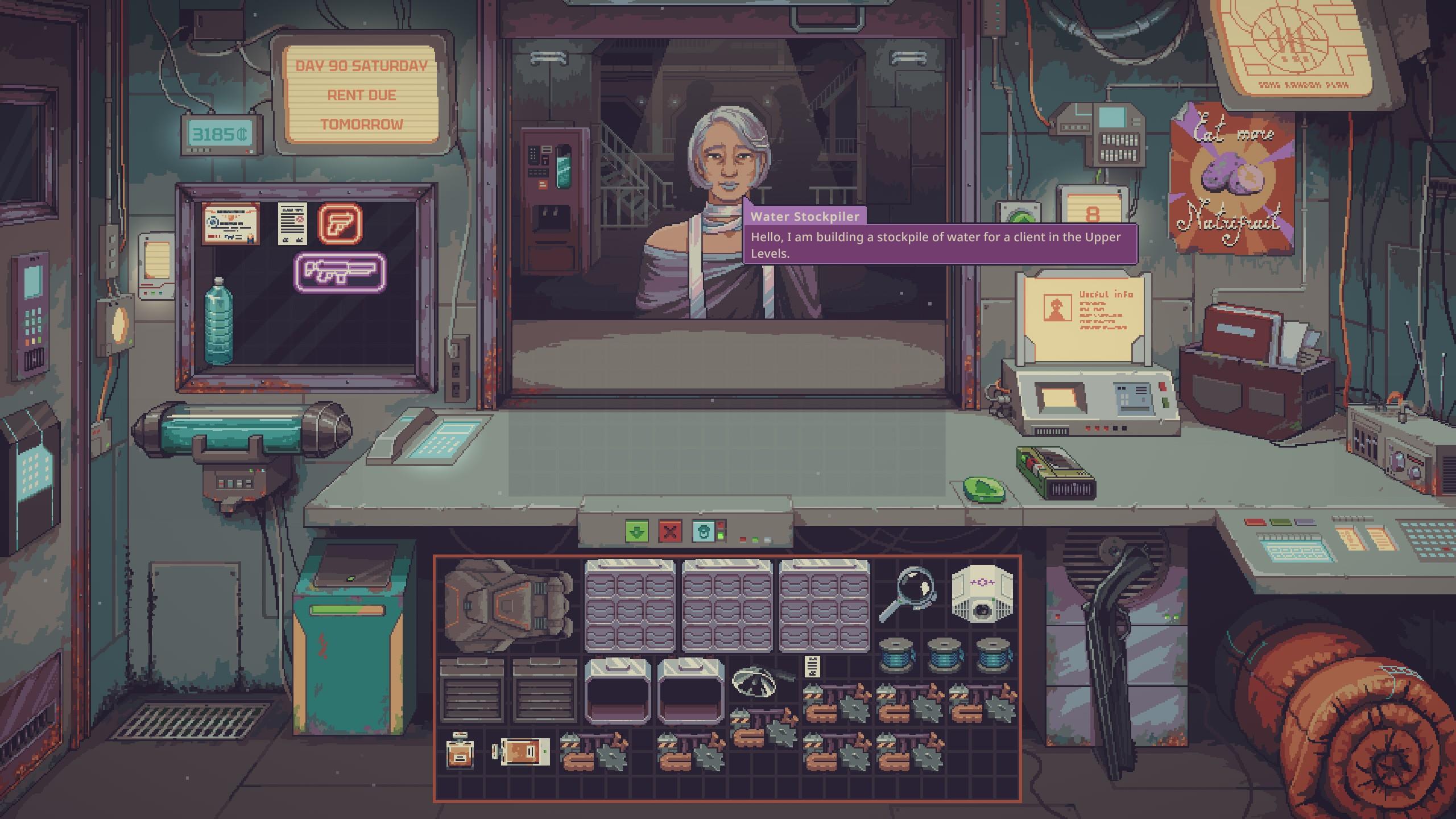
Graphically, the game is simple yet stylized, with a retro indie aesthetic. It’s pleasing to the eye, with subtle animations that convey everything they really need to. The rusted doors, retrofuturistic environments, and dusty atmosphere perfectly complement the dystopian setting. There’s a sense of wear to the environment that makes the world feel lived in.
What particularly impressed me, however, was the sound direction. Musically, the game emphasizes lo-fi tracks that rely primarily on synthesizers. As a musician, I appreciate the layers in each track, with my favorite being “Long Star River.” The subtle use of castanets and what sounds like a traditional Japanese pentatonic scale gives the track a distinctive character, while the drum beats and synthesized sounds give it a modern feel. It’s incredibly groovy. Music is played through cassette tapes, with additional tracks being available for purchase. Interestingly, the music isn’t playing by default, and you can easily pause it at any time, allowing the occasional clacking, distant crowds, and sounds of exhaust to fill the silence.
Despite how much I enjoyed the soundtrack, I often preferred playing with just the environmental ambience. There is so much to keep track of in Probably Stolen that, until I had things almost automated, I found myself paying more attention to the music than to what I needed to prioritize. As someone who is easily distracted by music, I appreciate having the ability to switch between the two without having to fiddle with the settings. When business was running smoothly, I could relax and crank up the jams. When things became hectic, I could return to the relative silence of my surroundings. It's a small design decision, but one that made a noticeable difference in my experience.
If there is one aspect of Probably Stolen that prospective players should be mindful of, it’s the learning curve. The sheer number of mechanics that make the game so rewarding can also make it intimidating at first. It takes time to understand how the various systems interact, and there’s a considerable difference between knowing how an individual mechanic works and knowing how to incorporate it into an efficient business. For players who enjoy gradually untangling complex systems, this is part of the appeal. For others, it might be a barrier to getting to the more rewarding aspects of the game.
The amount of freedom Probably Stolen offers is perhaps best illustrated by the trajectory of my second playthrough. While I started out as an innocent water salesman, I eventually started dabbling in gun sales. Before long, I was manufacturing my own guns to sell to the Revolution for increased reputation (and cash). Eventually, I shifted toward becoming a chemist, living out my own version of Walter White by manufacturing dream dust and phanta pills until I nearly killed a customer by accident. My conscience finally caught up with me, so I hung up my pork pie hat and went back to selling water.
None of this required a conventional storyline. It was simply the result of my curiosity, ambition, and a series of increasingly questionable business decisions. That, to me, is where Probably Stolen shines. Its mechanics are compelling individually, but it’s the way they interact with one another that allows you to create your own stories within its world.
There is so much at play within this game that I couldn’t possibly describe everything without this review becoming an entire novel. Heck, after almost 50 hours of playtime, there are still entire avenues of business I haven’t explored, and I’m certainly ready for more. If you have even a small interest in job simulators, economic management games, or the satisfaction that comes from optimizing an increasingly complex system, you owe it to yourself to try Probably Stolen.
Just remember to pay your rent.
VGChartz Verdict


9
Outstanding
This review is based on a digital copy of Probably Stolen for the PC, provided by the publisher.