







Steins;Gate Re:Boot (NS2) - Review
by Evan Norris , posted 13 minutes ago / 72 Views
If you could send an email back into the past to change the present, would you do it? What would you send? Would you consider all the ways that message might steer future events in unforeseen ways? These are some of the many questions at the heart of Steins;Gate Re:Boot, the second remake of what is generally considered one of the most important visual novels of all time.
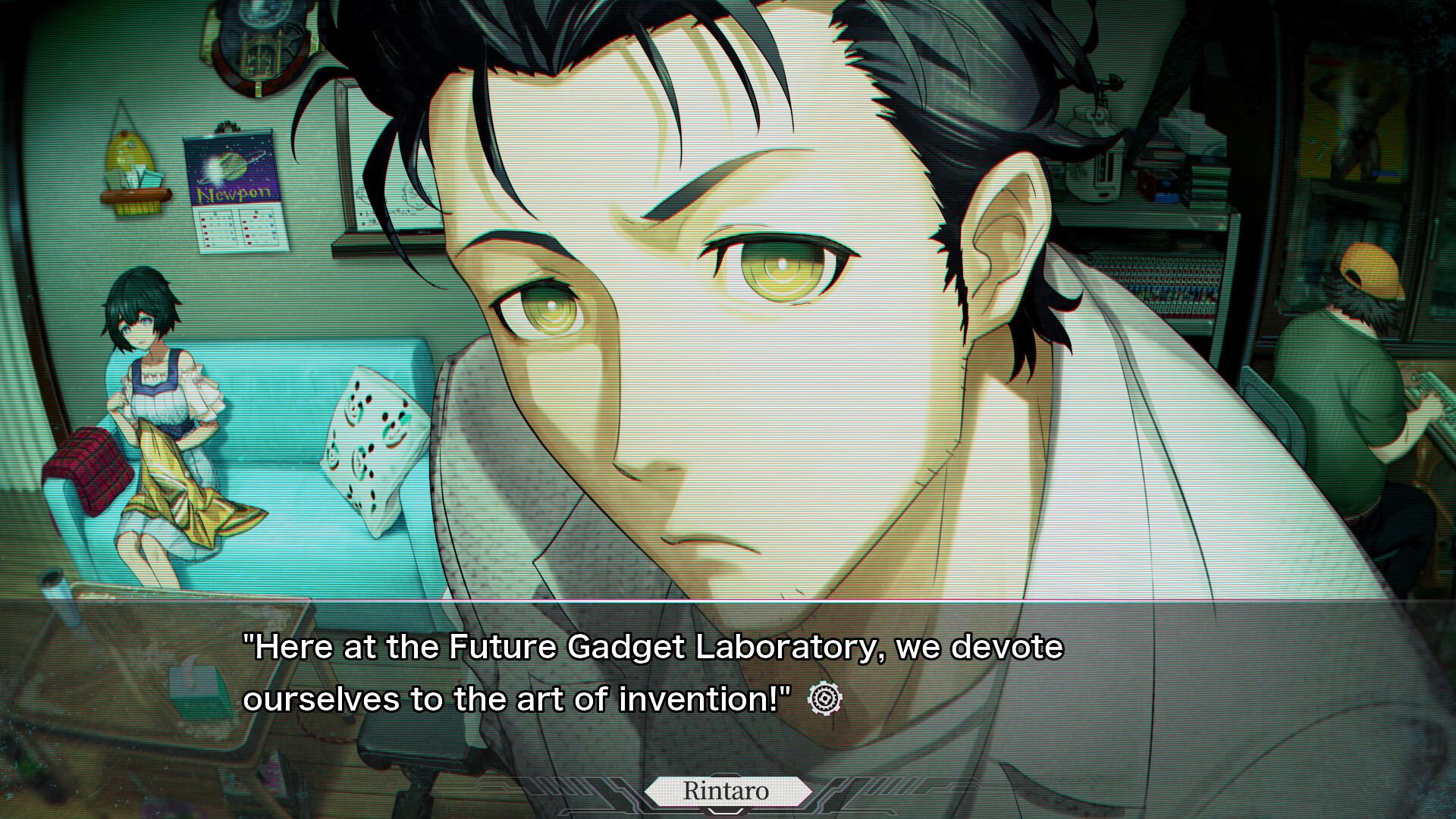
Steins;Gate Re:Boot, like the original game from 2009 and the first remake from 2019, is set in the summer of 2010, in the Akihabara district in Tokyo. It follows 18-year-old Rintaro Okabe, an eccentric young man who adopts the personality of Kyouma Hououin, a mad scientist. As described in the game, he is a chūnibyō, an individual with child-like delusions of grandeur. When not attending university, he runs a clubhouse in a second-floor apartment in a quiet corner of Akihabara called the "Future Gadget Laboratory", where he and his friends Mayushii and Daru invent items of questionable utility.
One of those items is, in fact, useful, whether by extreme coincidence or the will of Steins Gate, a term Okabe uses to describe a sort of divine agent that dictates the course of human events. It's Future Gadget No. 8, the PhoneWave (name subject to change), which somehow acts as a vehicle to send email messages backward in time. When Okabe accidentally sends a message, he changes the future of the world, in ways that only reveal themselves over the course of several weeks.
The story of those weeks, which plays out across approximately 25 real-world hours, is one of the most meaningful tales you'll encounter in a video game. It's a potent mix of heady science-fiction ideas and touching character drama, with a little thriller and murder mystery DNA thrown in for good measure. Not only does the game challenge you with theoretical physics and bold, imaginative notions of time travel and alternate timelines; it orients those concepts around the future lives of friends, family members, and allies.
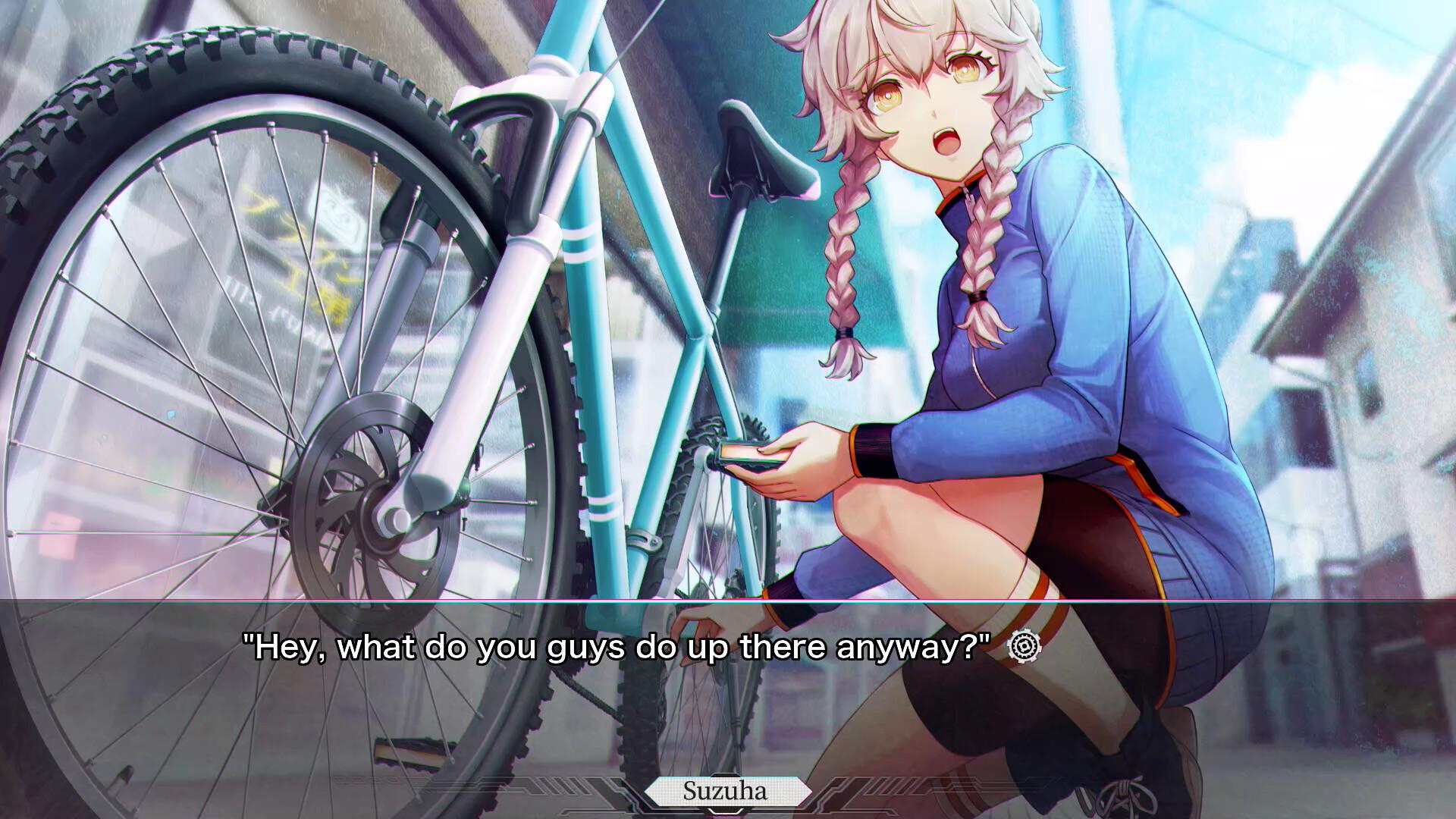
Those allies really elevate the experience. Kurisu Makise, who joins the original threesome of Okabe, Mayushii, and Daru, is one of the best characters I've come across in a visual novel, or any genre for that matter. She has an incredibly layered and complex personality; she's brilliant, confident, easily annoyed, and unexpectedly geeky. She's antagonistic toward Okabe, protective of Mayushii, and often blind to danger in her pursuit of scientific breakthroughs. Mayushii, Okabe's childhood friend, is sweet, caring, and more than a little ditzy. Daru is an amazingly gifted computer hacker whose mind wanders to sexual situations at any opportunity. There are others, of course, but you should really meet them yourself.
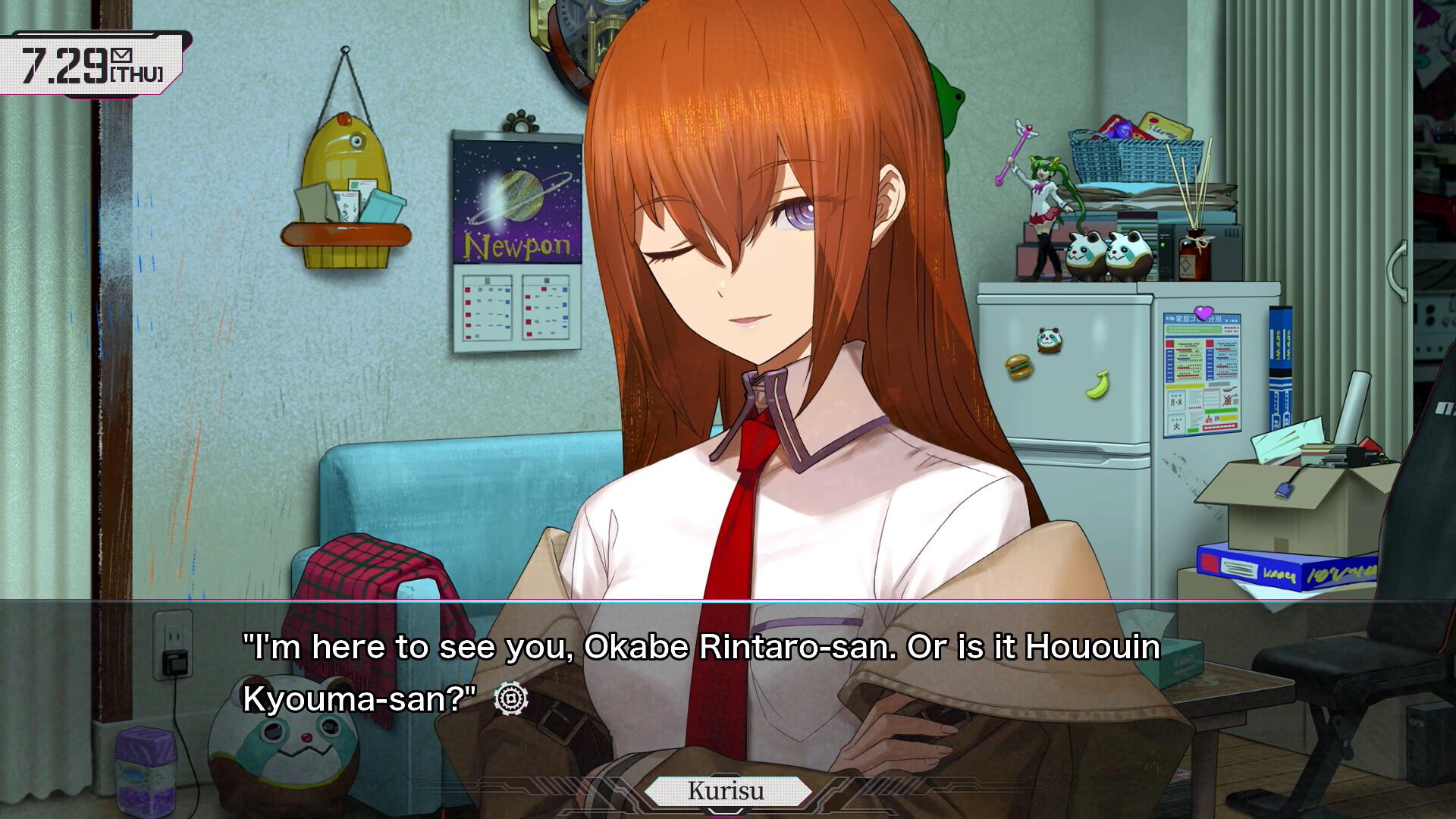
Finally, there's Okabe himself, who experiences some serious character growth throughout the game. He's by far the funniest character in Steins;Gate, provoking plenty of audible laughs thanks to his internal monologue and chūnibyō antics. While it's true the whole mad scientist thing does wear thin, if you play for long enough, you'll discover a tender, surprisingly sensitive reason for the persona.
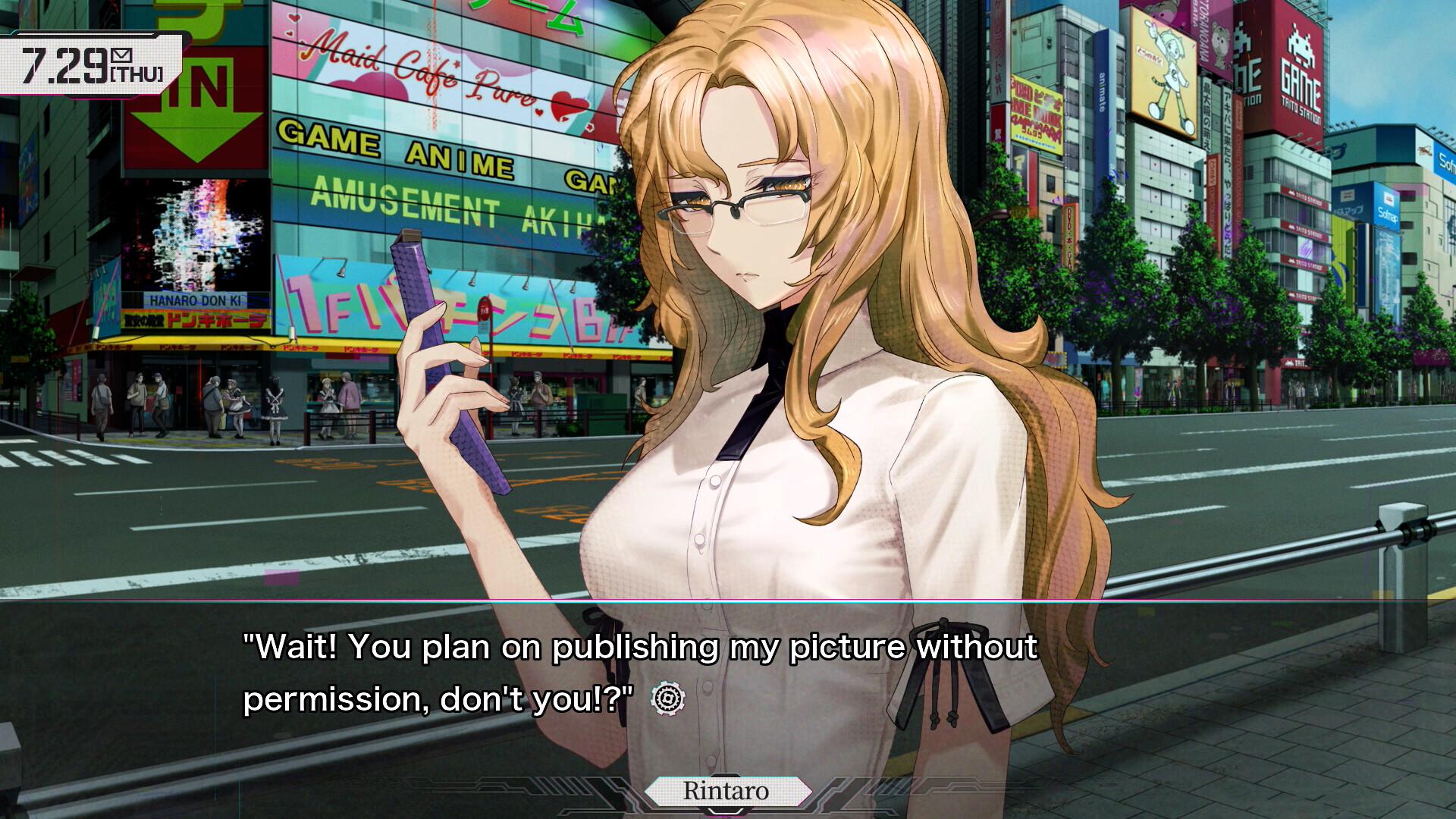
All of these characters are more alive and expressive than ever before due to changes introduced in this remake. Thanks to "E-mote", a 2D animation software engine developed by M2, characters are no longer static character sprites, but dynamic models that move, breathe, and subtly shift positions and facial expressions. What's more, original character designer Huke returned to update each character's outfits and accessories, adding new details and flourishes. Are these visual changes a complete victory? Not exactly. By embracing a cleaner, more modern anime look, the game has lost the original's graphic novel grit. Still, considering the scope of the changes — developer Mages doubled the number of event still images and increased the number of background visuals by ~20%, in addition to all the character revisions — it's a net positive.
The only visual hiccup comes when there are too many words in a character's comment. Instead of scrolling through the dialogue, the game compresses the entire paragraph to fit on one screen, which looks quite clumsy.
Despite that one oddity, Mages clearly invested a lot of time and energy on the visual components of the game. Unfortunately, it didn't touch the original game's biggest, most consequential problems. The first is that the story in Steins;Gate takes an unusually long time to get going. The dramatic catalyst takes place roughly 15 hours in, meaning that about 60 percent of the game is set-up. Now, to be fair to Mages, which co-developed the original game with Nitroplus, those hours are designed to immerse you in Okabe's world and make you grow attached to his friends, but there's no denying it's a very slow burn where the plot more or less treads water. Making matters worse is the fact that players have very little to do during this slow-moving slice-of-life time, apart from scrolling through dialogue and exposition and responding to email messages on Okabe's phone, which are mostly flavor text (with one big exception; more on that later).
Steins;Gate, both the original and the remake, would benefit greatly from being shorter and allowing players to make decisions earlier and more often. As is, you'll spend the great majority of your time simply pressing the A button to advance through dialogue. If you enable auto-mode, you don't even need to hold the controller.
Only in the final 10 hours do players have the opportunity to steer the narrative toward different conclusions. While these alternate endings are moving and provocative, they're not easily tracked. Unlike some other visual novel/adventure games, Steins;Gate doesn't have a flowchart that players can use to immediately jump back to a pivotal decision, allowing them to easily branch off toward a different ending. They must manually save before the decision, and then load that save to try something else. The game does have an Observer chart, which details consequential points in time, but you can't use it to warp to that spot. Unless you want to fast-forward through hours of text, you must use the game's many save slots to preserve those important junctures. It's not exactly an elegant, modern solution.
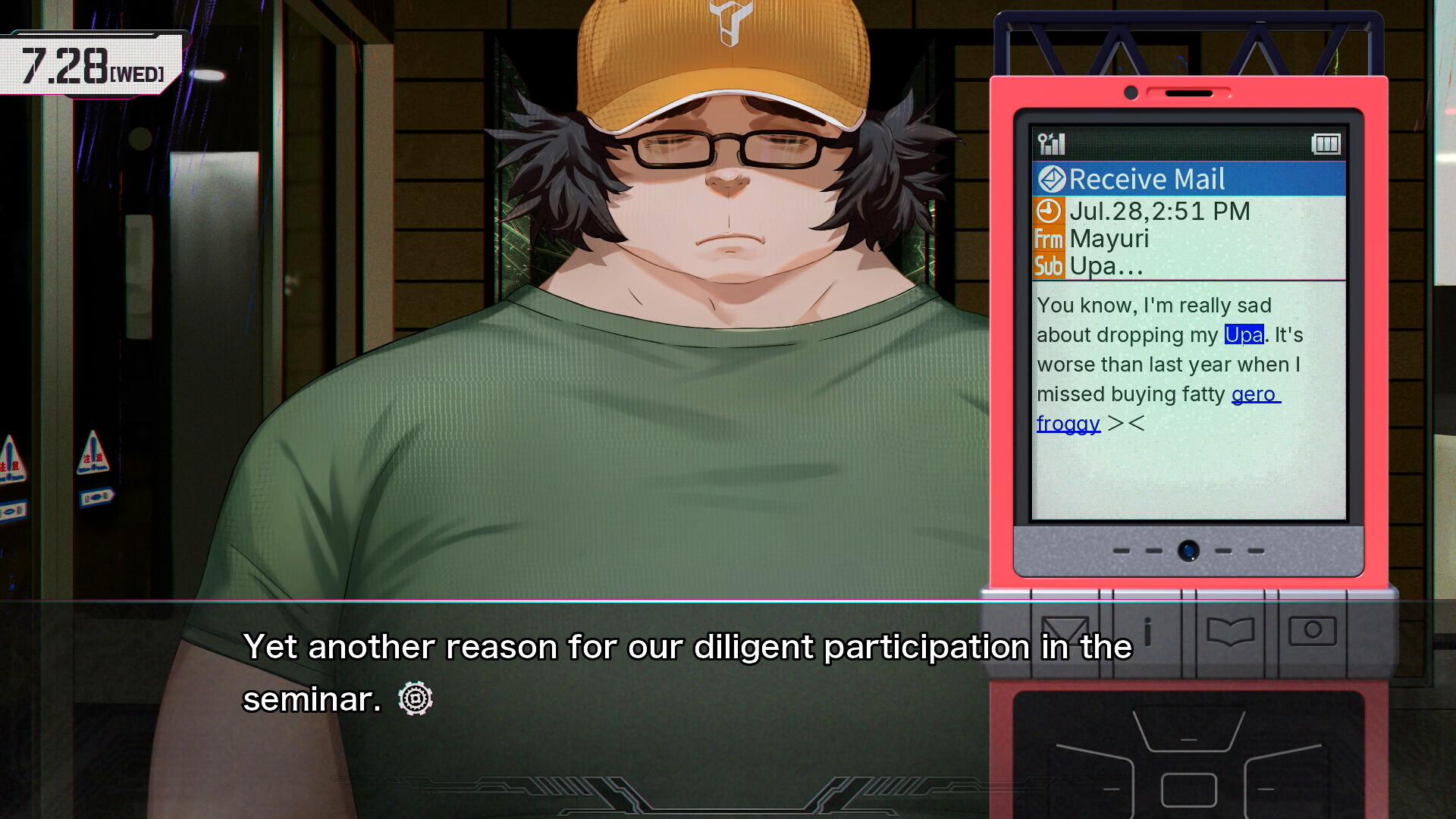
Even if you do get all the alternate endings by saving/loading your way through the story, you will almost certainly miss the true ending, which is a real gut punch in a game that makes you care deeply about the outcome of its world and heroes. Remember those email messages I mentioned before? While the great majority are there for flavor and world-building, or to flesh out the personalities of Okabe and his friends, a handful of them are essential to securing the true ending. When responding to certain messages from one of the main characters, you must select specific blue underlined keywords. The game won't tell you which word to choose, it won't provide feedback when you pick the right one, and if you happen to choose poorly on the first message, you'll be locked out of the remaining ones. The framework is practically invisible to the player; only with a walkthrough do you have a fighting chance. You shouldn't need to rely on an outside resource to see the full story in a video game, especially when the purpose of that video game is to tell a story.
Mages didn't make it any easier to arrive at every ending, but it did add a brand new one, which is a big deal. One of the main characters gets closure and players get a glimpse at a different reality. The studio also introduced new dialogue and narrative text throughout the story, providing a richer, deeper understanding of the world. One thing to note, for purists: this latest remake is built atop the script from the first remake, Steins;Gate Elite, which cut about 30% of the lines from the original. Re:Boot adds brand new lines, but doesn't reintroduce all of those cut back in 2019.
Finally, Mages worked with the original cast to re-record all in-game voices and partnered with original composer Takeshi Abo to remake all of the background music. It would be difficult to overestimate how amazing the voice acting and music are in Steins;Gate Re:Boot and how essential they are to its narrative power. I could listen to voice actors Mamoru Miyano, Kana Hanazawa, and Asami Imai speak all day.
Steins;Gate Re:Boot is a difficult game to judge. On one hand it features unforgettable characters, an inventive sci-fi setting, and a gripping, twisting story — all of which are elevated with updated art, re-recorded audio, and a new alternate ending — but on the other hand it offers very few opportunities for player agency (especially in the first 15 hours) and the process to unlock the true ending is hopelessly opaque. If you're a visual novel enthusiast who cares more about story than anything else, and you don't mind managing save files, Steins;Gate Re:Boot is worth the investment. Just be sure to pull up a walkthrough ahead of time.
VGChartz Verdict


6.5
Decent
This review is based on a digital copy of Steins;Gate Re:Boot for the NS2, provided by the publisher.