
History of Metal Gear: Dear Editor (Guns of the Patriots) - Article
by Taneli Palola , posted on 30 June 2018 / 9,027 Views
During its early life the PlayStation 3 wasn't exactly the most well regarded home console on the market. Releasing at a much higher price point than its two main competitors, lacking in important exclusive releases compared to the Wii or Xbox 360, and suffering from poor PR on Sony's part, the PS3 faced an uphill battle between 2006 and 2009. However, there were still some titles that did make gamers excited at the prospect of owning a PS3, despite its issues.
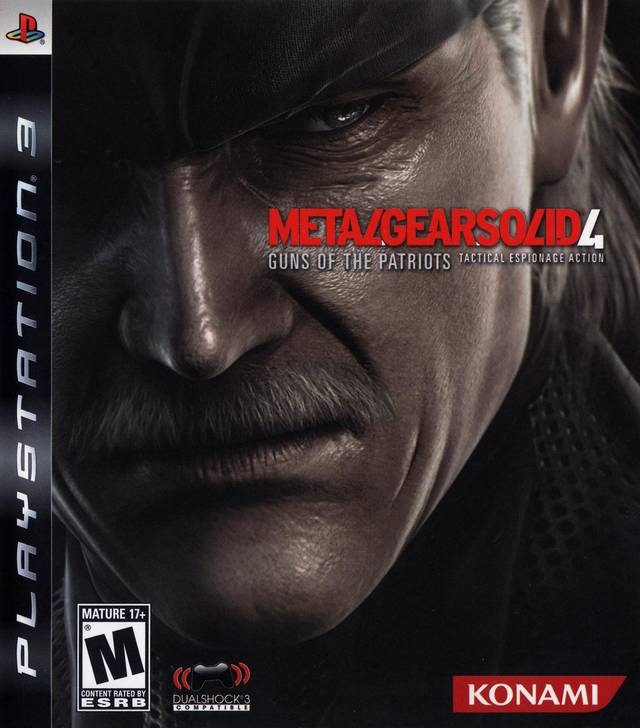
One of those titles was, without question, Metal Gear Solid 4: Guns of the Patriots. Not only was it a huge exclusive coming out at a time when the PS3 was severely lacking in that department, but it was also part of a series that had produced some of the best games on the previous two Sony home consoles. As such, it was quite understandable that many people placed a lot of weight on Kojima's next flagship project.
Metal Gear Solid 4: Guns of the Patriots – The Final Mission
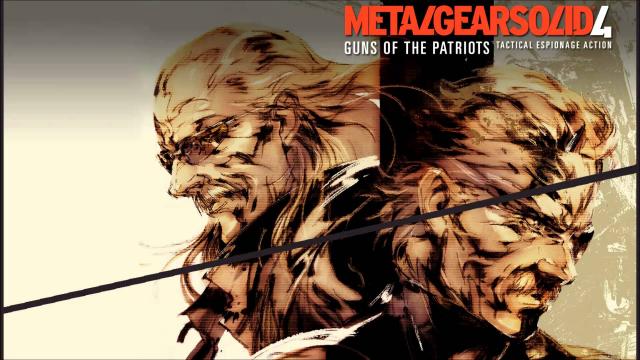
Hideo Kojima's initial plan for the series was to end it after Metal Gear Solid 3: Snake Eater and leave the questions left open at the end of Sons of Liberty as mysteries for players to resolve by themselves. However, strong fan demand eventually made him change his mind, and Guns of the Patriots went into production for Sony's then upcoming powerful new console, the PS3.
Furthermore, when plans were first put in place for the project, Kojima never intended to direct the game himself (he was only intending to serve as a writer and supervisor). Instead, Shuyo Murata, who had previously co-written MGS3 and directed Zone of the Enders: The 2nd Runner, was meant to direct the game. However, after some rather severe fan backlash that even included death threats, Kojima agreed to return as the game's co-director.
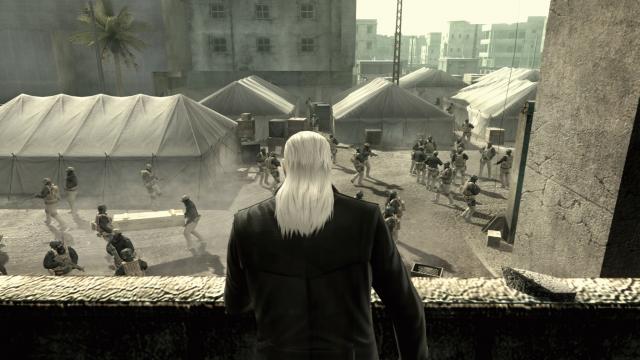
With Guns of the Patriots Kojima wanted to make a game that was set in a full-scale war zone, while still retaining the familiar stealth based gameplay the series was known for. This naturally presented the development team with many challenges when it came to designing the various environments found in the game. Kojima's goal also meant that it would take place across a number of different locations to show the large scale of the war taking place in MGS4.
The score once again saw Harry Gregson-Williams make a return to the series as composer, providing 14 of the score's tracks. The rest of it was for the most part created by a group of Konami's in-house composers, consisting of Nobuko Toda, Shuichi Kobori, and Kazuma Jinnouchi. Norihiko Hibino and his team also provided some additional music late in the game's production, marking the 6th time he was involved in creating music for the series.
The gameplay in Guns of the Patriots is similar to previous titles in the franchise, just with a number of tweaks and additions to the traditional formula. The usual mix of stealth, melee combat, and weapon-based combat is once again present, and the use of camouflage makes a return from Snake Eater, this time in the form a special suit called the OctoCamo suit that automatically adapts to the player's surroundings, mimicing the colour and texture of whatever surface Snake is against at the time.
A new addition is the Psyche meter, which is decreased by factors such as taking damage, being hunted by enemies, and extreme weather. Low Psyche can cause various different problems for Snake, including more frequent back pains, difficulties in aiming, and even passing out if he takes damage. The player can restore Snake's psyche by smoking, eating, or reading an adult magazine, for example.
Guns of the Patriots is set in 2014, five years after the events of Metal Gear Solid 2. The world has devolved into a near constant state of war as the world economy has become wholly dependent on Private Military Companies, whose armies now outnumber those of official government forces. Nanomachines have become ubiquitous in the field of war, as they are used by nearly every armed group to enhance and monitor the performance of their soldiers.
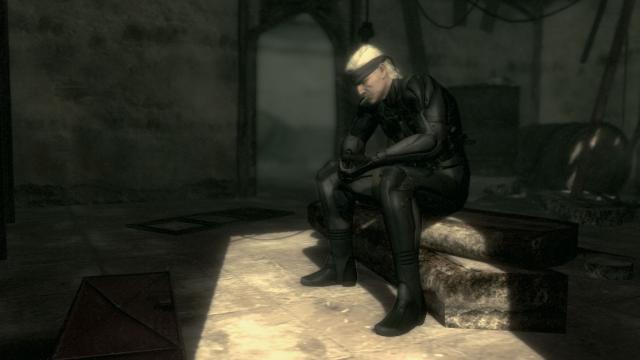
For the first time since the prologue chapter in MGS2, Solid Snake is the main playable character in a Metal Gear game, now going by the moniker Old Snake. Suffering from accelerated aging brought on by the FOXDIE virus and the cloning process through which he was born, Snake is given just one year to live. Despite this, he accepts one last mission from his former commanding officer Roy Campbell – to eliminate Liquid Ocelot.
Metal Gear Solid 4: Guns of the Patriots was released on June 12, 2008, and was an instant commercial and critical success. Not only did it sell extremely well upon release, but it also provided a massive boost to the sales of the struggling PS3. In the US alone PS3 sales roughly doubled over the previous month. To date MGS4 has sold 6 million copies worldwide, making it the third best-selling entry in the series history, trailing just slightly behind the first two Metal Gear Solid-titles.
Most Memorable Moment
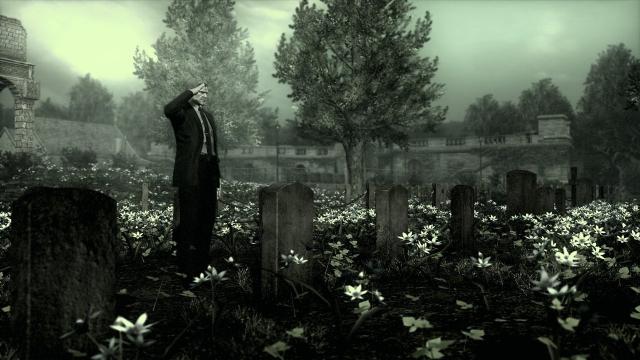
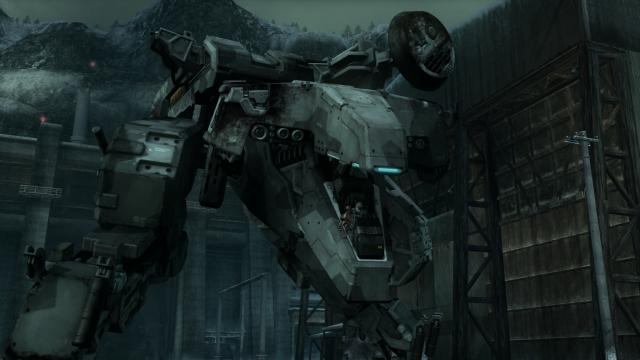
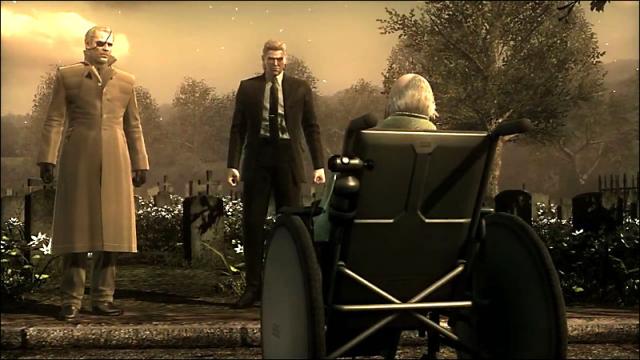
Just as with many of the other games in the series, it's very difficult to pick just one moment from Guns of the Patriots that stands above the rest. Arguments could be made for scenes and moments like the battle between Metal Gear REX and RAY at Shadow Moses, the entire Shadow Moses section, the climactic fist fight between Snake and Liquid, the graveyard scene with Snake and Big Boss, and many others.
However, for me personally, the scene that stands out the most is Old Snake's slow crawl through the radiation filled corridor in order to stop Outer Heaven. The entire scene is wonderfully put together, showing not only Snake's painful journey towards the core of Outer Heaven, but also the battle raging outside, his companions barely holding on as the odds are increasingly turning against them. Capping the scene is the excellent choice of music that perfectly complements the desperate struggle the characters are going through.
Does Guns of the Patriots Still Hold Up?
In most aspects, yes. Guns of the Patriots is without question a very good game, and one that is for the most part still a joy to play. It's not perfect by any means, and doesn't quite reach the same heights as the very best games in the series, but MGS4 is without a doubt an excellent game. However, it still has some notable flaws that we need to talk about, but before we get to those let's go over the good stuff first.
The most obvious high point is the music, which adheres to the high standards people have come to expect from the franchise. In fact, I would say that MGS4 contains some of the best pieces of music ever composed for the series. Another great aspect are the graphics that at the time were among the best in any game regardless of platform, and which to this day remain gorgeous to look at despite their age.
The gameplay in MGS4 is a lot of fun, with the changes and new additions fitting very well into the series continuity, taking what had worked in the past and improving on that in various ways. The new additions such as the psyche meter and the ability to purchase weapons also work wonderfully with the game's setting.
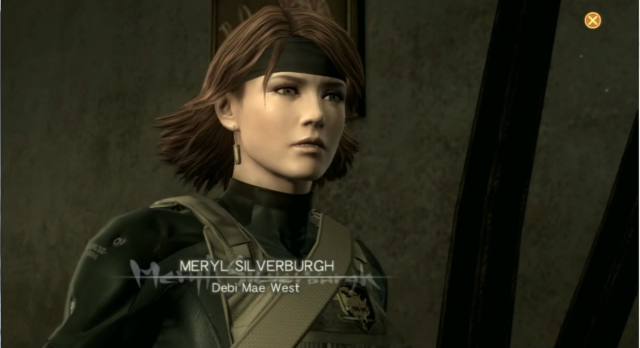
Guns of the Patriots also includes some of the most interesting and well written character development in the entire series. Every major character is given the spotlight at some point, and most of their stories have really memorable and often emotional conclusions. From Meryl Silverburgh to Otacon and Liquid Snake, everyone gets at least one defining moment in the game, and even many of the minor characters are given some time to shine.
The story in Guns of the Patriots feels appropriately heavy, as Solid Snake's failing health constantly looms over the entire narrative. For practically the entire time you're playing it, MGS4 essentially asks the player to quietly drag Snake towards his inevitable demise. This makes the game quite unique in that it explicitly tells us that there really isn't going to be a happy ending for the main character, and yet it still expects us to carry on until the end. This really makes the story stand out from most other video games.
Unfortunately, most of Guns of the Patriots' biggest issues are also related to its story, or perhaps more specifically, how its story is told. There are a lot of moments where things can get very confusing and convoluted, quite similar to the issues that plagued MGS2 with its overlapping conspiracy theories and overly complex plot twists. This is the game where some of Kojima's more questionable tendencies as a writer and director materialized in a big way.
Kojima has always been a rather verbose writer who often pushes his dialogue scenes to their breaking point in terms of length, but this is taken to a whole new level here. Any semblance of restraint is thrown right out the window the moment the game begins. Basically, Guns of the Patriots will seemingly never use just a few words to say something when it can instead spend several minutes expositing on the topic in an often heavy-handed manner.
If there ever was a game that desperately needed an editor to tighten its script, it's this one. When your cut-scenes begin to run over 30 minutes of game time, something's gone terribly wrong. The pacing is all over the place, and at times it's really easy to get completely lost in the constant twists and callbacks to previous games that require a great deal of knowledge of the series' overarching storyline to truly understand. Although I will fully admit that for many fans those same callbacks can be some of Guns of the Patriots' most memorable moments - and I can't deny that they got me a few times as well - they just make the title very difficult to get into for any players that are new to the series.
I can understand that Guns of the Patriots essentially needed to wrap up every single major storyline set up in all of the previous games, but this is no excuse for what are some of the most redundant and bloated scenes in video game history. Said scenes still often provide numerous highly effective and memorable moments, but to be perfectly honest, in most cases the same effect could have easily been achieved in half the time. Simply put, more isn't always better.
Among the more minor issues are the game's bosses, specifically the ”Beauty and the Beast” unit, which isn't nearly as memorable as the excellent bosses of previous titles in the series. Yet, there's no question that Guns of the Patriots was a hugely ambitious project, and for the most part that ambition paid off in spades. The conclusion to Solid Snake's story has a wonderfully emotional pay-off that serves as a fitting send-off to one of gaming's most beloved characters.
Unlike most other games in the series that can quite easily be found on multiple platforms, Guns of the Patriots has only ever been released on the PlayStation 3. As such, while I strongly recommend that anyone who is even slightly interested in trying it out should play MGS4, it does mean that you need to own a PS3 to do so. Still, it's not like this is a difficult game to find, especially as its also available for purchase on the PlayStation Store.
Fun Fact
The initial plan for Guns of the Patriots was for the game to end with Snake and Otacon giving themselves in for breaking the law, and subsequently being convicted and executed. However, Kojima eventually abandoned this idea because of the negative reception it got from the rest of the development team.
Sources:
-Hideo Kojima Interview (Konami)
-Hideo Kojima Interview (Gamespot)
-Norihiko Hibino Interview (Original Sound Version)