


Gears of War: E-Day Uses SSD on Xbox Series S as Makeshift RAM to Help Game Run Better - News
by William D'Angelo , posted 1 day ago / 2,809 Views
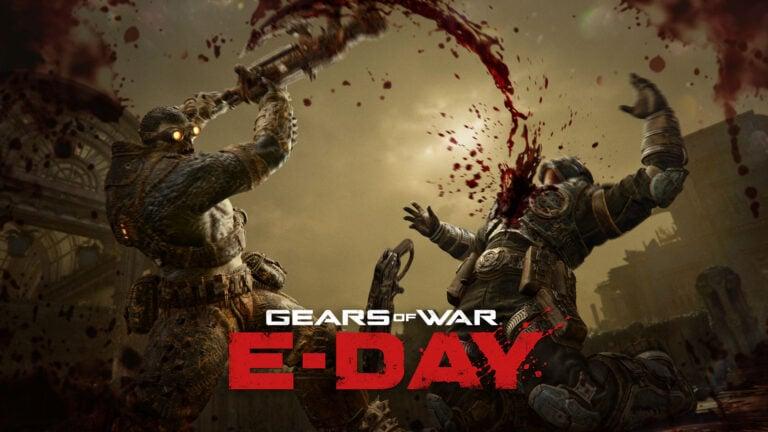
The Coalition technical director Kate speaking with Digital Foundry revealed the studio used the SSD storage in the Xbox Series S as Makeshift RAM to get Gears of War: E-Day running more smoothly than it would have otherwise.
The Xbox Series S comes with 10GB of RAM, while the more powerful Xbox Series X and PlayStation 5 have 16 GB of RAM.
The article reveals there is a "hierarchy of data storage that successively trades off speed for capacity: caches on a CPU are super-fast but hold only a tiny amount of data, RAM serves a middle ground and SSDs have a huge amount of storage but access times many many times slower. If the data you're working on can't be kept in the CPU, it goes to the RAM; if it's expelled from RAM, you have to read it out of storage, taking a speed penalty at every stage.
"The Coalition's system lets the game use the NVMe drive as random access memory, giving the streaming system enough to room to load and hold the complex city data. Memory that isn't being actively accessed is stored on disk, and what's needed at that moment is moved into system RAM. It's similar to paged virtual memory, with one important difference: it only covers specific subsets of memory that the team has decided won't slow the game down if they have to come back from the drive. The benefit is that, in exchange for a couple of gigabytes of storage on the SSD, you can gain about a gigabyte of usable system memory.
"Deciding what gets paged out is where most of the special sauce lies. The Coalition use advanced heuristics to make that call, with the system tracking access patterns and seeing which data was used most recently. Memory that isn't used in a frame, or over a run of frames, becomes a candidate for paging. Frequently used data stays in RAM, and anything idle can move to the SSD. It only works because the NVMe drive is fast enough to bring paged data back without the player noticing - a nice workaround that ameliorates one of the biggest issues with the Series S.
"The developers say that the game's density wouldn't have been possible with the use of the technique. The world contains around 1.6 million actors, so fitting everything into Series S memory became the baseline for all of the game's scaling work. The Series S is far from a slow platform - its CPU runs rings around last-gen machines like the Xbox One X and PS4 Pro - it's just about making the most of its 10GB of shared GDDR6 memory, versus the 16GB of the Xbox Series X. With this system in place, only one major feature had to be cut - Lumen reflections - in order to get a reasonable 60fps lock."
Gears of War: E-Day will launch for the Xbox Series X|S, PC via Steam and Microsoft Store, and Xbox Game Pass on October 6.
A life-long and avid gamer, William D'Angelo was first introduced to VGChartz in 2007. After years of supporting the site, he was brought on in 2010 as a junior analyst, working his way up to lead analyst in 2012 and taking over the hardware estimates in 2017. He has expanded his involvement in the gaming community by producing content on his own YouTube channel and Twitch channel. You can follow the author on Bluesky.
More Articles

Nice they finally figured out how to use virtual memory... something Windows has been able to do since 3.0

They always knew, good Developers like the Coalition utilise both consoles, same as all 1st party Xbox studios. Which is why when Xbox release a 1st party title, it holds up extremely well on Series S.

Good i dusted my series s and got gears pre ordered. Finally a game that takes the system seriously.

I also wonder why nobody else has done this before when it sounds so obvious. I always liked the whole idea behind the Series S, and its reveal trailer in my opinion was the most fire one of this gen by far. I myself was always going to buy the Series X, for physical media and performance, but felt the Series S had so much appeal. So it was bit of a pity to me it did not catch on as expected, and the latest when games started being delayed on Xbox due to problems with the Series S version, the reputation of the little box went really bad. Now finally they came to think of another workaround to show the machine can handle more than many thought.
Overall, optimization breakthroughs late in a generation are what I also love about console gaming. Kind of reminds me of when the N64 notoriously had hardly any voice acting due to cartridge storage limitations and the sentiment was: if you want voice acting, you have to go to Playstation/ Saturn. And then Factor 5 found a new compression method (IIRC) and in the end Conker's Bad Fur Day had hours of voice acting on a N64 cartridge.

10 GB RAM, even at faster speeds than the 12 GB RAM of One X and Switch 2 is not ideal. 10 GB was used to bring the cost down over 12 GB.
But you know what's crazy? With the memory and price crisis right now, Series S would probably be $50 to $100 more if it had 12 GB RAM at the same speed instead of the 10 GB it has.