



Fable Gets New Details on How Combat Works - News
by William D'Angelo , posted on 01 September 2026 / 3,133 Views
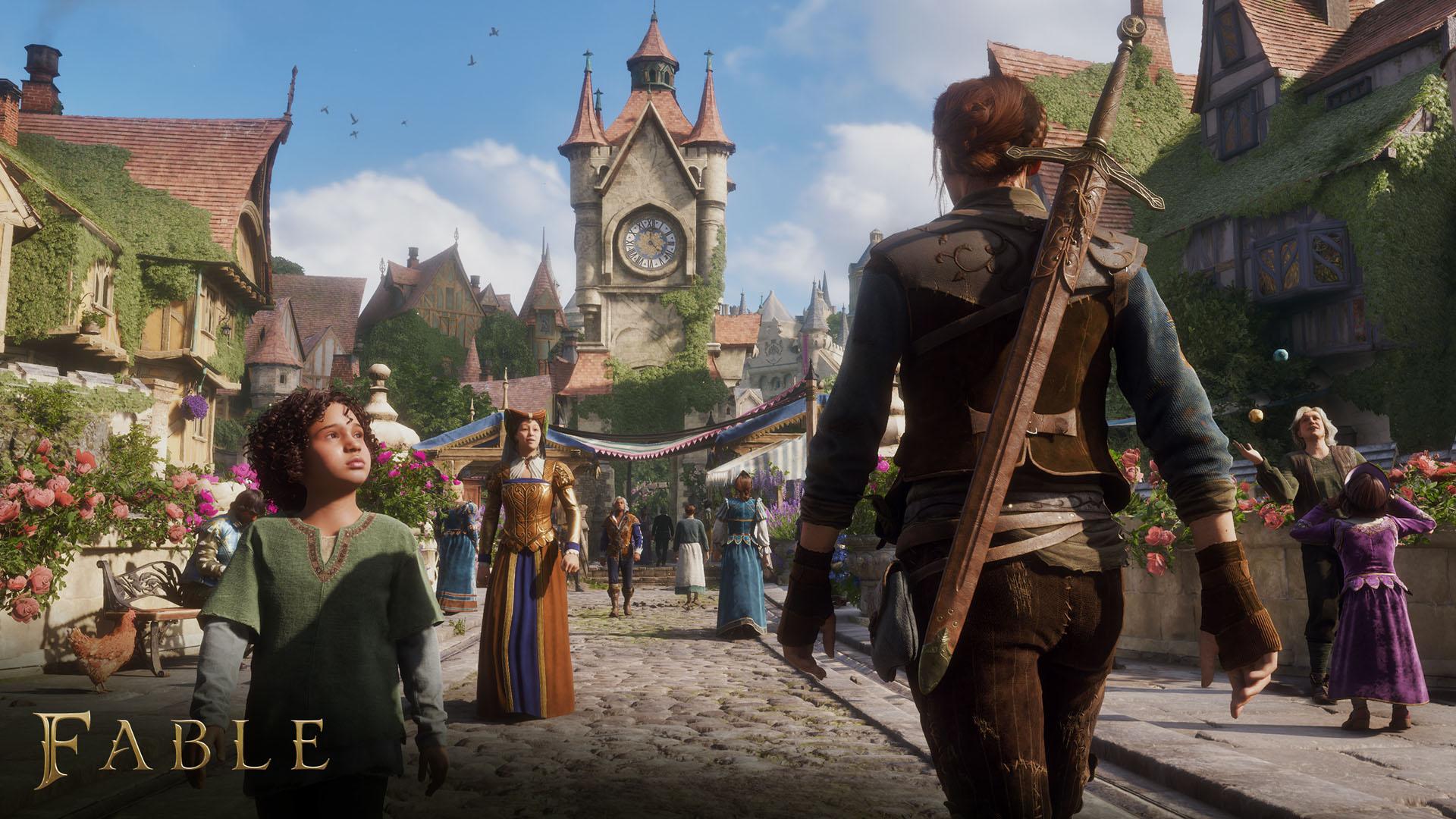
Developer Playground Games in a new Xbox Wire post has provided new details on how the combat works in the upcoming open-world RPG, Fable.
Fable will launch for the for the PlayStation 5, Xbox Series X|S, PC via Steam and Microsoft Store, and Xbox Game Pass on February 23, 2027.
View a new gameplay video below:
Read the new combat details below:
We’ve seen the grand overview at Developer_Direct, a look at the story and cast in the trailers, and had a walkthrough of the Living Population – but at gamescom 2026, Playground Games gave us our biggest look yet at how Fable’s combat will work in the form of a first ever demo for press and creators.
In a quest titled ‘Mud and Death’, The Hero joins the leader of the Heroes’ Guild, Humphry on a trip into a once-flooded, now-haunted mine packed with ghosts and skeletons alike – a perfect place to test out your burgeoning set of combat options.
Playground’s Fable sees an evolution of the classic “Strength, Skill and Will” systems of the original trilogy, allowing you seamlessly switch between melee, ranged, and magic options as you fight – with your choice of equipment and skills drastically altering how you play. To make that variety of choice abundantly clear, I was lucky enough to play the same demo twice – with two different loadouts. Let me talk you through everything I played with.
Melee
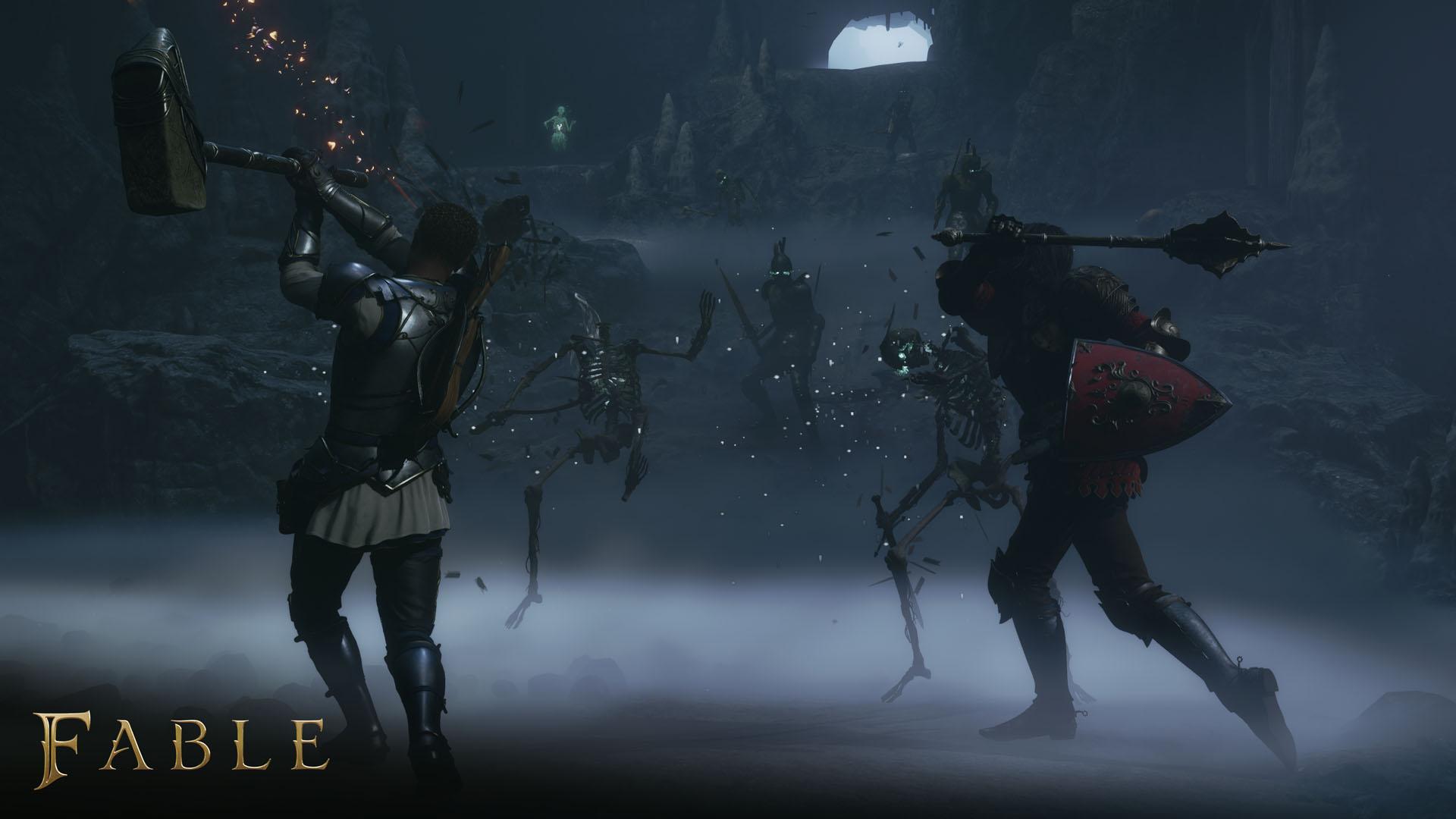
In both playthroughs, my Hero was equipped with a two-handed Bower Hammer – and, in a neat touch, Humphry calls out your choice of weapon on the way into the mine. As you’d expect, the hammer is a slower, more powerful choice, able to take out weaker enemies in a single hit. And once armored enemies began appearing, it really showed its utility.
It comes with the added bonus of having a huge swing, able to hit multiple enemies in a single button-press. That’s only improved with a charge attack that sends you spinning across the room with multiple strikes.
Aside from the strikes themselves, the Hero can also dodge and parry attacks – parries can even cause a skeleton’s head come clean off, sending them staggering, open to counter attacks, and far less accurate even if you don’t follow up with a final blow. Add to that some weapon-specific finisher moves and you’re left with energetic, responsive melee combat, built for flair.
Spells
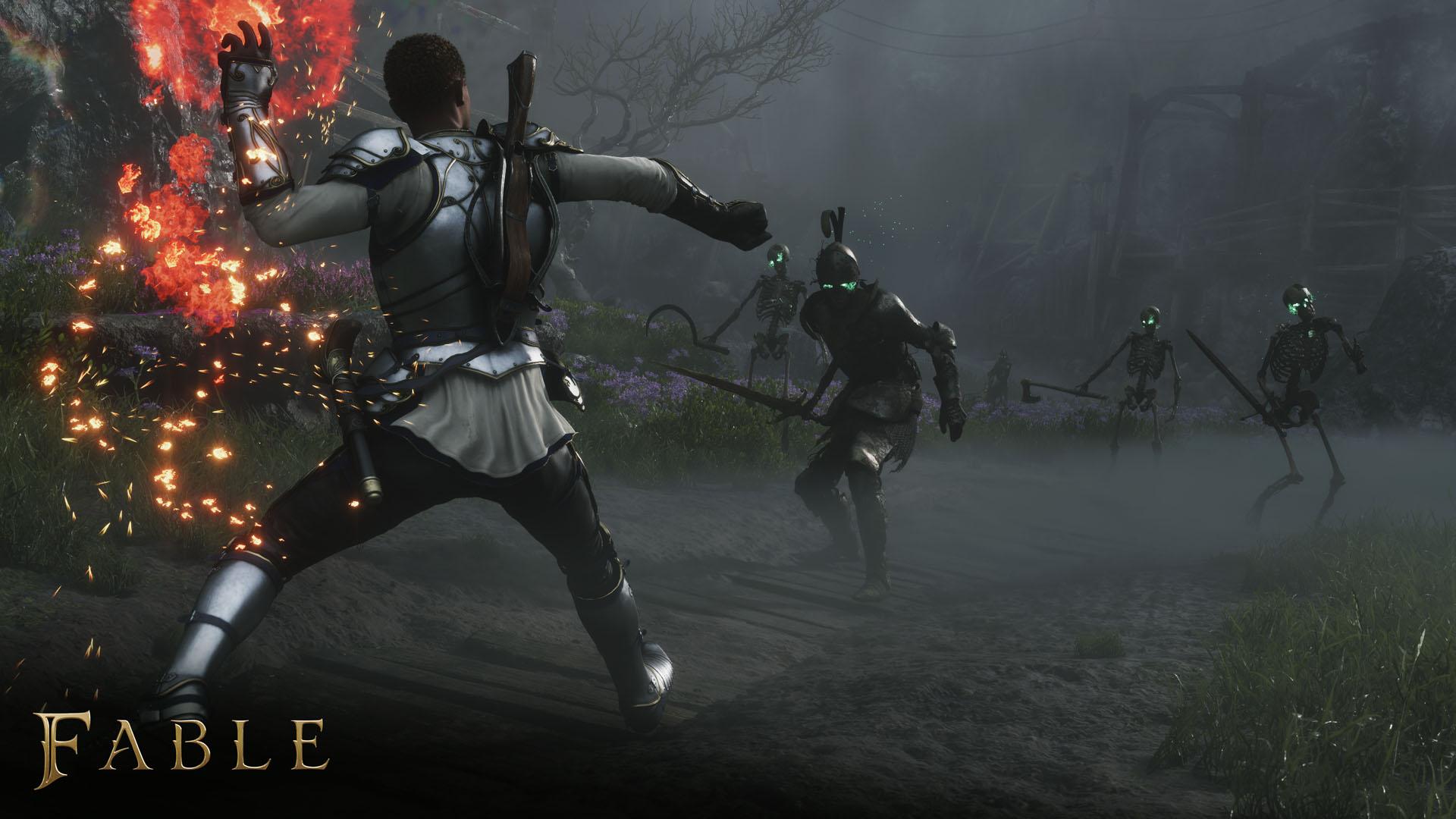
This demo was set a little way into the game, and the Hero came with a fully-stocked spell menu – hold RT and press one of the ABXY buttons to cast the spell from any one of four slots, which then puts it on a cooldown.
My two playthroughs meant I got to mess with a diverse palette of magical options:
- Fireball can be popped off for a quick interrupt, or be charged up for a room-clearing explosion.
- Lightning sends down bolts that can chain to nearby enemies.
- The Blades spell spawns phantom daggers, perfect for taking out multiple faraway threats.
- Lift is a great utility option. Cast it once, and multiple enemies can be drawn helplessly into the air, letting you follow up with ranged attacks or, even more spectacularly, Lightning. But cast it again once they’re lifted and you’ll slam the entire group back down to earth.
- Rush is a teleportation spell that pops you up behind a target for an unexpected melee attack. It also comes with the added bonus of letting you travel vertically, taking the fight directly to pesky archers in less-accessible areas.
- Push does what it says on the tin, forcing enemies back from around you. It’s a great potential combo with Rush – get behind an enemy on a ledge, then just push them straight off to their doom.
- Finally, Befowl lets you really indulge in a classic Fable motif – by turning people into chickens. Once they’re Befowled, they’re effectively harmless, letting you focus on other targets. Or, of course, you can boot them away. In a lovely detail, casting Befowl on an undead enemy creates, well, an undead chicken.
It’s already clear that the kinds of spells you pick can fundamentally alter how you play – you can see this allowing for builds centered on ranged, up-close, evasive, or AOE playstyles. Or you could simply fill in any gaps you may have created through your choices of physical weaponry.
Ranged
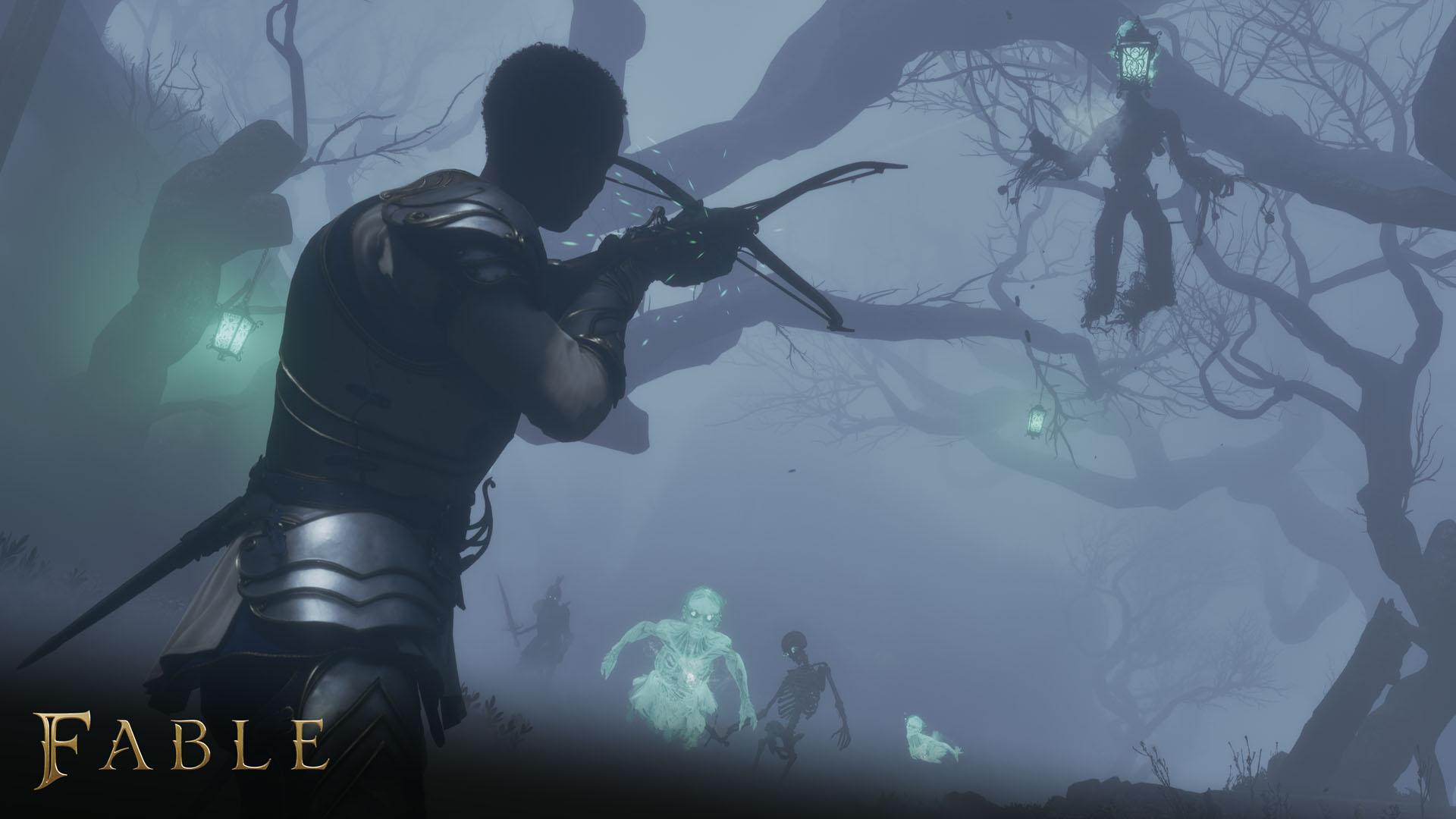
Rounding it all out is ranged combat. In my two playthroughs, the Hero brought along two different options. The first was a Deepwood Bow, which has a slower draw speed, but high accuracy, perfect for popping off skeleton heads before you get into the thick of battle.
Next time around, it was the Repeater Crossbow, which lets out a hail of weaker bolts at high-speed. This was particularly useful against Wraiths, who went down to a couple of bolts – I found myself clearing out all the Wraiths I could with a quick burst, before turning my attention to stronger enemies up close.
Ranged attacks also have the benefit of letting you hit weakspots most effectively – shooting an unarmored enemy in the leg causes them to stumble, for example. Later in the demo, I came up against the far stronger Lantern Keeper, who can fly, and the ranged weapons truly showed their worth, letting me hit its lantern weakspot more effectively than any of my spells.
Strength, Skill, and Will
Of course, what matters most is how all of this ties together. As you can tell from the above, it’s immediately intuitive how you can use all of these abilities in tandem – for example: use a spell to impede a group of weaker enemies, use a ranged attack to stagger a stronger foe, then set them up for a finisher with melee.
There’s no fussing with menus or loadout bars, just a clear set of abilities, all easily accessible on the controller, letting you pick your equipment and capitalise on it with the minimum amount of busywork.
But despite that ease of use, my two playthroughs make it abundantly clear how much possibility space is being left for when you’re preparing for combat – picking your weapons and spells can stack up to create wildly different playstyles.
Enemies
But there’s no combat without someone to fight. From my time with the game, I already have a sense of how different enemies will provide different challenges:
- Hollow Folk is the collective name for Fable’s skeleton enemies, and they come in multiple forms. I saw melee-focused, ranged-focused, or armored variants – the last of which are immune to your ranged attacks, adding some texture to a fight and forcing you to think more deeply about how you take on a larger group. All Hollow Folk can be dismembered (so long as they’re not wearing armour on your chosen body part), but will keep coming at you despite their impairments.
- Wraiths are fast, flying ghosts – very weak, but dangerous if not dealt with quickly. They have a tendency to spawn and inhabit even more Hollow Folk within a fight, meaning things can get out of hand if you don’t prioritize getting rid of them. Even when you defeat the Hollows they’ve spawned, they’ll pop out for a second stage of the fight.
- Finally, the Lantern Keeper is a mini-boss. Large and slow, but able to fly and with a serious healthbar, they come with an unblockable fire breath ranged attack, explosive projectiles, and can actively spawn Wraiths.
What’s immediately evident is that Playground isn’t skimping on the number of enemies you’ll be fighting at any one time – not only did it regularly throw large groups at me, even in the Lantern Keeper fight, but the fact that most enemies can spawn other enemies means that those groups can keep growing if not dealt with effectively. You’ll need to be quick on your toes and trigger fingers.
A life-long and avid gamer, William D'Angelo was first introduced to VGChartz in 2007. After years of supporting the site, he was brought on in 2010 as a junior analyst, working his way up to lead analyst in 2012 and taking over the hardware estimates in 2017. He has expanded his involvement in the gaming community by producing content on his own YouTube channel and Twitch channel. You can follow the author on Bluesky.