Existing User Log In
New User Registration


Register for a free account to gain full access to the VGChartz Network and join our thriving community.





America - Front

America - Back

Mega Cat Studios
Action
 (Add Date)
 (Add Date)
 (Add Date)
| Owners: | 0 |
| Favorite: | 0 |
| Tracked: | 0 |
| Wishlist: | 0 |
| Now Playing: | 0 |
Reviewer's Note: While it's easier to make non-specific storytelling critiques here, some SPOILERS will nonetheless be necessary. Read on at your own risk.
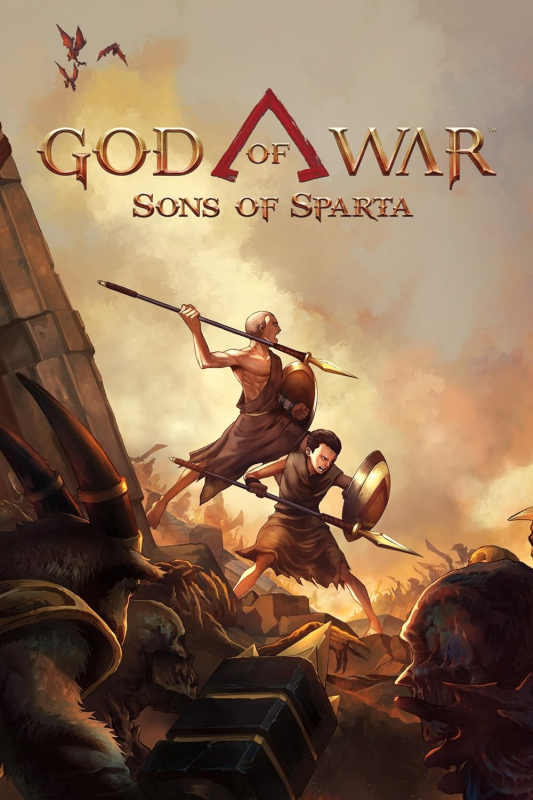
For a God of War spinoff sporting a pixelated art style, perhaps its most surprising turn is seeing Kratos quickly pinned by a mere Cyclops. After all, a generic foot soldier like himself constantly says "a good Spartan never lets his back hit the ground." But this moment of weakness calls attention to the Sons of Sparta subtitle: Deimos rescuing his older brother before they defeat the beast together. To their credit, it's daunting to battle giants without mythical weapons… while also going through puberty. Mega Cat Studios and Sony Santa Monica's coming-of-age prequel delves into a time before Kratos' notable strength and any semblance of personality.
This isn't the whole story though. In keeping with the Greek Saga's spirit, these events are a long flashback narrated by Kratos to his daughter, Calliope. A recent outburst with her mother gives the pair some alone time, which prompts a rather typical tale about family, duty, and so on. The lion's share sticks to the younger pair's search for a missing pupil – named Vasilis – but with occasional present-day interjections as a means to show his shifted outlook since then.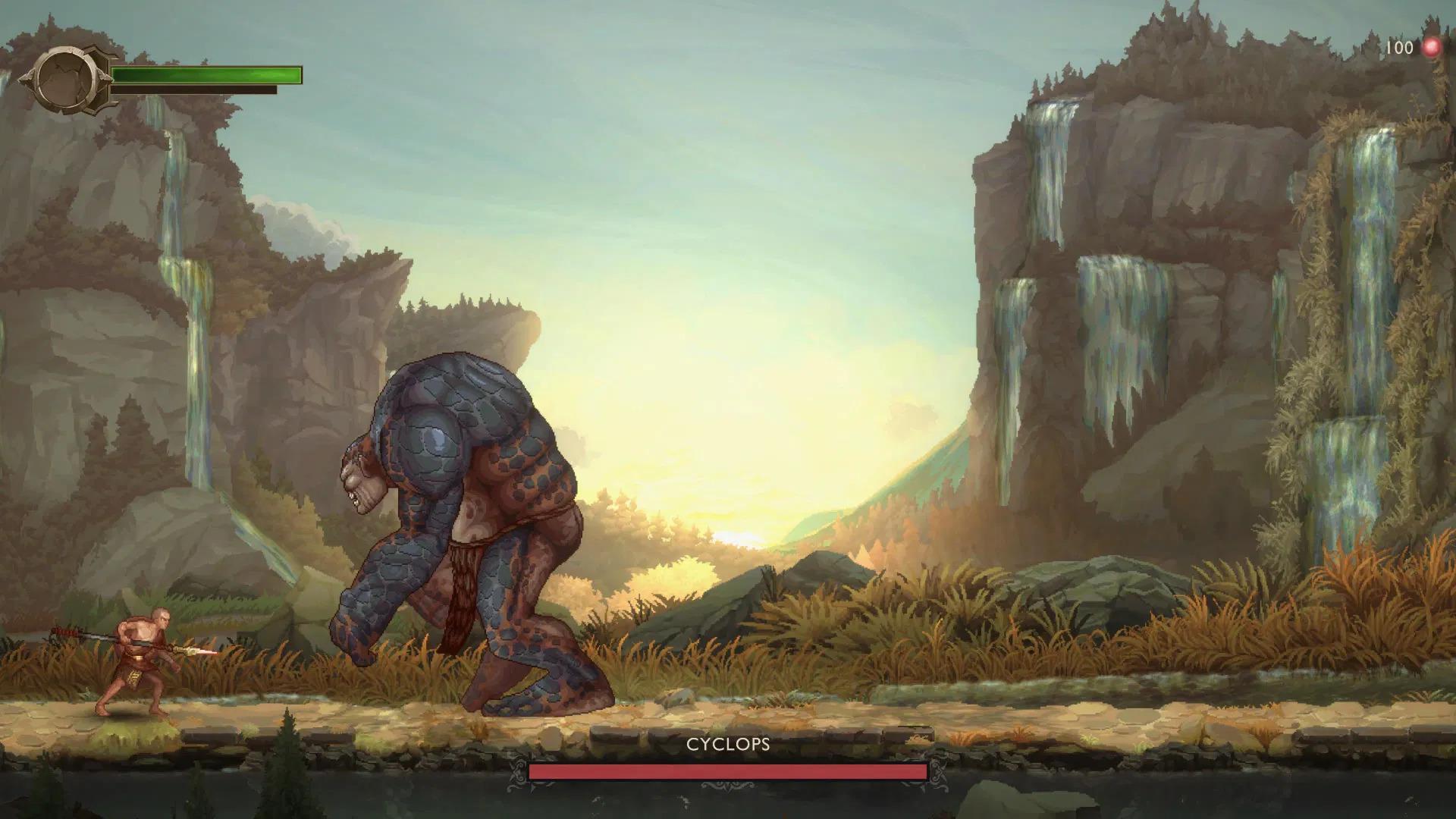
A fine gesture at greater world-building, but also internally confusing for a Metroidvania. "So then, daughter, I returned to the same Laconian woods with my new double-jump ability to reach a special item to upgrade my health bar." Even if only telling an abridged version, its flashback structure serves as the first signal of defanging Kratos & Deimos to excessive degrees. It's less to do with a singular aspect that obviously wouldn't be included (like overtly sexual themes) but rather an ethos towards a family-focused adventure facing mythological creatures with a hard T-rated edge. Have them endlessly recite chauvinist Spartan maxims without really grappling with this militaristic culture; it's just Sparta translated by Disney/Marvel with more blood.
Despite similarities to The Greek Saga's structure, the devil is in the details. Clunky as it often was, the original trilogy's expositional dialogue was trying to emulate Greek plays to give its bigger scenes more gravitas. It was understood as a natural by-product similar to early "talkie" films having actors with limited vocal ranges due both to expectations and imperfect recording technology. And since Greek mythology isn't well-known today, enunciating encyclopedic blurbs for Gods and Titans was important for ensuring players could follow along. Conversely, Sons of Sparta feels like Hollywood hacks getting free license to fuse Kratos' pre-established militaristic fervor with the premade traits of a young-teenaged protagonist in a modern cartoon.
The reference is fitting given how Deimos' actor Scott Menville is recycling Teen Titans Robin. He's the most emulative of the type of casting and tone Sony Santa Monica wanted for an edgier Nickelodeon show. There are some nice acknowledgments too, such as the sonorous TC Carson (Greek God of War saga) and Anthony Del Rio (Ghost of Sparta) reprising their respective Kratos roles, and extra detail to this era's world-building, but the overall remains tainted by quip-laden hollowness. And it's impossible to look past that moment-to-moment characterization when the main plot is basically "Vasilis is in another castle" until the finale.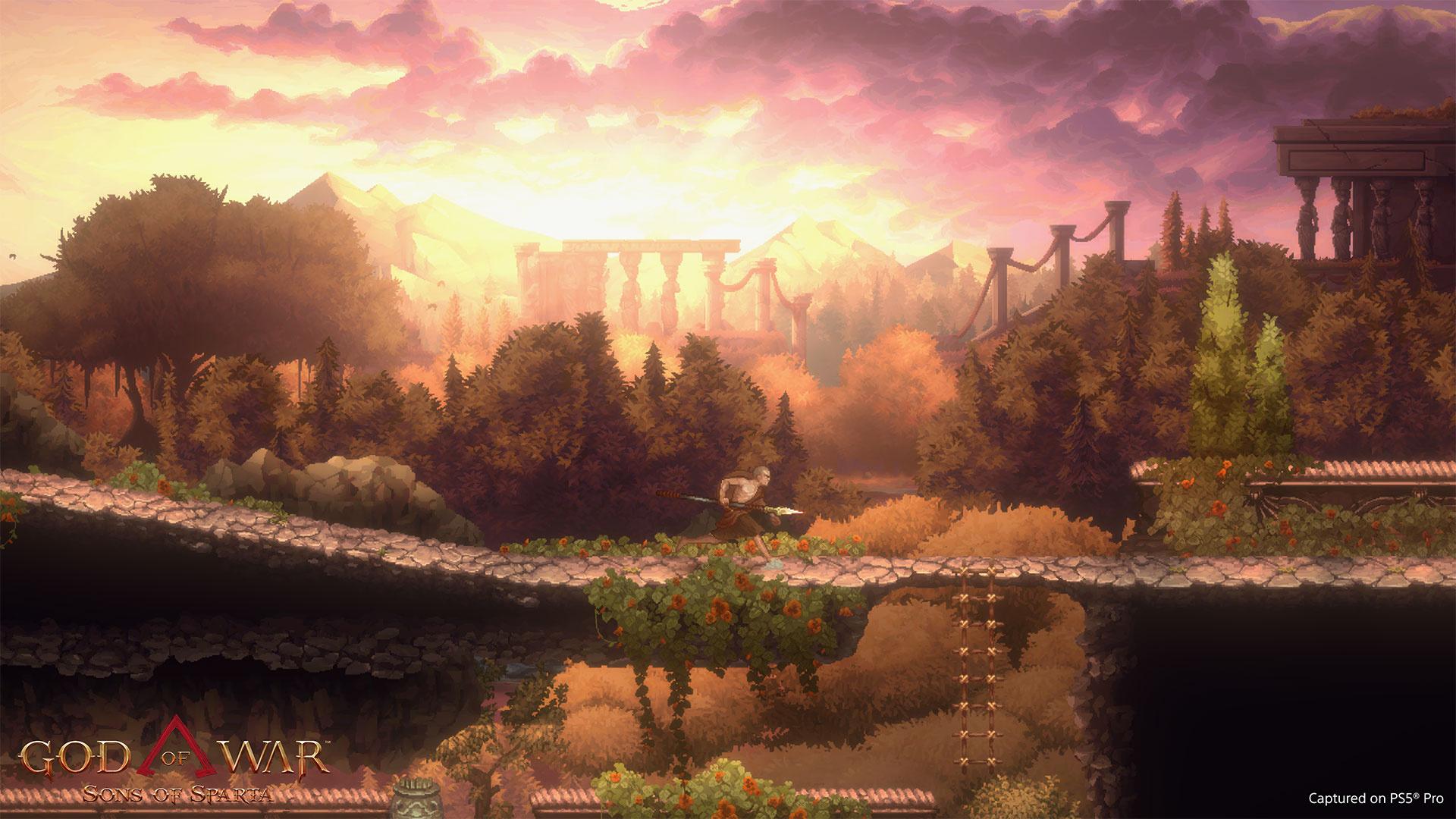
At least that continually rehashed excuse means there are over a dozen unique environments to explore. As a Metroidvania, it's structurally sound. That trifecta of exploration, puzzle design, and combat is harmonized here through various blockades that can be revisited once acquiring gifts from the gods – such as Apollo's slingshot, Nike's sandals, and so on. The plethora of biomes help in mentally land-marking distinct altars and olive trees, which are necessary in upgrading these special-use items. That variety also means an expansive amount of unique enemy types – from winged pests to imposing colossi – that flesh out interesting challenge rooms, the best of which balance combat and puzzles in unison. Mega Cat knows the broad strokes.
Once again, though, the devil is in the details. Although some alterations can be made to its confused default controls (down + triangle to drop from platforms?), aiming and movement is currently restricted to control sticks. Given how stabbing with Kratos' dory sticks to the standard 8 directions – instead of full 360-degree control – combat feels clunky; a reflexive misstep with your finger will result in jabbing at air to your 2 'o clock instead of hitting the bat flying directly above. A technique move ties both the block and attack buttons together, which is destined to be misapplied. No consistent action cancelling system means it's harder to keep a flow between offense and defense.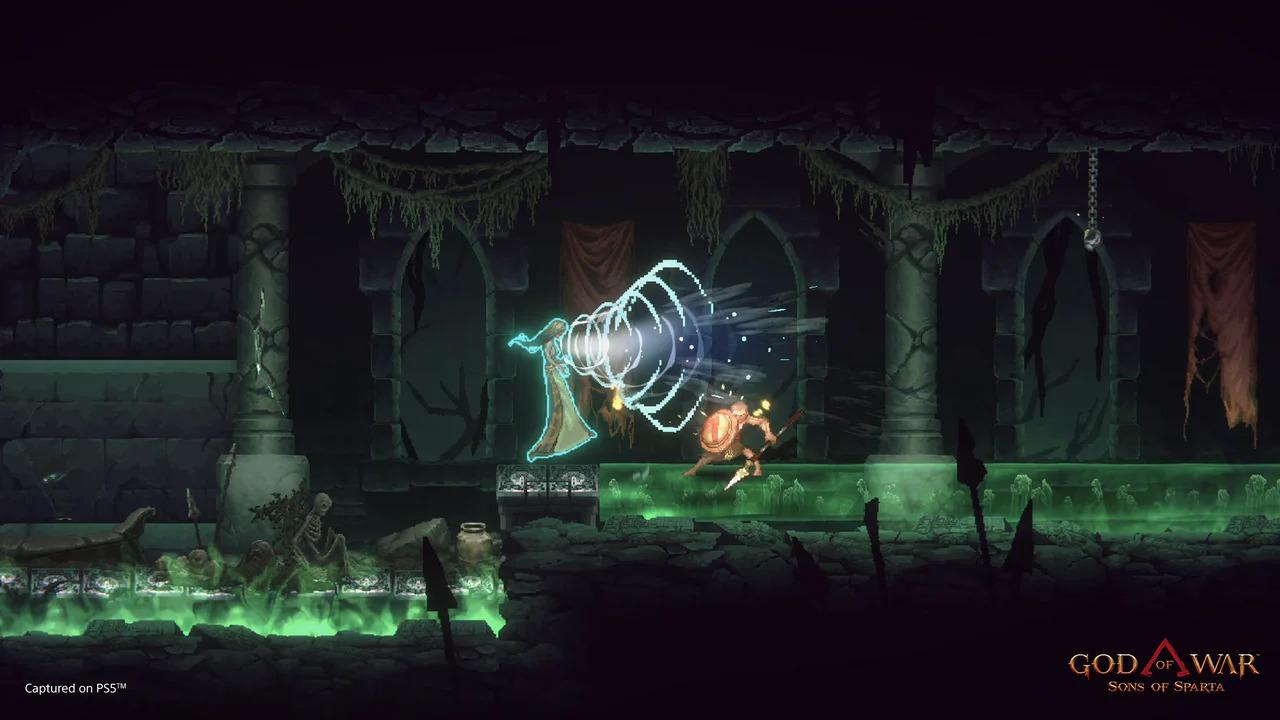
It's the story of a dozen paper cuts that are then highlighted across the wider world. Certain enemy attacks have colored outlines: one can't be blocked, but can be parried (yellow); one can only be blocked, but not evaded or parried (blue); and so on and so forth. The rock-paper-scissors system is fine in principle, but most often the best tactic is to dodge-roll through their animation and strike from behind. Enemy AI can be ripe for abuse when idling by a platform's edge at lower or higher elevations; cheesing minions is a common thing, but the occasionally-broken pathfinding can also lead to them blocking your ascent. And when stronger enemies are clustered across separate platforms, there's a chance of being batted around – especially without knockdown invincibility. A crucial knockdown can cascade to losing half a health bar in mere seconds on Spartan difficulty.
Certain punishments can be punitive, but most call attention to potential upgrades – either in Kratos' moveset or materiel. The former relies solely on accumulating red orbs while the latter demands orbs and a particular craftable item (iron, putrescent flesh, etc.), depending on what's being improved. The early economy for both categories is stringent to keep things simpler. Both for story context and design, restraining Kratos and enemy levels to single digits is to make these gains one of inches instead of miles. That deliberate drip-feed of sugar works because of the world's volume of options; even when combat gets too routine, the temptation of clearing yet another stupid combat rooms works just enough because of that promise of easier fights down the road. It's the one singular aspect Mega Cat perfectly balanced in the lab.
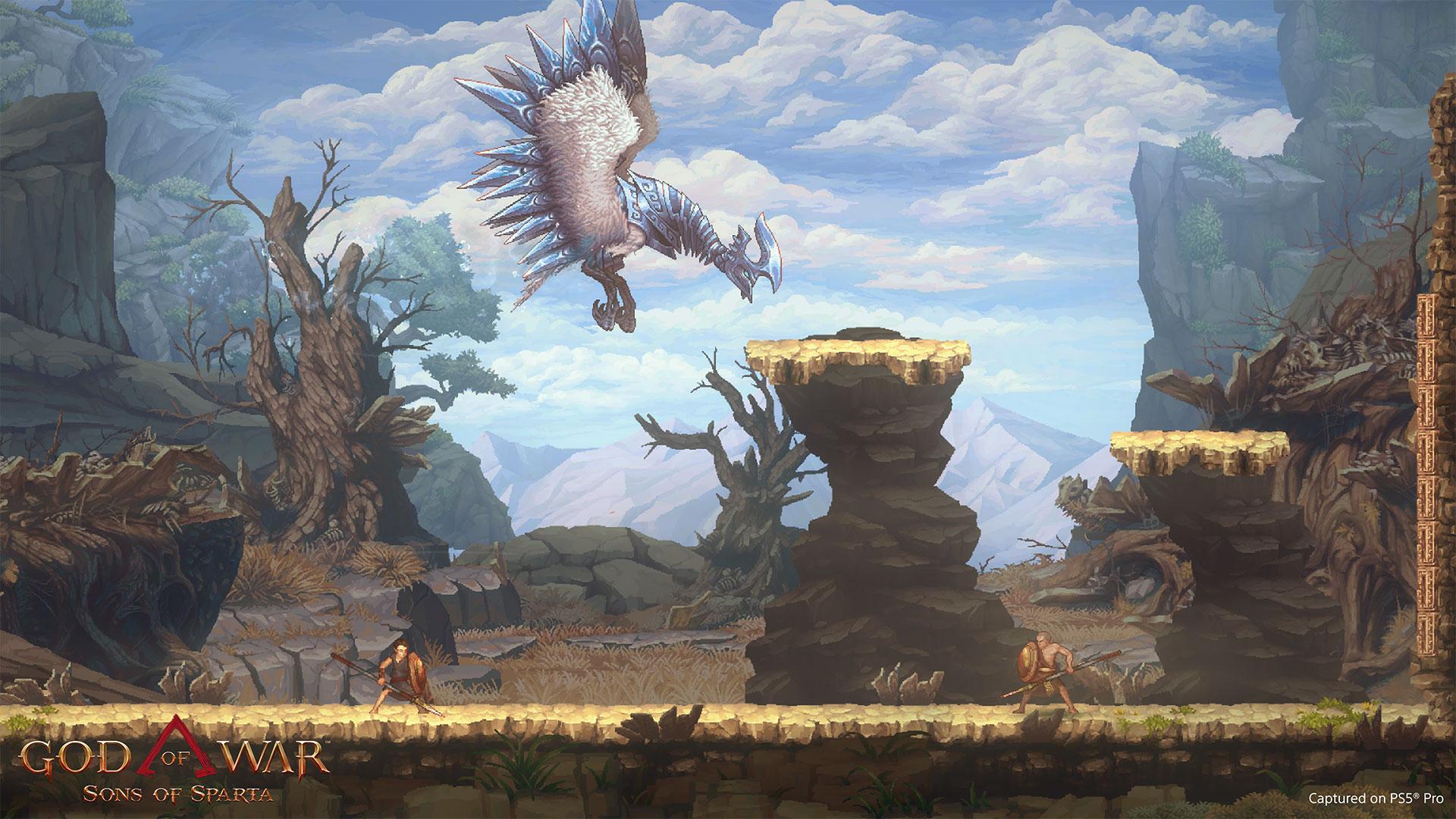
It's probably no small comfort to say Sons of Sparta plays better than it looks. Describing this as a "passion project" for the pixel-bit era while retailing for $30 (and $40 Digital Deluxe), in a sea of cheaper Mid-troidvanias with stronger aesthetics (Last Case of Benedict Fox, Tales of Kenzera: ZAU), feels artificial at best. Wesley Clavio & co.'s art design falters by not picking a goddamn lane. Kratos & Deimos seemingly look like 3D models, with a retro layer on top of the pixelated environs; meanwhile, the high-definition UI can vacillate between wonderful tile mosaics in the lore portion and non-stylized pictures in the weapon upgrade page. It'd be unfair to denigrate the pixel art altogether - especially those striking vistas towards the finale – but these awkwardly-smashed contrasts diminish its otherwise notable variety.
Its inconsistent aesthetic also subtly bleeds into level design. The miscommunication between what's distinctly foreground and background leads to awkward combat and puzzle-solving moments. Hitting certain stationary hazards (spitting vines and whatnot) often encourages using a slingshot from a distance, yet its targeting reticule doesn't accurately delineate between objects or platforms it can or cannot pass through; there's no accurate visual of whether the rock will hit an edge or a wall, unlike the trajectory indicator of a grenade in most shooters. Similar oversights extend to the rare visual clutter around certain puzzle switches; that said, experimenting with its systems is simple enough. It's less to do with an issue's flagrancy and more with how reflective they are of this team not maintaining a coherent philosophy.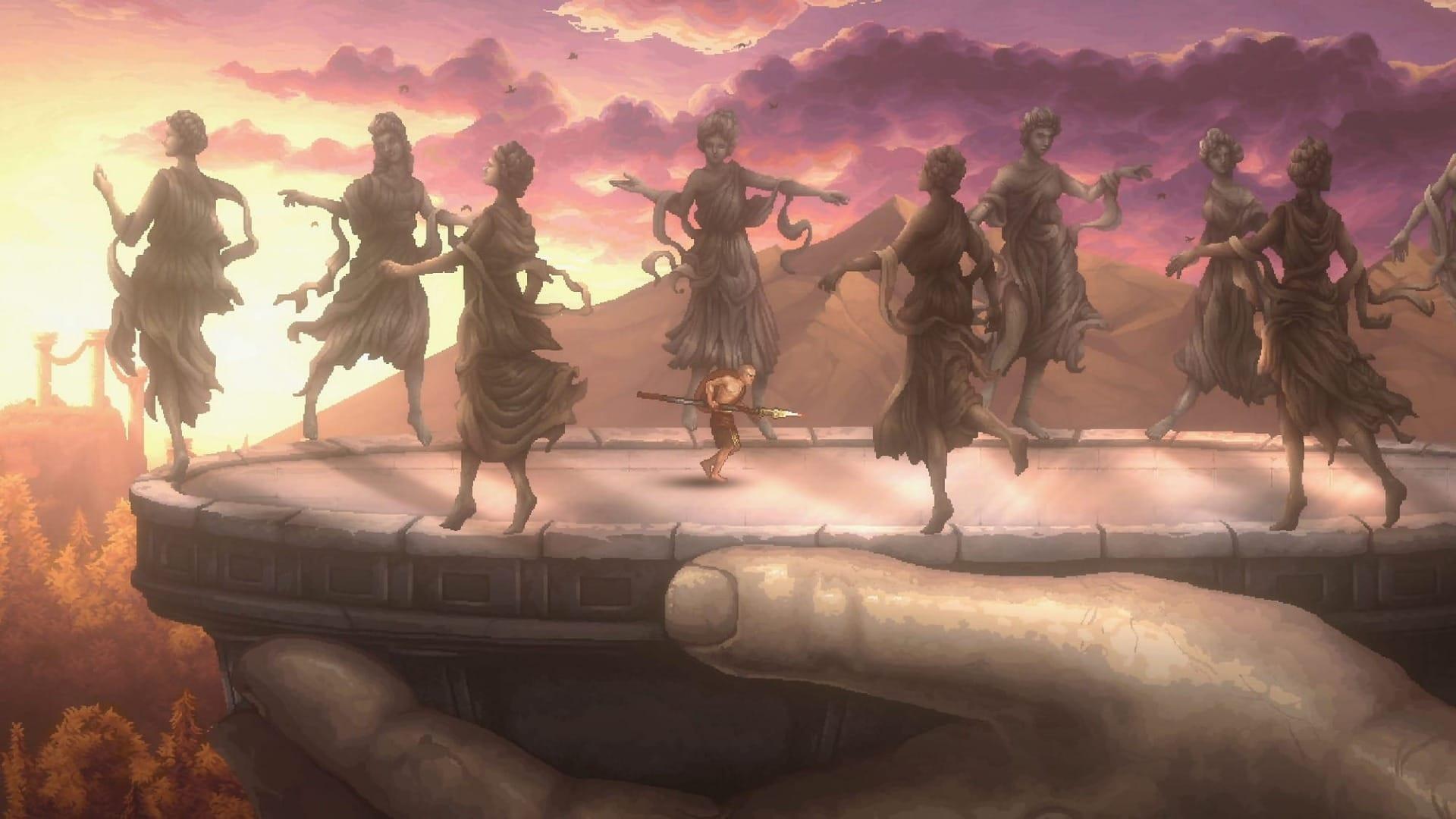
Making up for lacklustre looks with more content can work for ardent genre fans. Though the most recent update (Version 1.007) incorrectly added thousands of in-game hours to my save’s internal clock, I'd estimate my quasi-exploratory (non-completionist) run took about 24 hours, which would mean reaching 100% could take over 35 hours. Past the campaign, there's also a secondary mode – Pit of Agonies – which gives Deimos more attention thanks to optional couch co-op. Whether playing duo or solo, the main concept is a rouge-lite where you're initially stripped down and handed back more abilities and powers upon completing each successive room. It's certainly a pleasant addition, but the combat already overstays its welcome before the campaign credits roll.
Ultimately, Sons of Sparta feels unsure about its size, its looks, and even its own voice. As a Metroidvania, it understands how to tease the next secret spot or occasionally tempt you with an intriguing challenge; but when looking at the particulars, from pacing to controls, engagement will fizzle out. As a story – even on its own terms, what's left is a confused tale about familial and societal duty that's layered with mawkish comradery. As a God of War adventure, this iteration of Kratos takes his character to uncharted territory: eliciting abject apathy. Even the Gods struggle to maintain attention.
Contractor by trade and writer by hobby, Lee's obnoxious criticisms have found a way to be featured across several gaming sites: N4G, VGChartz, Gaming Nexus, DarkStation, TechRaptor, and Cubed3! He started gaming in the mid-90s and has had the privilege in playing many games across a plethora of platforms. Reader warning: each click given to his articles only helps to inflate his Texas-sized ego. Proceed with caution.



About Us |
Terms of Use |
Privacy Policy |
Advertise |
Staff |
Contact
Display As Desktop
Display As Mobile
© 2006-2026 VGChartz Ltd. All rights reserved.