As one of the most storied and historic RPG franchises in gaming history, Dragon Quest has long since earned its spot in the hall of fame for game franchises. Now, almost 40 years since their initial release, Dragon Quest I and Dragon Quest II come in Square Enix's fresh 2D-HD style, just like their sequel (which is actually a prequel, storywise), Dragon Quest III did last year. Much like when Dragon Quest III HD-2D Remake was initially shown and Square Enix confirmed in that very video that the first two games were also being remade, you can't really talk about Dragon Quest I & II HD-2D Remake without mentioning its predecessor.
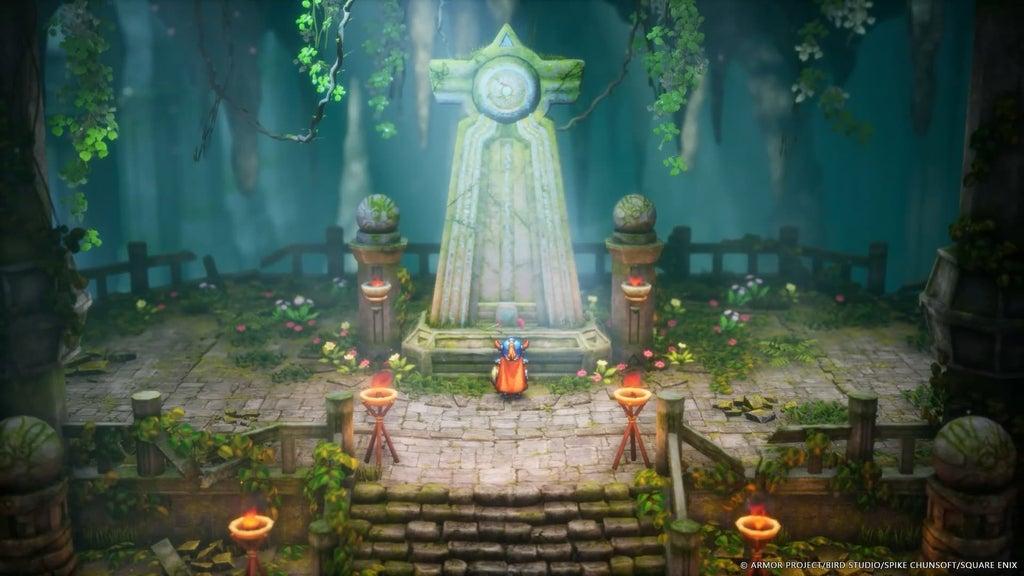
Dragon Quest I & II HD-2D Remake follows up on the foundation laid by Dragon Quest III HD-2D Remake in splendid fashion with Square Enix's new favorite graphical style, which was first popularized in Octopath Traveler. The decision to release the third game first, since it takes place chronologically first, was a very sound one when you experience the games one after the other. The story being told in Dragon Quest I takes place long after the living memory of Dragon Quest III's characters. You take on the role of a descendant of Erdrick, the hero who saved the world all those centuries ago, but parts of the world, the melodies tied to them, and the consequences of decisions made centuries earlier in the game's world are felt constantly, so looking for various references or callbacks is a great time for anyone invested in the world of Alefgard.
It's a similar tale for Dragon Quest II, which follows up an indeterminate (but likely centuries-long) time after Dragon Quest I, where descendants of the previous hero have spread out across the world, forming their own kingdoms; now a band of separate princes and princesses carrying the blood of Erdrick must unite from across the world to defy the new evil that has awakened. This setting weaves all the stories together into an epic tale, though it doesn't feel to the detriment of any title standing on its own as a story either, which means that even if you prefer to play them in release order, you won't feel lost if you haven't tried your hand at Dragon Quest III yet. Still, given the chronology, it becomes quite clear why Square Enix decided to release them in this fashion.
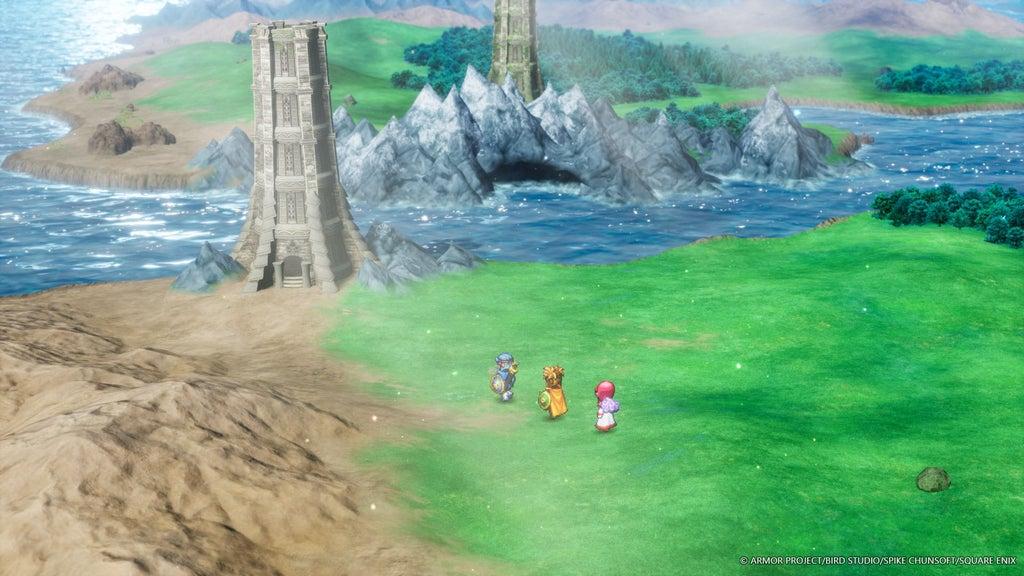
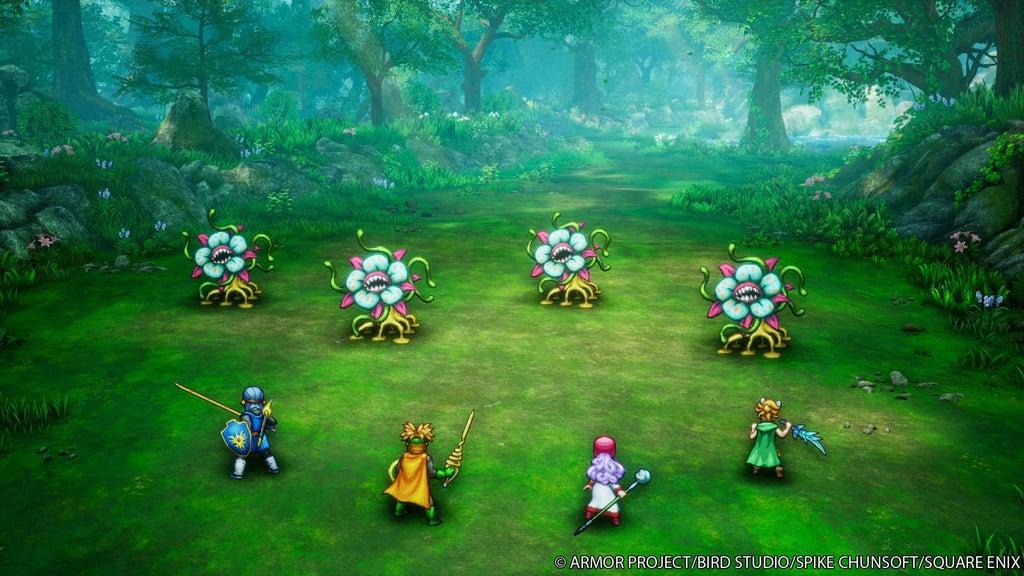
The visuals are as stellar as you'd expect if you've played any of the other games in this graphical style, like Octopath Traveler or Triangle Strategy, and give a lot of life to the world while still feeling quite familiar to someone who grew up with 16-bit RPG sprites. The presentation is enhanced by selected segments featuring voice acting for more impactful scenes, which is delivered well with lots of personality oozing from not just the core cast of characters that fill up your party, but even side characters you'll encounter, such as mischievous fairies, ditzy mermaids, or vile villains.
Complementing the visuals and voice cast are absolutely beautiful orchestral arrangements of the classical Dragon Quest tracks originally composed by series composer Koichi Sugiyama several decades ago, and these arrangements really bring out the utmost beauty from these tracks. I found myself putting down the controller at times just to enjoy Dragon Quest II's overworld music more than once, and the same could be said for several other of the compositions as well.
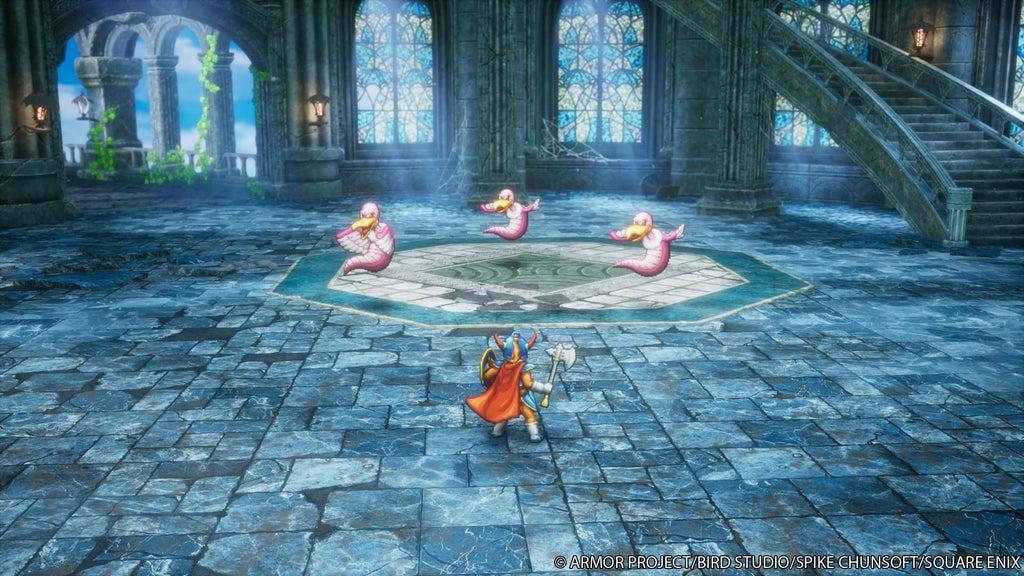
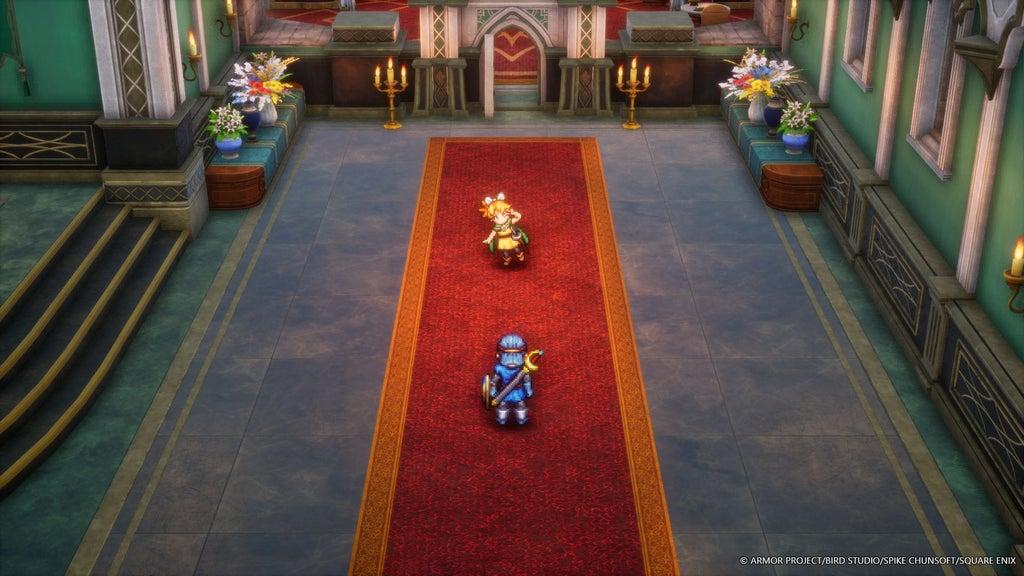
On the gameplay portion, it's interesting to see how the series has developed. Overall, as a long-time Dragon Quest franchise fan, I have to say that being limited to just one character in Dragon Quest I was quite the unique experience and made battles that normally would feel quite simple a lot more daunting, since any time your foes greatly outnumbered you, the danger was so much greater than when you have a party at your side. While it was nice to experience this as a change of pace, I was relieved when I progressed to Dragon Quest II and found myself after some time with a full four-character party again, which is much more of what I expected when playing an RPG.
One aspect of the gameplay that is new to the remakes is that you can find items called scrolls hidden in various places. These will unlock new skills for your hero, and while you already get plenty of spells and abilities just from leveling up, some of these can be absolutely pivotal to help you advance more smoothly. This gives much stronger incentive to actually explore the areas you visit thoroughly, and I quite enjoyed the high of picking up a new scroll to see which ability it might have for my hero. In Dragon Quest I there isn't much strategy to it - you pick it up and teach it to your hero, since he's your only character, but in Dragon Quest II some scrolls can be taught to several different party members, meaning that now you have to start considering your options and figuring out which character will benefit you the most by learning the scroll's inscription.
Besides the implementation of scrolls as a gameplay element, it's difficult to give that much praise to Dragon Quest I & II HD-2D Remake, which you wouldn't also have to aim towards last year's Dragon Quest III HD-2D Remake, since the quality-of-life improvements and general vibe are very much the same here as they were there, but that's also a testament to how perfect these changes were in the first place.
Features such as being able to change difficulty modes on the fly, adding objective markers to guide you if you feel lost on where to go next, or even just retrying a battle instead of losing half your gold and respawning at your last visited church upon defeat are all very welcome changes, but the most impressive part of these additions is that they're all entirely optional. If you prefer going the hard route, much like we did back on our CRTs three to four decades ago, you're perfectly welcome to do so. The choice of going the adventure just like back in the day or getting some very comfortable quality-of-life improvements is totally up to you at every point of your quest, meaning that each and every player can choose for themselves how they want to experience the journey.
To me, this makes them the absolute perfect type of remake. Despite being a long-time Dragon Quest gamer, I actually never had the opportunity to play the original trilogy, despite having experienced every other mainline entry in the series. But with these remakes, you not only get to carve out the experience on your own - in the sense that you can eliminate any of the things that might be annoying or which feel poorly aged from older RPGs (or choose not to, if that's your preference) - it also seems from my research that they added more content and details, meaning that even those who explored every nook and cranny in Dragon Quest I and Dragon Quest II back in the day may well have more to find here and get even more out of a world they've already experienced.
If you're someone like myself who really loves Dragon Quest as a series, Dragon Quest I & II 2D-HD Remake scratches that itch perfectly in every way I need it to. I also think the quality-of-life additions make it really fitting for newer players who might not have tried their hand at the series before to have a guiding hand help them get into it. What I will say, though, is that regardless of how many quality-of-life features have been added, this is still a very unapologetic Dragon Quest game. Having a 20 minute-long boss fight go all for naught because the boss decided to land a critical hit in that pivotal moment, or seeing your own best laid plans go south because your character happened to miss his decisive strike right when they absolutely had to hit can be very frustrating, and it is very much still a thing here.
A very good metric on whether you'll enjoy this game or not is if you tried out Dragon Quest III 2D-HD Remake, since it came out last year, and how you felt about your experience with it. If you had a good time playing through the original Erdrick's adventure, then revisiting Alefgard centuries later should be right up your alley. However, if you tried it and didn't really get into it, there's unlikely to be much in Dragon Quest I & II HD-2D Remake to sway your opinion any further.
In summary, Dragon Quest I & II HD-2D Remake takes the original two Dragon Quest games from 1986 and 1987, respectively, and elevates them to new heights, while also making them just as accessible or non-accessible as you, the player, want them to be. But they're still Dragon Quest games. If that traditionally hasn't been your cup of tea, Dragon Quest I & II HD-2D Remake is unlikely to change that perception. For someone like me who loves Dragon Quest, though? This experience has been an absolute blast.
This review is based on a retail copy of Dragon Quest I & II HD-2D Remake for the NS
Read more about our Review Methodology here











 (Add Date)
 (Add Date)
 (Add Date)