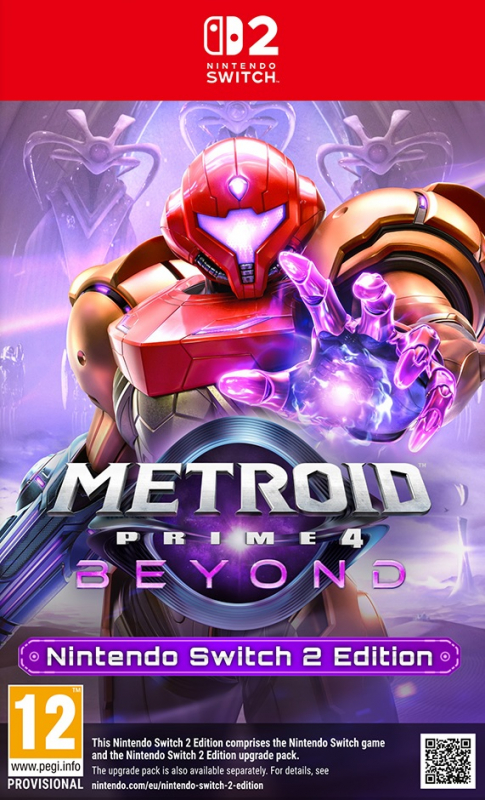
It's been a long road for Metroid Prime 4: Beyond. Believe it or not, Nintendo first revealed the game at E3 in 2017, eight years ago. Then, in early 2019, Shinya Takahashi, Senior Managing Executive Officer at Nintendo, announced that "the current development process has not reached the standards we seek in a sequel to the Metroid Prime series" and essentially restarted the project, with Retro Studios and producer Kensuke Tanabe at the helm. Now, six years later, the question remains: did Retro and Tanabe end up overcoming that troubled development history and delivering something worthy of the original Prime trilogy, one of the finest video game sagas of all time?
Beyond starts with a bang. Bounty hunter Samus Aran, heroine of the Metroid franchise, arrives in her sleek gunship above a Galactic Federation outpost, shortly after receiving a distress signal. Once there she gracefully cuts down a couple of Space Pirate ships before landing and taking the fight to the marauders face-to-face. Things go awry, however, when Sylux, a fellow hunter and Samus' nemesis, fires on a strange alien artifact, triggering a teleportation field that sends everyone and everything nearby to the mysterious planet Viewros in an uncharted corner of the galaxy. Now it's up to Samus to follow the instructions left behind by an advanced civilization and collect the far-flung teleporter keys needed to open a path home.
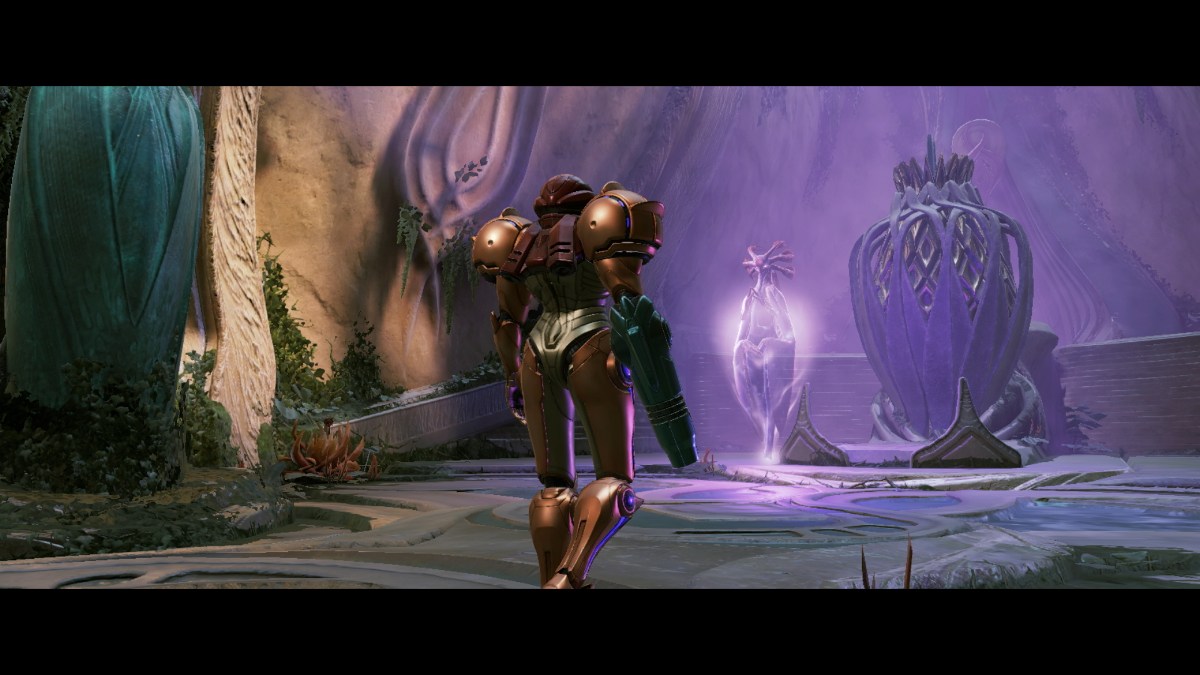
The story in Beyond is good, but not great. The downfall of the Lamorn, the advanced society that occupied Viewros in the distant past, is the key emotional linchpin; and that piece of the narrative certainly works. There are moments of genuine pathos in the game, thanks to the left behind records, hopes, and desperate dreams of the ancient race. Samus' role as the prophesied champion of the Lamorn is less effective, in part because the "chosen one" storyline has been used so many times before, including in Metroid.
The other narrative component, and one which has generated a fair bit of controversy within the gaming community, is a group of Galactic Federation troopers, stranded on Viewros along with Samus. These characters are fine, if archetypal. There's the gruff sergeant, the solitary sniper, etc. And, to be fair, there are some nice moments, like when that same sniper shares his family history with Samus around the campfire or when a young private gets positively starstruck over the legendary bounty hunter (who wouldn't?). The problem is that the inclusion of several well-armed, professionally-trained soldiers works against the game by cutting the tension.
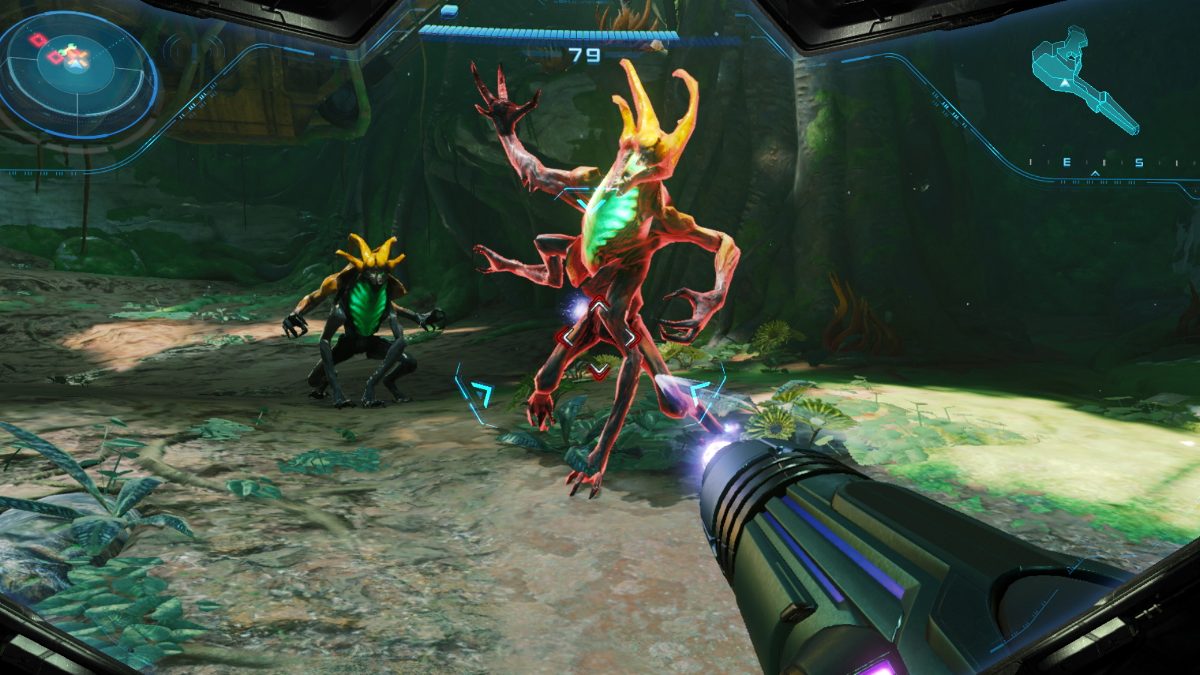
Here's the best example. There's a sequence early on in the game, in the heavily forested area called Fury Green, where Samus follows a Glister Beetle through a burrow. Eventually she runs into the beetle's lifeless corpse, having been dropped by a flying creature onto a sharp, protruding thorn. It's a sad, disturbing scene that reminds Samus she is moving through an alien place where death comes quickly and where her place in the food chain has yet to be determined. Then she opens the door and runs into Myles MacKenzie, a bespectacled tech-head who quips to himself while lounging atop a derelict Federation ship. It's a jarring transition.
It's also the first instance where Beyond can't seem to decide on what sort of game it wants to be. Perhaps due to its troubled development history, this latest entry in the Metroid franchise often tugs in different, opposing directions. It's a linear action game, a backtracking Metroidvania, and even an open-world action-adventure — in some instances at the same time. It's a testament to Retro Studio's dexterity and Nintendo's stewardship that the game maintains its structural integrity.
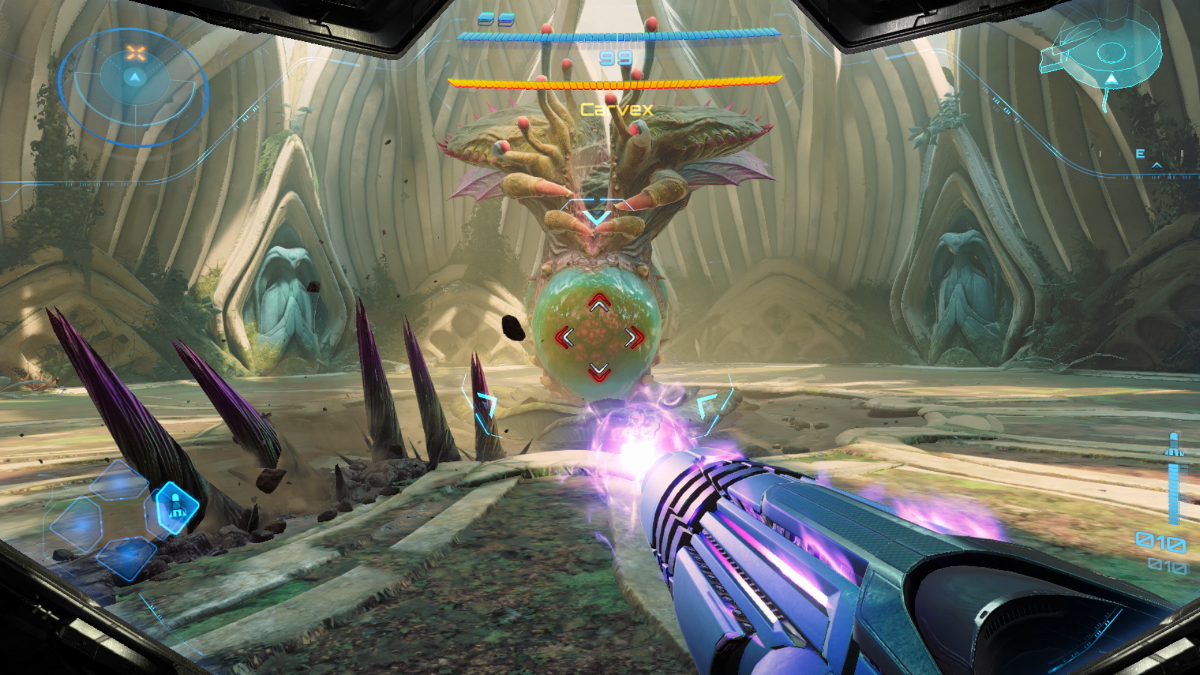
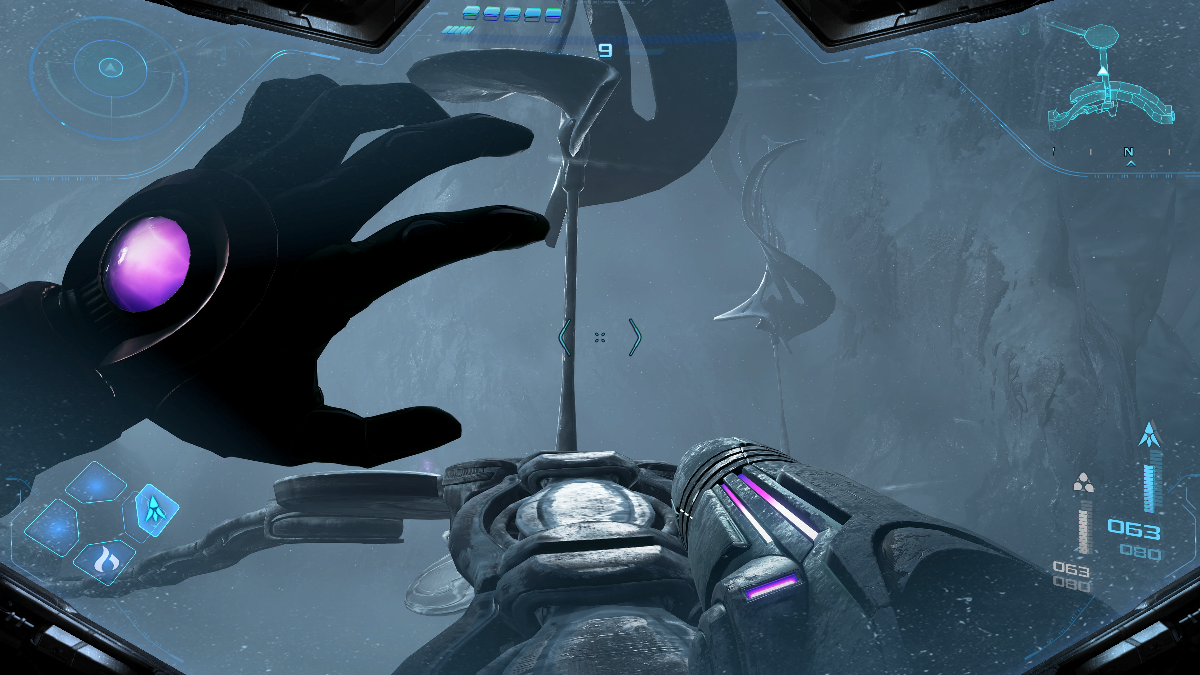
Indeed, at times, the game soars. This happens primarily when it fully embraces action. Judged on its moment-to-moment combat and gunplay, Beyond is perhaps the best of the entire Prime sub-series. This is due partly to the game's nimble, fluid gyro/mouse controls, which allow freedom of movement and precision aiming, and partly to several elemental and psychic weapon types, each with their own upgrade paths. It's also due to clever, swarming enemies, who can overwhelm Samus if she doesn't use her arsenal wisely.
Then there are the boss battles, which, once again, are arguably the best of the sub-series. They require quick-thinking and fast reflexes, close observation of enemy tells and weaknesses, and the deployment of the right weapon type at the right time to capitalize on weak points. Each one is a puzzle unto itself. They're absolutely the high point of the campaign.
A couple of the boss battles even use Samus' new bike, Vi-O-La, in interesting, unexpected ways. That bike, like the Federation soldiers, raised some eyebrows upon its reveal, but I'm happy to report it's a worthwhile addition to the series. I actually wish it was used more, or at least more thoughtfully. As it stands, it exists primarily to move Samus more efficiently across the vast desert that separates each of the planet's biomes.
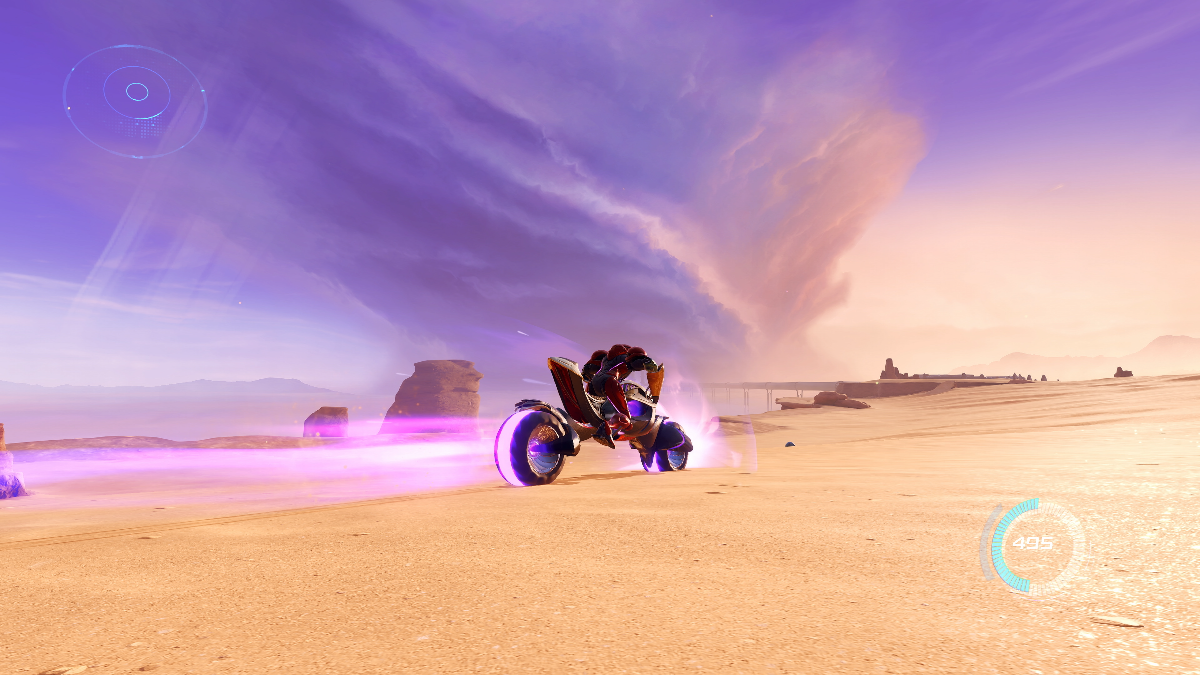
That desert, like a lot of things in Beyond, isn't exactly sure what it wants to be. It's not sufficiently populated or dangerous to be a Breath of the Wild-style wilderness (although there are scattered enemies and power-ups) and it's too big and amorphous to be a hub world. It's sort of a half measure.
But the most frustrating issue with Beyond isn't a large, mostly-vacant desert, or a platoon of chatty NPCs, although it is exacerbated by those things. It's level design, the bread and butter of a Metroidvania. Everything is a hair too streamlined, linear, and, dare I say it, scripted. It always feels like there's a logical next step or set path. There aren't many opportunities to get lost, or scared, or even frustrated — which isn't typically a positive thing, but can be in small doses in an alien, inhospitable environment. There's still a sense of discovery, yes, but it often feels like you're discovering according to a schedule.
This isn't a deadly sin, of course. It doesn't make Beyond a bad game. But it does keep it shy of greatness.
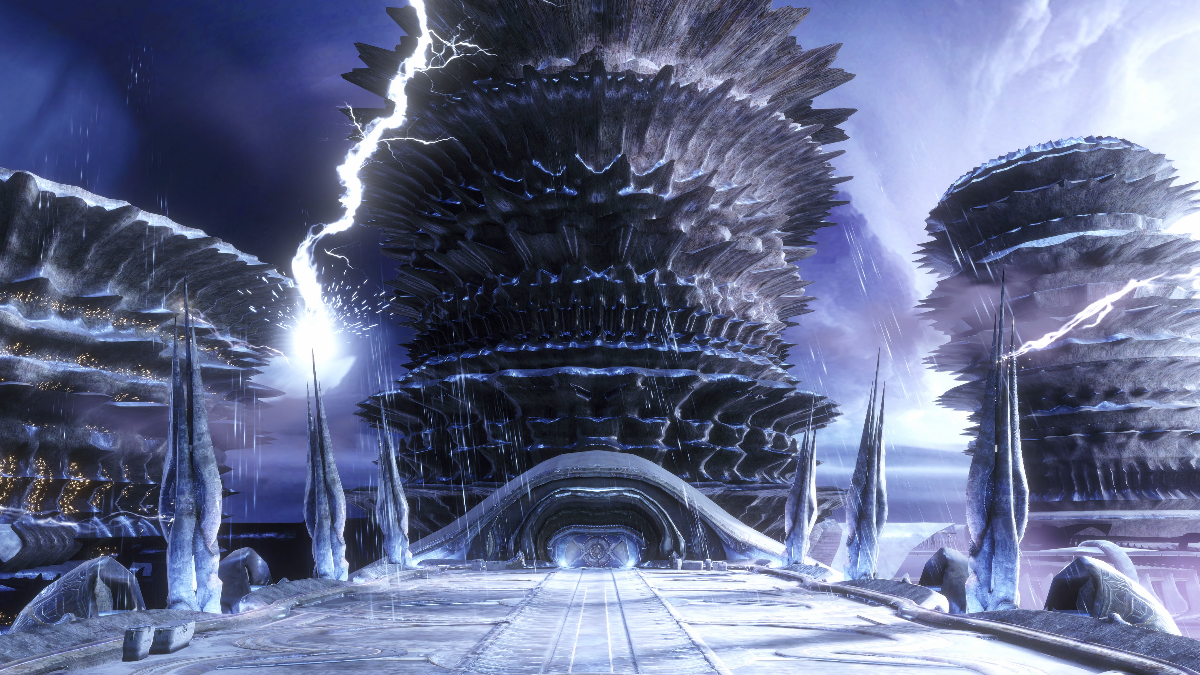
Then again, there are many things that help it inch back closer to greatness. Artistically and technically, the game is exceptional. Retro Studios has once again achieved a beautiful sci-fi world, filled with impressive environmental diversity, awe-inspiring alien architecture, and an impressive sense of scale and antiquity. The developer has also delivered all those important little details: the split-second reflection of Samus' face in her visor, the frost that coats her arm cannon when she charges the ice shot, etc.
Art direction does a lot of heavy lifting, but Beyond is no slouch technologically. While a few unsightly textures betray its origins as a Switch title, its sharp visuals, 4K resolution, and rock-solid 60 fps guarantee the game is silky smooth, both at rest and in motion. Indeed, when you factor in its agile, flowing controls, "smooth" might just be the perfect word to describe this latest Samus Aran adventure.
The perfect word to describe the soundtrack? Extraordinary. Composed by Kenji Yamamoto and Minako Hamano, it is entirely worthy of the Metroid name. It's otherworldly, epic, and even haunting at times. One of the best single tracks accompanies the boss fights with Xelios. It has that warped, creeping sound profile of so many Metroid songs, but it's paired with a heavy metal guitar riff. It's just amazing. Overall, Beyond boasts one of the best musical scores of the year, which is saying something.
In terms of value, Beyond acquits itself reasonably well. If you aim for 100% completion (and you should) you can expect to spend about 17 hours on Viewros. After completing the game, you'll unlock hard mode, which is a nice bonus for loyal fans.
After an eight-year wait, Metroid Prime 4: Beyond is finally here. While it's inferior to the three games in the original Prime trilogy and also recent entries like Metroid Dread, it remains a rock-solid action-adventure game that at times flirts with greatness. The moment-to-moment action is thrilling, the boss battles are among the best in the entire Metroid canon, the art direction and music are exceptionally good, and the technical performance impressive. With more complex and interesting levels, and fewer distractions and half-measures, it could have been a Game of the Year contender. Hopefully Retro will nail the next one.
This review is based on a retail copy of Metroid Prime 4: Beyond for the NS2
Read more about our Review Methodology here










 12/04/25 Nintendo
  (Add Date)
 12/04/25 Nintendo