









Develop Conference 2015 - Day 1 Highlights - Article
by VGChartz Staff , posted on 16 July 2015 / 4,163 Views
Neil Young - Is Mobile Over?
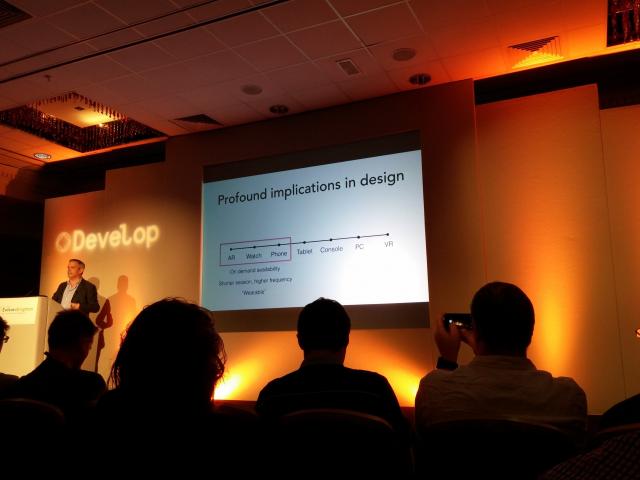
Neil Young, an industry veteran who used to work for Electronic Arts, started off day one of the Develop Conference 2015 with an opening statement on how the mobile market is shaping up in the west. Taking figures and statistics from Japan, Neil made the argument that we still have a long way to go before we're even remotely close to maturity. Fantastic statistics were shown off, including one which noted how the average mobile user in the west only spends $3 on mobile games, whereas a typical Japanese customer spends over $30.
Young also demonstrated how the trends we are currently undergoing in the west already happened 10 years ago in Japan; the landscape will change, mobile games will no longer be produced for quick cash, but will instead aim for player retention. One key way in which developers can retain customers is through more live events within their games (Young explicitly said, however, that this does not mean holiday specials).
Regardless of how you feel about the mobile market, Young’s enthusiasm helped convince me that the market is nowhere near matured; there's a lot of untapped potential still awaiting discovery. The coming years will certainly be interesting.
Harry Holmwood - Big $ in Japan
In what felt like a perfect follow-up to Young's presentation, Harry Holmwood talked about how the Japanese market has already matured. Holmwood showed off some brilliant statistics on how the top downloaded games in Japan were also popular in the west, but their highest grossing apps were always isolated to Japan. In short, each customer who downloads a game in Japan is more likely to spend money inside of that game, making them more valuable than customers in western markets, which are seen as being quite fickle.
Holmwood gave some examples of what we should expect in the coming years, with 44 of the top 50 games (on app stores) advertising on terrestrial TV in Japan, demonstrating just how much money the mobile market can generate. He said we should expect this in the west soon, with adverts for games like Clash of Clans becoming much more commonplace.
Ian Chambers, Seamus Masterson - Non-Gaming VR
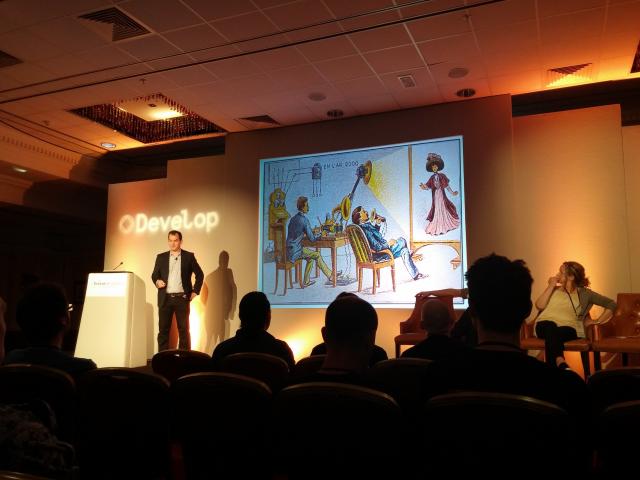
In this presentation, Ian Chambers, another industry veteran, talked about the coming advantages VR devices will have in everything but games. From advertising, architecture, and entertainment, all the way to social events, VR will change the future. He explained that it's not possible for us to imagine all of the possibilities right now, and that this raises some fantastic parallels to the 19th century Victorians who imagined the possibility of television, albeit in a completely different form.
Seamus Masterson then took to the stage and talked about how VR will help transform advertising in the coming years (and I should note here that when people say VR at Develop, they mean both Augmented Reality and Virtual Reality at the same time). He said that comparisons can be made with the format wars, and he feels it could take a long time for developers and consumers to actually accept this new technology.
Masterson philosophically talked about how, when you believe something is real, it truly becomes real. For example, he showed a picture of an egg on stage, followed by a video, always adding more 'information' about the egg he was talking about. Eventually, he threw an egg into the audience, only for us to find that it was actually fake. He claimed that because we believed it was real, it truly was. This feeling can be taken advantage of by advertisers, and so advertising will be revolutionised by VR.
Lee Bamber- User Generated Content of the future
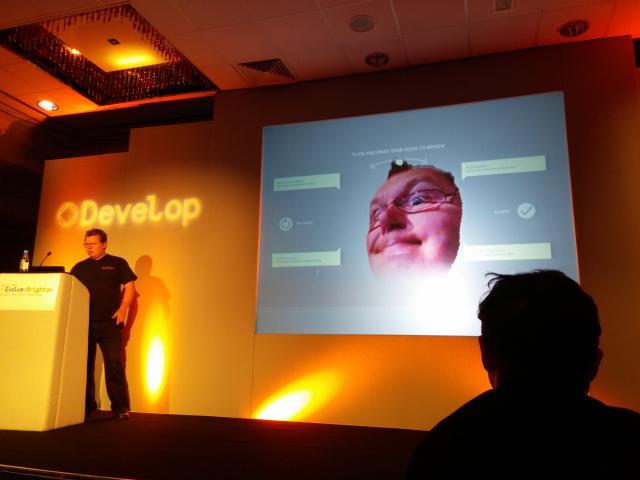
Lee Bamber, software developer at GameGuru, talked about the ways in which users of content will eventually become developers in their own right. Bamber made references to the dawn of the computer age, where in order to use a computer you’d have to create the software first.
He went through all of the current ways in which users create new content for games, from mods to hacks, and then proceeded to explain and predict what he thought the future would hold, with users putting themselves into games or even replacing entire chunks of games on a whim, giving them easier and better control over the gaming experience.
Technologies like the Nueron, a motion sensor detector that can translate how you move directly into animations which can be used within a game, are fantastically simple, and will simplify things so that users can create their own games. Lee performed live demo on stage where he 3D scanned his face and inserted it into a game of his choice, making his face appear on a princess. It was all very quick and efficient, and reinforced what he had said in regards to the future of content creation.